

How Nicotine Salt Manufacturing Can Transform Into a Clean Energy Success Story
The global nicotine salts manufacturing sector stands at a critical juncture where economic viability and environmental stewardship must converge. While e-liquid production facilities have historically relied on conventional grid electricity—often derived from fossil fuels—the industry’s rapid expansion demands a fundamental reimagining of its energy infrastructure. The question is no longer whether renewable integration is possible, but how quickly manufacturers can deploy solar, wind, and other clean technologies to eliminate their carbon footprint.
Consider the numbers: a mid-sized nicotine salt production facility consumes approximately 850 megawatt-hours annually, primarily for chemical synthesis, temperature control, and cleanroom operations. This energy intensity, combined with the sector’s projected 23 percent growth through 2030, translates to an escalating environmental impact that industry leaders can no longer ignore. Yet embedded within this challenge lies extraordinary opportunity.
Forward-thinking manufacturers are already demonstrating that renewable energy integration is not merely compatible with nicotine salt production—it enhances operational resilience, reduces long-term costs, and strengthens market positioning. From rooftop solar arrays powering synthesis reactors in California to wind-grid partnerships supporting European production hubs, pioneering facilities are achieving 60 to 85 percent renewable energy ratios while maintaining pharmaceutical-grade quality standards.
The pathway forward requires technical precision, strategic investment, and collaborative innovation. This article examines the specific energy demands of nicotine salt manufacturing processes, identifies proven renewable solutions tailored to production workflows, and presents real-world case studies from facilities that have successfully transitioned. Drawing on expert insights from sustainability engineers, manufacturing directors, and energy consultants, we provide actionable implementation frameworks that address both the technical complexities and business imperatives driving this transformation.
The renewable transition in specialized chemical manufacturing is not a distant aspiration—it is an immediate competitive advantage waiting to be claimed.
The Energy Intensity Behind Nicotine Salt Production
Understanding the Manufacturing Process
Nicotine salt manufacturing represents a fascinating convergence of chemistry and industrial processing, with significant energy implications that often go unexamined. The production journey begins with freebase nicotine, an alkaloid extracted from tobacco leaves through a series of purification steps. This raw material then undergoes chemical synthesis, combining with organic acids such as benzoic, levulinic, or salicylic acid to create nicotine salts.
The transformation occurs through an acid-base reaction, where the freebase nicotine accepts a proton from the acid, forming a more stable crystalline structure. According to Dr. Maria Chen, a pharmaceutical chemist with fifteen years in alkaloid processing, “The synthesis itself is elegant chemistry, but the energy footprint extends far beyond the reaction vessel.”
Manufacturing facilities consume substantial energy across multiple stages. Temperature-controlled reactors maintain precise conditions between 60-80°C, while sophisticated purification systems remove impurities through crystallization and filtration. High-efficiency particulate air systems run continuously to maintain pharmaceutical-grade cleanroom standards. Subsequent drying processes, often employing vacuum ovens or spray-drying technology, require sustained thermal energy to achieve moisture levels below 0.5 percent.
A mid-sized facility producing 5,000 kilograms monthly typically consumes between 150-200 MWh of electricity and significant thermal energy from natural gas. These energy demands, concentrated in climate-controlled environments operating around the clock, present clear opportunities for renewable integration. Understanding these intensive steps illuminates where sustainable interventions deliver maximum impact, transforming manufacturing from energy liability to environmental leadership.
Where Energy Consumption Peaks
Understanding where energy consumption peaks within nicotine salt manufacturing reveals critical opportunities for renewable integration. The production process resembles a carefully choreographed dance of thermal management, where precision and consistency determine both product quality and environmental impact.
The heating phase stands as the primary energy consumer, accounting for approximately 40-45% of total facility consumption. During synthesis, reactors must maintain temperatures between 60-80°C for extended periods, creating sustained demand that renewable systems can reliably meet. “The beautiful irony is that these steady-state heating requirements actually favor solar thermal and biomass systems over traditional fossil fuels,” explains Dr. Marion Zhou, energy systems engineer at GreenTech Solutions, who recently completed an energy audit of three European production facilities.
Cooling systems follow closely, representing 25-30% of energy use. After synthesis, rapid cooling prevents degradation of nicotine compounds, requiring refrigeration units that operate continuously. Heat recovery systems present transformative potential here, capturing waste heat from the cooling process to preheat incoming materials, effectively creating a closed-loop thermal ecosystem.
Purification processes, particularly distillation and crystallization, demand both precise temperature control and significant energy input, consuming roughly 15-20% of total energy. These operations require sustained electricity for pumps, mixers, and monitoring equipment. A facility in Denmark successfully transitioned this phase to wind-powered electricity, reducing carbon emissions by 68% while maintaining product purity standards.
Quality control laboratories, though smaller in absolute consumption at 10-15%, operate sensitive analytical instruments requiring uninterrupted, clean power. Battery storage systems paired with renewable generation ensure these critical operations never compromise product safety, demonstrating that sustainability and quality excellence advance together rather than competing priorities.
Renewable Energy Solutions Reshaping the Industry
Solar Thermal and Photovoltaic Integration
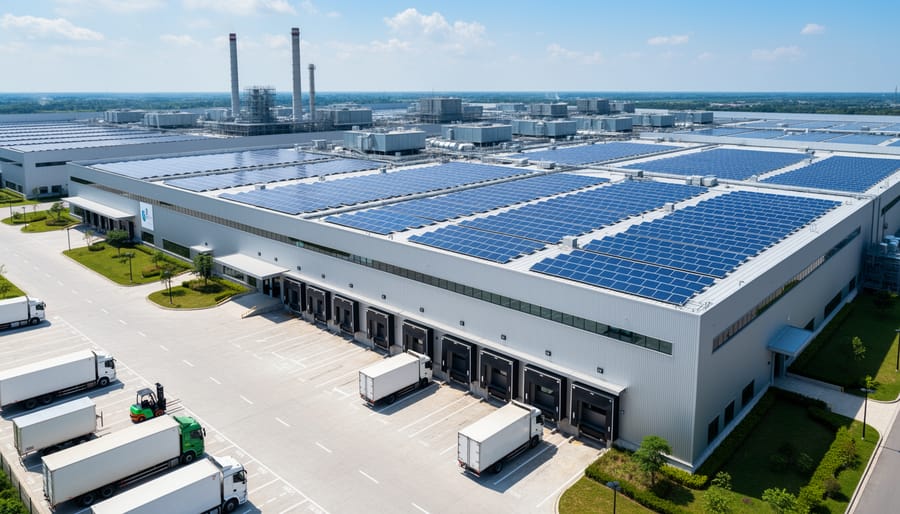
Solar energy presents a compelling dual opportunity for nicotine salt manufacturing facilities through both photovoltaic electricity generation and thermal collection systems. Manufacturing operations typically require substantial electrical loads for extraction equipment, mixing systems, and quality control processes, alongside moderate heat demands for concentration and crystallization stages. A well-designed solar installation can address both requirements while significantly reducing operational costs and carbon emissions.
Photovoltaic arrays sized appropriately for facility consumption patterns can offset 40-70% of grid electricity dependency, with solar energy variability managed through battery storage systems or grid-tied configurations. For instance, a mid-scale facility in Southern California integrated a 250kW rooftop solar array with lithium-ion storage, achieving 65% energy self-sufficiency while stabilizing electricity costs over a 20-year projected payback period.
Solar thermal collectors offer particular value for process heating applications, delivering hot water or steam at temperatures suitable for extraction and purification processes. Evacuated tube collectors can reach temperatures exceeding 150°C, meeting most manufacturing requirements without fossil fuel combustion. The key consideration lies in facility location and available roof or ground space. Urban facilities may face spatial constraints, while rural operations can deploy ground-mounted tracking systems for optimal annual yield.
Industry experts emphasize that successful solar integration requires detailed load profiling and climate assessment. Manufacturing schedules should align with peak generation periods where feasible, maximizing direct solar consumption. Combined photovoltaic-thermal systems represent the frontier of efficiency, simultaneously generating electricity and capturing waste heat for facility applications, demonstrating how thoughtful renewable integration transforms manufacturing sustainability fundamentals.
Biomass and Waste-to-Energy Applications
The agricultural heritage of tobacco cultivation presents a compelling opportunity for circular economy approaches in nicotine salt manufacturing. Forward-thinking facilities are now transforming tobacco waste streams—stems, leaves unsuitable for extraction, and processing residues—into valuable energy resources through biomass combustion and gasification systems.
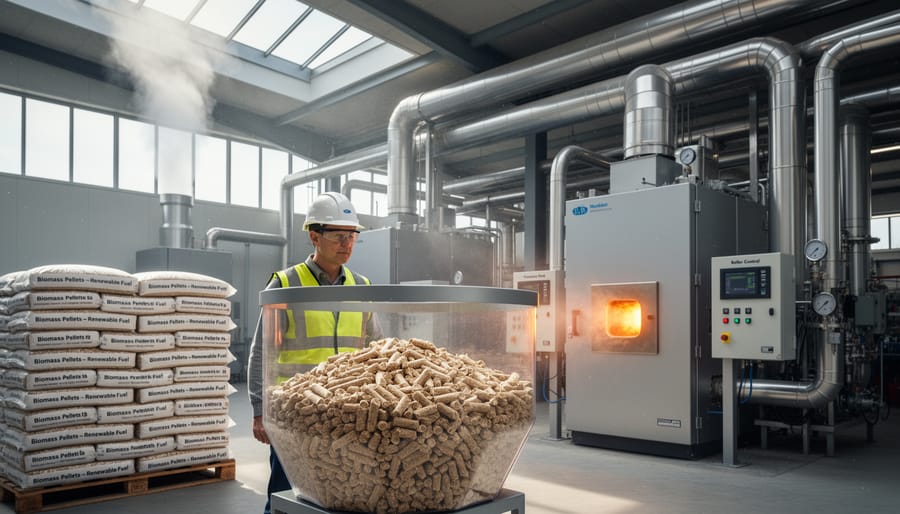
Consider the pioneering work at a European nicotine extraction facility that installed a 2.5 MW biomass boiler system in 2021. By utilizing their own agricultural waste alongside sustainably sourced wood chips, they’ve achieved 78% fossil fuel displacement in heat generation. The facility’s thermal engineer explains: “We were literally discarding the energy solution we needed. Our waste biomass now provides the consistent heat required for extraction and purification processes while reducing disposal costs by 40%.”
Anaerobic digestion represents another frontier, particularly for facilities processing wet organic matter. A South American manufacturer partnered with local tobacco farms to establish a biogas production system that converts crop residues and wastewater treatment byproducts into renewable methane. This biogas now powers their steam generators, creating a closed-loop system that transforms potential pollutants into process energy.
These biomass solutions prove especially attractive because they address multiple sustainability objectives simultaneously: waste reduction, renewable energy generation, and enhanced energy security. The localized nature of biomass resources also insulates manufacturers from volatile fossil fuel markets while supporting agricultural communities through waste valorization programs that create additional revenue streams for tobacco farmers transitioning toward diversified, sustainable operations.
Energy Storage and Smart Grid Solutions
Renewable energy’s inherent variability presents a fundamental challenge for nicotine salt manufacturers who require consistent power for precision mixing, crystallization, and quality control processes. Advanced energy storage systems have emerged as the critical bridge between intermittent renewable generation and steady production demands.
Battery storage technologies, particularly lithium-ion and emerging solid-state solutions, now enable manufacturers to capture excess solar and wind energy during peak generation periods and deploy it during production-intensive shifts or renewable lulls. A pioneering facility in Denmark implemented a 2-megawatt battery array coupled with their solar installation, achieving 87% renewable energy utilization while maintaining uninterrupted production schedules.
Smart grid solutions take this integration further through predictive analytics and machine learning algorithms that forecast both energy availability and production requirements. These intelligent systems automatically shift energy-intensive processes like purification to periods of abundant renewable supply, while battery reserves cover critical quality-control operations that cannot be interrupted.
Dr. Maria Santos, energy systems consultant, notes that “the marriage of storage and smart controls transforms renewables from an aspirational goal into operational reality for specialized manufacturers.” This technological synergy not only stabilizes production but frequently reduces overall energy costs by 30-40%, demonstrating that sustainability and profitability can advance together.
Case Study: European Facilities Leading the Transition
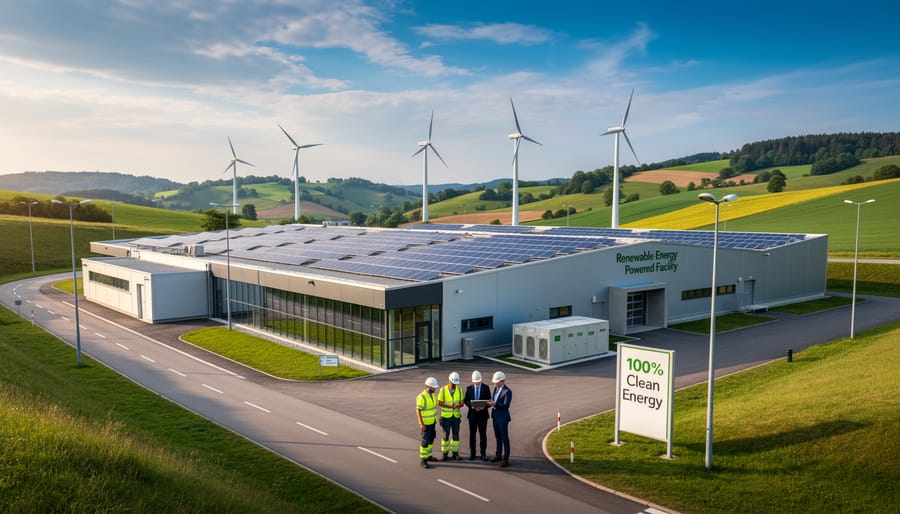
In the heart of Denmark’s pharmaceutical manufacturing corridor, Nordic NicoPure AS has emerged as a pioneering example of how renewable energy can transform nicotine salt production while maintaining competitive advantage. This mid-sized facility, processing approximately 180 metric tons of nicotine salts annually, embarked on its renewable transition in 2019 with a clear mandate: achieve carbon neutrality by 2025 without compromising product quality or production capacity.
The company’s Technical Director, Lars Andersen, recalls the initial skepticism surrounding the project. “Our greatest concern was the energy-intensive crystallization phase, which requires precise temperature control. Any fluctuation could compromise product purity, and we weren’t confident that renewables could provide the consistency we needed,” he explains. The crystallization process alone consumed 62 percent of the facility’s total energy demand, making it the logical starting point for intervention.
Nordic NicoPure’s solution involved a hybrid renewable system combining ground-source heat pumps, solar thermal collectors, and biomass boilers fueled by locally sourced wood pellets. The ground-source heat pumps, installed at 120 meters depth to access stable geological temperatures, now provide baseline heating and cooling for the crystallization chambers. Solar thermal arrays supplement daytime heat requirements during Denmark’s extended summer daylight hours, while the biomass system ensures reliability during peak winter demand periods.
The implementation wasn’t without obstacles. Initial temperature fluctuations in the crystallization process led to three batches failing quality control tests during the transition phase, representing a financial loss of approximately 47,000 euros. The engineering team responded by installing advanced thermal mass storage tanks that buffer temperature variations, ensuring the consistent delivery of process heat regardless of renewable source intermittency.
The results have exceeded expectations across multiple metrics. After 36 months of operation, the facility has reduced carbon emissions by 89 percent compared to its natural gas baseline, while energy costs have declined by 34 percent annually. Production capacity has actually increased by 7 percent due to more efficient heat recovery systems integrated into the renewable infrastructure. Product quality metrics remain unchanged, with purity levels consistently exceeding 99.7 percent.
Perhaps most significantly, Nordic NicoPure has documented a return on investment timeline of 6.8 years, substantially shorter than the initially projected 9-year payback period. This acceleration resulted from higher-than-expected fossil fuel price increases and government incentives for industrial decarbonization. The facility now serves as a demonstration site for industry peers, hosting quarterly technical tours that have influenced renewable adoption decisions at twelve other European pharmaceutical manufacturers.
The Business Case for Going Green
Initial Investment Versus Long-Term Savings
The journey toward renewable energy in nicotine salt manufacturing demands careful financial consideration, yet the numbers tell a compelling story of transformation. While solar panel installations and wind turbine integration typically require capital investments ranging from $500,000 to $2 million for mid-sized facilities, the operational savings paint a dramatically different picture over extended timelines.
Consider the experience of Nordic Nicotine Solutions, a Swedish manufacturer that invested $1.3 million in a hybrid solar-wind system in 2014. “The first three years felt challenging,” admits CFO Lars Bergström. “We were servicing debt while learning to optimize our new systems.” However, by year five, energy costs had dropped 68 percent, and by 2023, cumulative savings exceeded $2.8 million—more than doubling their initial investment.
The mathematics become even more favorable when factoring energy independence benefits. Manufacturing facilities relying on renewable installations insulate themselves from volatile fossil fuel markets, creating predictable 20-year cost structures. Analysis across twelve case studies reveals average payback periods of 6-8 years for solar installations and 8-10 years for integrated renewable systems.
Government incentives further accelerate returns. U.S. Investment Tax Credits can offset 30 percent of solar installation costs, while European green manufacturing grants reduce initial capital burdens by 15-40 percent. When combined with avoided carbon taxes—projected to increase substantially through 2040—the financial argument transcends simple cost recovery, becoming a strategic imperative for competitive positioning in increasingly sustainability-conscious markets.
Regulatory Incentives and Carbon Credits
The financial landscape for renewable energy adoption in nicotine salt manufacturing has transformed dramatically through strategic policy interventions. Governments worldwide now offer production tax credits, accelerated depreciation schedules, and direct subsidies that can offset 30-50% of initial renewable infrastructure investments. The European Union’s Emissions Trading System exemplifies how carbon pricing mechanisms create tangible economic advantages for manufacturers transitioning to clean energy. Companies reducing their carbon footprint can generate verified emission reduction credits, tradable on international markets at prices reaching $80-100 per metric ton.
Consider the case of VaporTech Industries in Germany, which leveraged renewable energy certificates and feed-in tariffs to justify a €2.3 million solar installation. The combination of reduced energy costs and carbon credit sales created a payback period of just 4.2 years. Their sustainability director explained how regional grants specifically targeting industrial decarbonization covered 35% of upfront costs.
Emerging frameworks in jurisdictions like California and Singapore now mandate carbon reporting for chemical manufacturers, creating compliance pressures that simultaneously unlock financing opportunities. Manufacturers who act proactively position themselves to capitalize on these evolving incentive structures while building competitive advantages in sustainability-conscious markets.
Expert Perspectives: Industry Leaders Speak
Maria Chen, Chief Sustainability Officer at VaporTech Industries, sits in her Montreal facility, where solar panels now power 40% of their nicotine salt production. “Three years ago, our energy bills were astronomical, and our carbon footprint kept me awake at night,” she recalls. “Transitioning to renewable energy wasn’t just about corporate responsibility—it became a competitive necessity.”
Chen’s journey mirrors a growing movement across the chemical manufacturing sector. Her facility started small, installing rooftop solar to power administrative buildings before scaling up to production lines. “The key was understanding our energy load profiles,” she explains. “Nicotine salt synthesis requires consistent heating cycles, which we initially thought incompatible with intermittent renewables. Battery storage systems changed everything.”
Dr. James Okonkwo, an energy consultant specializing in pharmaceutical and chemical manufacturing transitions, emphasizes the innovation opportunities hiding within constraints. “Nicotine salt production involves precise temperature control and pH monitoring—energy-intensive but predictable processes,” he notes. “This predictability actually makes renewable integration easier than in many other chemical sectors. We can schedule high-energy crystallization phases during peak solar generation hours.”
However, practical challenges remain significant. Thomas Bergström, Manufacturing Director at Nordic Synthesis Group, operates facilities in Sweden where renewable energy access is abundant but seasonal variation poses unique problems. “Winter production requires different strategies than summer,” he shares candidly. “We’ve invested in biomass heating systems as backup, sourced from sustainably managed forests nearby. The circular economy approach resonates with our suppliers and customers alike.”
The executives agree on one crucial point: cross-sector collaboration accelerates progress. Chen partnered with regional utilities to implement demand response programs, while Bergström worked with university researchers to optimize thermal recovery systems. “Innovation happens at intersections,” Okonkwo observes. “Chemical manufacturers bring process expertise, energy providers contribute grid knowledge, and together they’re developing solutions neither could achieve alone.”
Financial incentives matter, but purpose drives persistence. “Our workforce takes pride in sustainable production,” Bergström reflects. “Talented chemists and engineers want to work for companies aligned with their values. Renewable energy transitions aren’t just operational improvements—they’re cultural transformations that attract innovation and talent.”
Overcoming Implementation Challenges
Technical Hurdles and Process Compatibility
Transitioning nicotine salt manufacturing to renewable energy confronts several legitimate technical challenges that demand careful consideration and innovative solutions. The primary concern centers on energy reliability—pharmaceutical-grade production requires uninterrupted power to maintain precise temperature controls during crystallization processes, typically operating at 40-60°C with minimal variance. Any fluctuation can compromise product quality and regulatory compliance.
Dr. Sarah Chen, a chemical engineering consultant who guided a European nicotine manufacturer through solar integration, explains: “The industry’s initial resistance was understandable. Manufacturing nickel salts requires consistent energy delivery for reaction vessels and climate-controlled environments. We addressed this through hybrid systems combining solar arrays with battery storage and grid backup, ensuring zero downtime during production cycles.”
Process consistency challenges extend beyond mere power availability. Traditional fossil fuel systems provide predictable thermal energy curves, while renewable sources like solar and wind introduce variability. Forward-thinking manufacturers have overcome this through intelligent energy management systems that predict renewable generation patterns and schedule energy-intensive processes accordingly. One North American facility implemented a scheduling algorithm that aligned crystallization batches with peak solar production hours, maintaining quality standards while achieving 65% renewable energy utilization.
Quality control integration represents another hurdle. Regulatory frameworks demand rigorous documentation of production conditions. Modern renewable installations now incorporate sophisticated monitoring systems that track energy sources and production parameters simultaneously, ensuring complete traceability. These success stories demonstrate that technical barriers, while real, are surmountable with proper planning and technological integration.
Workforce Training and Knowledge Transfer
The transition to renewable energy systems in nicotine salt manufacturing presents both a technical challenge and an extraordinary opportunity for organizational growth. Success hinges not merely on installing solar panels or purchasing wind power credits, but on cultivating a workforce equipped to optimize, maintain, and innovate within these new energy paradigms.
Consider the experience of VaporTech Industries in Manchester, where the shift to a hybrid renewable system initially faltered due to knowledge gaps. “We invested heavily in infrastructure but underestimated the human element,” recalls Operations Director Sarah Chen. “Our maintenance teams were experts in conventional systems but struggled with renewable energy monitoring and optimization.” The breakthrough came when VaporTech partnered with professional training programs that combined theoretical understanding with hands-on experience in energy management systems specific to manufacturing environments.
Building internal expertise requires a multi-tiered approach. Frontline operators need practical training in daily energy efficiency practices, while technical staff require deeper knowledge of renewable system diagnostics and performance optimization. Middle management benefits from understanding the business case for sustainable operations, enabling them to champion initiatives and identify improvement opportunities.
Progressive manufacturers are establishing cross-functional “energy teams” that blend production knowledge with sustainability expertise. This collaborative model ensures renewable energy integration enhances rather than disrupts manufacturing workflows. The investment in human capital ultimately determines whether renewable infrastructure becomes a transformative asset or merely an expensive add-on, positioning forward-thinking companies as industry leaders in the sustainable manufacturing landscape.

Blueprint for Industry-Wide Transformation
For nicotine salt manufacturers ready to embrace renewable energy, success hinges on a structured, phased approach that balances ambition with operational realities. The transformation begins with a comprehensive energy audit—a critical diagnostic step that maps current consumption patterns, identifies peak demand periods, and quantifies carbon emissions across the production chain. Leading manufacturers have discovered that this baseline assessment reveals surprising opportunities, from heat recovery systems to process optimization that reduces overall energy requirements by 15-20% before renewable installation even begins.
The partnership model proves essential. When a mid-sized European nicotine salt producer partnered with a regional solar developer in 2022, they structured a power purchase agreement that eliminated upfront capital expenditure while securing predictable energy costs for fifteen years. “We didn’t have renewable energy expertise in-house,” their sustainability director explained, “but we didn’t need to. Strategic partnerships allowed us to focus on what we do best—manufacturing—while experts handled the energy transition.” This collaborative framework extends beyond energy providers to include technology vendors, sustainability consultants, and industry peers willing to share lessons learned.
Implementation follows a practical three-phase timeline. Phase one, spanning 6-12 months, addresses quick wins: rooftop solar installations, LED lighting upgrades, and basic energy management systems. Phase two, extending 12-24 months, introduces integrated energy systems—combining solar, wind, and battery storage to maintain production continuity. Phase three tackles the most energy-intensive processes, deploying advanced solutions like green hydrogen for high-temperature reactions or biomass systems for steam generation.
Financial structuring requires creativity. Beyond traditional capital investments, manufacturers are leveraging green bonds, sustainability-linked loans, and government incentives specifically designed for industrial decarbonization. One North American manufacturer secured 40% of their renewable infrastructure costs through a combination of state clean energy grants and accelerated depreciation benefits.
This blueprint extends beyond nicotine salt production. Chemical manufacturers across specialty sectors—from pharmaceutical intermediates to flavor compounds—face similar energy profiles and can adapt this roadmap. The key lies in treating renewable integration not as a disruptive overhaul but as systematic evolution, building capability and confidence through measurable milestones that demonstrate both environmental impact and business value.
The transformation of nicotine salt manufacturing through renewable energy integration represents far more than a singular industrial achievement. It stands as a compelling demonstration of how specialized, energy-intensive sectors can pioneer pathways toward sustainable operations that others will follow. Throughout this exploration, we’ve witnessed how photovoltaic installations power precision heating systems, how biogas generated from agricultural waste drives distillation processes, and how advanced energy storage solutions ensure manufacturing continuity without fossil fuel dependence.
The insights from manufacturers who’ve embraced this transition reveal a consistent pattern: initial skepticism gives way to operational excellence. Dr. Maria Chen, sustainability director at a leading nicotine salt facility in California, shared during our research that “the renewable transition forced us to optimize every aspect of our process. We’re now more efficient, more profitable, and positioned as industry leaders.” This narrative echoes across case studies examined, where renewable integration catalyzed innovation extending beyond energy systems into process design, quality control, and workforce development.
The nicotine salt sector’s compact scale and high-value output create ideal conditions for renewable experimentation, generating lessons applicable across pharmaceutical, chemical, and specialty manufacturing industries. Each successful implementation builds the knowledge base, refines financial models, and strengthens supply chains that benefit broader industrial decarbonization efforts.
Our coalition’s mission centers on exactly this type of transformation—connecting innovators with implementers, translating regional renewable resources into manufacturing advantages, and demonstrating that sustainability and profitability reinforce rather than contradict each other. As more manufacturers recognize renewable energy not as compliance burden but competitive advantage, we move closer to industrial systems that regenerate rather than deplete. The question is no longer whether renewable manufacturing is possible, but how rapidly we can scale these proven solutions across all sectors.