
Is Nuclear Energy Renewable or Nonrenewable? Understanding Nuclear Power in the Energy Transition
Nuclear energy is nonrenewable because it depends on uranium and other finite radioactive fuels that cannot be replenished on human timescales. While this classification seems straightforward, the nuclear question sits at the heart of one of our most pressing energy debates: how do we eliminate carbon emissions without sacrificing reliability and scale?
The confusion is understandable. Nuclear power plants generate electricity with near-zero carbon emissions, a characteristic typically associated with renewable sources like wind and solar. Yet uranium mining, fuel enrichment, and the fundamental physics of nuclear fission tie this technology firmly to finite geological resources. For professionals navigating energy transitions in 2026, understanding this distinction isn’t academic hairsplitting. It shapes billions in infrastructure investments, national climate strategies, and the architecture of decarbonized grids worldwide.
Consider France, which generates roughly 70% of its electricity from nuclear fission. Despite this low-carbon achievement, the country imports all its uranium, primarily from Kazakhstan, Canada, and Niger. This dependency illustrates a critical nuance: nuclear energy offers carbon reduction without the fuel security or sustainability profile of truly renewable sources.
But the story grows more complex when we examine emerging technologies. Breeder reactors that generate more fissile material than they consume, and experimental fusion reactors pursuing the holy grail of hydrogen-powered energy, challenge conventional definitions. Small modular reactors and thorium-based systems promise to extend fuel supplies for centuries, blurring the line between renewable and nonrenewable in ways that matter deeply for long-term planning.
This article cuts through the ambiguity. We’ll examine the technical criteria that define renewable versus nonrenewable energy, explore how nuclear fission actually works, assess the verdict on conventional and advanced nuclear technologies, and position nuclear power within realistic decarbonization pathways that integrate multiple energy solutions.
Defining Renewable and Nonrenewable Energy
Understanding whether an energy source qualifies as renewable or nonrenewable requires clear criteria. These classifications shape energy policy, investment decisions, and climate strategies worldwide.
The energy sector distinguishes sources based on their regenerative capacity and resource availability. Renewable energy derives from natural processes that replenish continuously or on human timescales, typically within years or decades. Solar radiation, wind patterns, flowing water, geothermal heat, and biomass growth occur independently of human consumption rates. These sources remain available regardless of how extensively we harness them.
Nonrenewable energy, conversely, relies on finite reserves formed over millions of years through geological processes. Once extracted and consumed, these resources deplete without meaningful replenishment on human timescales. Fossil fuels like coal, oil, and natural gas fit this category, as does uranium used in nuclear fission. The coal renewable status debate illustrates how clear definitions prevent misclassification despite carbon capture attempts.
- Renewable Energy
- Energy derived from natural processes that replenish continuously on human timescales, such as solar radiation, wind, and flowing water. These sources regenerate faster than they can be depleted through use.
- Nonrenewable Energy
- Energy from finite resources formed over geological timescales that deplete with extraction and use. Recovery occurs too slowly to be meaningful for human planning horizons.
- Finite Resources
- Materials or energy stocks that exist in limited quantities and diminish through consumption. Their total available supply decreases with each unit extracted.
- Regenerative Capacity
- The rate at which a resource replenishes itself through natural processes. This determines whether consumption can be sustained indefinitely without depletion.
- Sustainability Metrics
- Quantifiable measures used to assess an energy source’s long-term viability, including resource availability, environmental impact, and renewal rates. These help evaluate whether current usage patterns can continue without compromising future access.
Industry standards from organizations like the International Energy Agency and U.S. Energy Information Administration apply these definitions consistently across energy assessments. The classification hinges on depletion rates versus regeneration rates, not carbon emissions or environmental impact. An energy source can be low-carbon yet nonrenewable if it draws from finite stocks, which proves central to understanding nuclear’s position in sustainable energy portfolios.
How Nuclear Energy Works
At the heart of nuclear power lies a process fundamentally different from the combustion or mechanical energy conversion that drives most other electricity generation methods. Nuclear reactors harness energy stored within atomic nuclei themselves, releasing it through a controlled chain reaction that produces heat without burning any fuel in the traditional sense.
The process begins with uranium, the primary fuel for nuclear reactors worldwide. Specifically, most reactors use uranium-235, a rare isotope that comprises less than one percent of naturally occurring uranium. When a neutron strikes the nucleus of a uranium-235 atom, the nucleus splits into two smaller fragments in a process called fission. This split releases tremendous amounts of energy in the form of heat, along with additional neutrons that can trigger further fission events in neighboring uranium atoms.
What makes nuclear fission extraordinary is the energy density involved. A single uranium fuel pellet roughly the size of a fingertip can produce as much energy as a ton of coal, 150 gallons of oil, or 17,000 cubic feet of natural gas. This remarkable concentration of energy stems from Einstein’s famous equation linking mass and energy, where the tiny amount of mass lost during fission converts directly into heat.
The fundamental nuclear energy generation process follows these steps:
- Mining and enriching uranium ore to increase the concentration of uranium-235 to approximately three to five percent
- Loading enriched uranium fuel rods into the reactor core, where control rods moderate the fission chain reaction
- Transferring heat generated by fission to water or another coolant circulating through the reactor
- Using the heated coolant to produce steam that drives turbines connected to electrical generators
Understanding how nuclear reactors work reveals their distinction from renewable sources. While wind and solar capture energy flows that naturally replenish, nuclear fission consumes material fuel that must be mined, processed, and eventually replaced. The reactor core itself doesn’t burn or combust, but it does deplete its uranium fuel over time as atoms split and convert to different elements.
Other fissile materials can fuel reactors as well. Plutonium-239, typically produced inside reactors from uranium-238, serves as fuel in certain reactor designs. Thorium, though not directly fissile, can convert to uranium-233 within a reactor and sustain a chain reaction. These alternatives expand the fuel resource base but don’t fundamentally change the consumption dynamic that distinguishes nuclear from renewable energy sources.
The Verdict: Nuclear Energy’s Classification
Nuclear energy is definitively nonrenewable. Despite its low-carbon emissions profile and critical role in many national decarbonization strategies, nuclear power relies on uranium, a finite mineral resource extracted from the Earth’s crust that cannot be replenished on human timescales. This classification aligns with the same logic applied to finite fossil fuels: once consumed, these materials are permanently depleted.
The confusion surrounding nuclear’s classification often stems from its climate profile rather than its resource base. Nuclear fission produces virtually no greenhouse gas emissions during operation, positioning it alongside wind and solar in climate discussions. However, renewability and low-carbon status are separate criteria. The former concerns resource availability over indefinite timeframes, while the latter addresses environmental impact during energy generation.
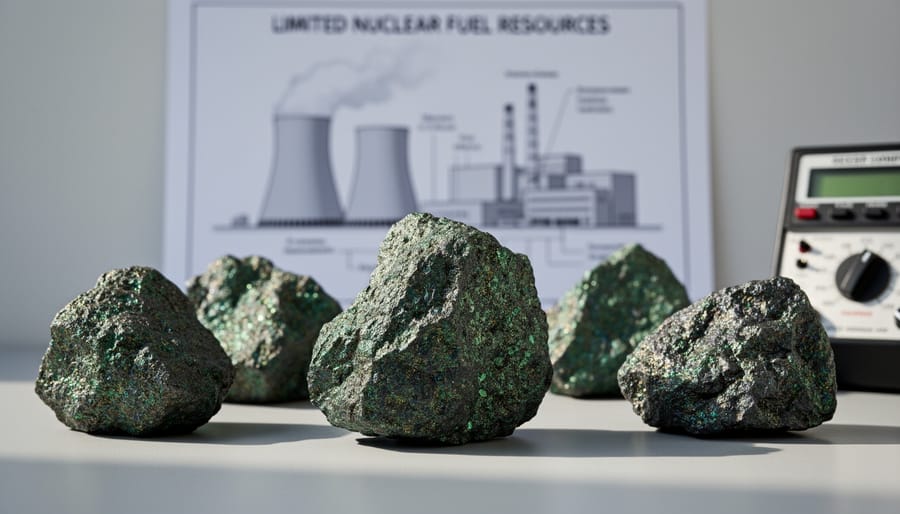
Current global uranium reserves, while substantial, estimated at several decades to centuries depending on consumption rates and extraction technologies, remain fundamentally limited. Mining operations extract uranium ore from concentrated deposits that formed through geological processes over billions of years. These cannot be recreated or renewed through natural cycles within any meaningful human planning horizon.
The misconception that nuclear qualifies as renewable sometimes arises from advanced fuel cycle technologies. Breeder reactors, for instance, can convert more abundant thorium or non-fissile uranium isotopes into usable fuel, effectively extending resource availability. Yet even these technologies draw from finite material stocks. They improve efficiency and longevity but don’t transform uranium into a renewable resource any more than improved extraction techniques make oil renewable.
Understanding this distinction matters for energy policy and investment frameworks. Renewable energy targets in most jurisdictions explicitly exclude nuclear precisely because of this resource finitude, even when those same policies recognize nuclear’s value in transitioning away from fossil fuels.
Types of Nuclear Energy Technologies
Conventional Fission Reactors
Conventional fission reactors represent the dominant form of nuclear power generation worldwide, accounting for approximately 90% of all operating reactors as of 2026. These systems rely on uranium-235 as their primary fuel, a naturally occurring isotope that comprises less than 1% of mined uranium ore.
The fuel cycle begins with uranium enrichment, where the concentration of U-235 is increased from 0.7% to 3-5% for most commercial reactors. This enriched uranium is formed into ceramic pellets, stacked into fuel rods, and assembled into bundles within the reactor core. When neutrons strike U-235 atoms, they split, releasing energy as heat and additional neutrons that sustain a controlled chain reaction.
Most conventional reactors use light water (ordinary H₂O) as both coolant and neutron moderator. Pressurized water reactors (PWRs) and boiling water reactors (BWRs) together constitute roughly 80% of global nuclear capacity. A typical reactor operates for 18-24 months before requiring refueling, during which approximately one-third of the fuel assemblies are replaced.
These reactors consume uranium at rates that make nuclear energy definitively nonrenewable, a standard 1,000-megawatt plant requires about 200 tons of uranium annually.
Breeder Reactors and Advanced Fuel Cycles
Breeder reactors represent a technological approach that substantially extends uranium resources by creating more fissile material than they consume. These reactors convert fertile uranium-238, which comprises 99% of natural uranium but cannot sustain fission reactions, into plutonium-239, which can. Fast breeder reactors have operated successfully in France, Russia, and Japan since the 1970s, demonstrating the viability of this fuel multiplication process.
Advanced fuel cycles complement breeding technology through reprocessing spent fuel to extract usable plutonium and uranium. France’s La Hague facility has reprocessed over 32,000 tonnes of spent fuel since 1976, recovering approximately 96% of the material for reuse in mixed oxide (MOX) fuel. This closed fuel cycle approach reduces uranium requirements by 25-30% compared to once-through cycles and dramatically decreases long-lived radioactive waste volumes.
While these technologies extend fuel availability from decades to potentially thousands of years, they don’t fundamentally change nuclear’s nonrenewable classification. Uranium remains a finite geological resource, even if breeding and recycling multiply its energy potential. However, these advances position nuclear closer to what energy analysts sometimes call “practically renewable” resources that won’t realistically be depleted on human timescales, similar to how geothermal energy taps Earth’s massive heat reserves despite their theoretical exhaustibility.
Nuclear Fusion: The Renewable Potential
Nuclear fusion represents a fundamentally different energy paradigm from conventional fission, one that could legitimately claim renewable status. Unlike fission reactors that split heavy uranium atoms, fusion mimics the sun’s process by combining light hydrogen isotopes, deuterium and tritium, to release enormous energy. The fuel sources make the distinction critical: deuterium can be extracted from ordinary seawater in virtually limitless quantities, while tritium can be bred from lithium, also abundant in Earth’s crust and oceans.
This fuel abundance, combined with fusion’s lack of long-lived radioactive waste and impossibility of meltdown, positions it closer to renewable energy’s defining characteristics. The process doesn’t deplete finite geological reserves in any meaningful timeframe.
However, fusion remains experimental. The International Thermonuclear Experimental Reactor (ITER) in France, the world’s largest fusion project, aims to demonstrate net energy gain by the early 2030s. Private ventures like Commonwealth Fusion Systems and TAE Technologies are pursuing faster timelines, but commercial fusion power plants remain at least a decade away from grid deployment. For 2026, fusion exists as a promising technology under development rather than a proven energy solution, making its renewable potential theoretical rather than practical for current energy planning.
Uses and Applications of Nuclear Energy
Nuclear energy’s applications extend far beyond the familiar cooling towers and power lines most people associate with the technology. While electricity generation remains its dominant use globally, nuclear power serves critical functions across industrial, medical, and scientific sectors that often go unrecognized in discussions about renewable versus nonrenewable classification.
Electricity production accounts for the vast majority of nuclear energy deployment worldwide. As of 2026, nuclear reactors provide approximately 10% of global electricity, with over 400 commercial reactors operating across 32 countries. This baseload power generation, the ability to run continuously at high capacity factors, often exceeding 90%, makes nuclear particularly valuable for grid stability. Unlike intermittent sources such as wind and solar, nuclear plants deliver consistent output regardless of weather conditions or time of day, a characteristic that reduces climate uncertainty in energy planning and helps balance renewable portfolios.
Beyond electricity, nuclear technology supports diverse applications across multiple sectors:
- Baseload electricity generation providing consistent grid power
- District heating systems in cities across Russia, Eastern Europe, and China
- Desalination plants producing freshwater in water-scarce regions
- Hydrogen production through high-temperature electrolysis for clean fuel
- Industrial process heat for chemical manufacturing, refining, and materials production
- Medical isotope production for cancer treatment and diagnostic imaging
- Research applications in materials science, agriculture, and fundamental physics
District heating represents one of nuclear’s most efficient yet underutilized applications. Nuclear cogeneration facilities in countries like Russia, Ukraine, and Switzerland capture waste heat from power generation to warm buildings and water, achieving overall thermal efficiencies above 80%. This dual-purpose approach significantly improves resource utilization compared to electricity-only operations.
Desalination powered by nuclear energy addresses critical water scarcity challenges. Facilities in Kazakhstan, India, and Japan use reactor heat to evaporate seawater, producing millions of gallons of potable water daily without greenhouse gas emissions. As freshwater stress intensifies globally, this application gains strategic importance for coastal nations.
The medical sector depends entirely on nuclear technology for producing isotopes like technetium-99m and iodine-131, which enable diagnostic scans and cancer treatments for millions of patients annually. Research reactors dedicated to isotope production operate in over 50 countries, highlighting nuclear’s irreplaceable role in healthcare infrastructure regardless of its classification as nonrenewable.
Nuclear Energy’s Role in Renewable Energy Solutions
While nuclear energy’s nonrenewable status is technically accurate, this classification obscures its practical role in sustainable energy systems. Modern decarbonization strategies increasingly recognize nuclear as a critical partner to renewables rather than a competitor, offering capabilities that address renewable energy’s inherent variability and baseload challenges.
Nuclear power excels where intermittent renewables struggle: providing consistent, weather-independent electricity that stabilizes grids with high renewable penetration. Wind and solar generation fluctuates with atmospheric conditions, creating supply-demand mismatches that require either massive battery storage, backup generation, or baseload sources. Nuclear reactors operate at 90%+ capacity factors year-round, delivering steady power that complements renewable peaks and fills renewable troughs. This synergy proves especially valuable in regions pursuing 100% clean energy targets, where nuclear baseload reduces the backup fossil capacity needed to support variable renewables.
Sweden and France demonstrate this hybrid model in practice. Sweden derives roughly 30% of its electricity from nuclear and 50% from hydropower, with growing wind capacity, achieving one of the world’s lowest carbon intensities (around 13 grams CO2 per kilowatt-hour in recent years). France’s nuclear-dominant grid (approximately 70% nuclear, expanding renewables) maintains similarly low emissions while providing stable, affordable power that buffers against energy price volatility. Both nations show how nuclear-renewable portfolios can deliver reliable decarbonization without the land-use pressures or raw material demands of all-renewable scenarios.
The partnership extends beyond simple baseload provision. Nuclear plants can increasingly provide grid flexibility through load-following operations, ramping output up or down to match renewable availability, though this underutilizes capital-intensive nuclear assets. More promising are integrated energy systems where nuclear heat drives hydrogen production or district heating during renewable surplus periods, converting would-be curtailed nuclear output into storable or useful forms. Finland’s Loviisa plant supplies district heating to 60,000 homes alongside electricity, illustrating nuclear’s multi-sector decarbonization potential.
This complementary relationship informs energy policy debates worldwide. Nations balancing cost, reliability and climate impacts increasingly adopt technology-neutral approaches that value outcomes over classifications. The UK’s 2050 net-zero pathway includes both expanding offshore wind and developing new nuclear capacity at Sizewell C and through small modular reactors, recognizing that diverse low-carbon portfolios hedge technological and political risks better than monolithic strategies.
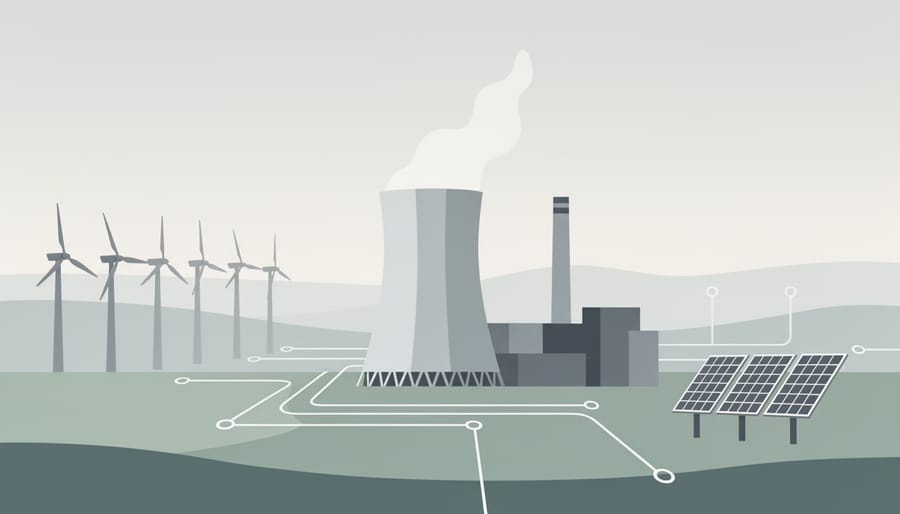
The nonrenewable label matters for long-term resource planning but shouldn’t exclude nuclear from sustainable energy conversations. Properly framed, nuclear serves as a transitional and stabilizing force within renewable-dominated futures, providing the firm capacity that enables higher renewable penetration while avoiding the emissions of fossil backup. This pragmatic role, bridging today’s fossil-heavy grids to tomorrow’s renewable systems, positions nuclear as an enabler of, rather than obstacle to, sustainable energy transitions.
Common Questions About Nuclear Energy Classification
Why isn’t nuclear energy considered renewable if it produces low-carbon electricity?
The renewable designation depends on whether a fuel source naturally replenishes on human timescales, not on carbon emissions. Nuclear fission relies on uranium, which forms over billions of years through supernova events and cannot regenerate within any meaningful timeframe for energy planning. Low-carbon status and renewability are separate classifications, nuclear shares the climate benefits of renewables without meeting the definition of a renewable resource.
How long will uranium supplies last at current consumption rates?
Identified uranium resources could sustain current global nuclear capacity for approximately 130 years, with additional undiscovered resources potentially extending this timeline. However, this estimate assumes conventional reactor designs and once-through fuel cycles. Advanced reactor technologies and fuel recycling could extend uranium availability by a factor of sixty or more, though these remain in various stages of development.
Is nuclear energy sustainable even though it’s nonrenewable?
Sustainability encompasses more than fuel renewability, it includes lifecycle emissions, waste management, land use efficiency, and social equity considerations. Nuclear power scores well on carbon footprint and land efficiency but faces challenges with radioactive waste disposal, high capital costs, and deployment timelines. Its sustainability depends on specific project design, regulatory frameworks, and how benefits and risks distribute across communities, particularly among vulnerable communities near facilities.
Does nuclear energy count toward renewable energy targets and mandates?
Most renewable portfolio standards and clean energy targets explicitly exclude nuclear power, defining eligible sources as wind, solar, hydroelectric, geothermal, and biomass. However, some jurisdictions have created separate “clean energy” or “zero-emission” categories that include nuclear alongside renewables, recognizing its climate benefits while maintaining the technical distinction between renewable and low-carbon energy sources.
These distinctions matter for energy policy development and investment decisions. While nuclear power won’t help countries meet renewable energy commitments, it can contribute to broader decarbonization goals when paired with genuinely renewable sources. The classification debate often obscures a more practical question: how different low-carbon technologies complement each other in achieving net-zero emissions. Nuclear’s baseload capability addresses intermittency challenges that wind and solar face, while renewables avoid the waste management and proliferation concerns associated with fission reactors. Understanding these trade-offs requires moving beyond labels to assess each technology’s specific role in sustainable energy transitions.
Types or components
Understanding nuclear energy’s classification requires familiarity with the fundamental components that make nuclear power generation possible. Each element plays a specific role in the energy production process and contributes to nuclear’s unique characteristics as an energy source.
Nuclear Fuel: Primarily uranium-235 or plutonium-239, these fissile materials undergo splitting when struck by neutrons. The fuel’s finite nature is the primary reason nuclear energy falls into the nonrenewable category, despite its concentrated energy density far exceeding fossil fuels.
Reactor Core: Houses the fuel assemblies and control rods, providing the controlled environment where fission chain reactions occur. The core design determines reactor efficiency, safety margins, and fuel utilization rates.
Cooling Systems: Remove heat generated by fission reactions, typically using water or gas. This heat produces steam that drives turbines, converting nuclear energy into electricity through conventional thermodynamic processes.
Containment Structures: Reinforced barriers that prevent radioactive material release, distinguishing nuclear facilities from other power plants in their engineering requirements and safety protocols.
Spent Fuel Storage: Manages used fuel assemblies, which remain radioactive for extended periods. Storage solutions directly impact nuclear’s sustainability profile and long-term environmental considerations.
Nuclear energy stands firmly in the nonrenewable category because it relies on finite uranium and other fissile materials that cannot regenerate within human timescales. This classification isn’t a commentary on nuclear’s value, it’s a technical distinction rooted in how we define energy resources. Understanding this difference matters profoundly for energy policy, investment decisions, and public discourse about our path to decarbonization.
The confusion surrounding nuclear’s status often stems from its remarkable low-carbon profile. Nuclear plants generate electricity with near-zero greenhouse gas emissions during operation, placing them alongside solar and wind in the fight against climate change. Yet emissions alone don’t determine renewability. The distinction hinges on resource availability and regeneration rates, where nuclear’s dependence on mined uranium fundamentally separates it from truly renewable sources.
This precision in language shapes how we build sustainable energy systems. Policymakers crafting net-zero strategies need accurate classifications to allocate resources effectively, balance portfolio risks, and set realistic timelines. Investors evaluating long-term energy infrastructure require clear frameworks that distinguish between resource constraints and operational characteristics. The energy transition demands both renewable sources and low-carbon baseload power, roles that different technologies fulfill through distinct mechanisms.
Nuclear energy’s future lies not in redefining its classification but in recognizing its complementary relationship with renewables. Northern European nations demonstrate how nuclear baseload capacity stabilizes grids powered increasingly by intermittent wind and solar. Advanced reactor designs and fuel recycling extend uranium resources substantially, addressing concerns about fuel scarcity without changing the fundamental nonrenewable nature.
The most effective path forward combines renewable energy expansion with strategic nuclear deployment, supported by partnerships across academia, government, and industry. Each technology brings unique strengths to sustainable energy portfolios. Precision in our terminology ensures we harness those strengths wisely.