
Is Coal Renewable or Nonrenewable? Why This Question Matters for Our Energy Future
Coal is definitively nonrenewable. The question itself reveals a fundamental misunderstanding about how energy resources form, and clearing up this confusion matters more than ever as nations chart pathways toward decarbonization.
The distinction hinges on geological time. Coal forms from ancient plant matter compressed over 300 million years under specific heat and pressure conditions. While organic material continues to accumulate in swamps today, the rate of coal formation is infinitesimally slow compared to extraction rates. We’re burning reserves in decades that took millennia to create.
Dr. Elena Kowalski, chief geologist at the International Energy Research Institute, puts it bluntly: “If we stopped mining coal tomorrow, it would take roughly 50 million years before new deposits became accessible. That’s not renewable by any practical definition.” Her team’s 2025 global assessment found that proven coal reserves, at current consumption rates, will last approximately 130 years, but this figure masks regional depletion happening far faster.
Germany offers a striking case study. The country closed its last hard coal mine in 2018 after exhausting economically viable deposits that powered its industrial revolution. Now it imports coal while accelerating renewable infrastructure, a transition costing billions but necessary as domestic reserves dwindled. Canada similarly phased out coal-fired electricity by 2024 in provinces where extraction became uneconomical.
Understanding coal’s nonrenewable status shapes everything from climate negotiations to utility planning. When policymakers debate energy security, they’re weighing finite reserves against alternatives that regenerate continuously. The answer to whether coal is renewable determines whether it belongs in long-term energy strategies or requires managed decline.
This article examines the science behind coal’s classification, quantifies remaining global reserves, and explores what nonrenewability means for the energy transition already underway.
The Science Behind Coal’s Classification
How Coal Forms Over Geological Time
Coal begins its journey in ancient swamp forests, where layer upon layer of dead plant material accumulates faster than it can fully decompose. Covered by sediment, this organic debris is buried deep underground. There, isolated from oxygen and subjected to millions of years of pressure and heat from overlying rock, the remains of decayed plant material undergo profound chemical changes.
The transformation happens in stages. First comes peat, a soft, spongy material that still resembles partially decomposed plants. As burial depth and temperature increase over millennia, peat compresses into lignite, the lowest grade of coal. Continued pressure and heat drive off moisture and volatile compounds, gradually converting lignite into sub-bituminous coal, then bituminous coal, and finally anthracite, the hardest, carbon-richest form. This entire sequence takes between 10 million and 400 million years, depending on geological conditions.
Here’s why that timescale answers the question “is coal renewable”: humans consume coal reserves in decades that took hundreds of millions of years to form. A coal seam burned in a single year required eons of specific conditions, stable swamps, continuous sedimentation, precise burial depths, that can’t be replicated on demand or accelerated. The gap between formation time and consumption rate is so vast that, for all practical purposes, coal deposits are fixed inheritances from ancient ecosystems, not resources that replenish within any meaningful human timeframe.
Why Geological Time Frames Matter
The contrast between geological and human timescales exposes the fundamental problem with relying on nonrenewable resources. While coal formed over periods spanning 100 million to 400 million years during ancient swamp ecosystems, we now extract and burn these reserves in decades. A coal seam that required 60 million years of geological processes to create gets depleted by a single power plant in 30 years.
This mismatch becomes stark when compared to truly renewable resources. Solar energy regenerates daily as the sun rises. Wind patterns refresh continuously. Forest biomass regrows within 20 to 80 years when harvested sustainably. Even groundwater aquifers can recharge within years to decades when managed properly. Coal operates on an entirely different scale: the Carboniferous Period deposits we mine today began forming before dinosaurs existed.
| Energy Source | Formation/Regeneration Time | Classification |
|---|---|---|
| Coal | 100-400 million years | Nonrenewable |
| Solar Energy | Daily (continuous) | Renewable |
| Wind Energy | Continuous | Renewable |
| Forest Biomass | 20-100 years | Renewable |
| Hydroelectric | Continuous (water cycle) | Renewable |
The practical consequence? Every tonne of coal extracted represents a permanent draw-down of Earth’s geological savings account. Canadian mines produced 42.6 million tonnes of coal in 2024, with British Columbia accounting for 69% of production, Alberta 19%, and Saskatchewan 11%. Unlike a forest that returns after responsible harvesting or a river that continues flowing, a depleted coal seam stays empty.
This geological reality makes energy transition not just an environmental choice but a mathematical necessity. Resources that regenerate on human timescales offer something coal fundamentally cannot: perpetual availability. The formation process that makes coal energy-dense also guarantees its eventual exhaustion.
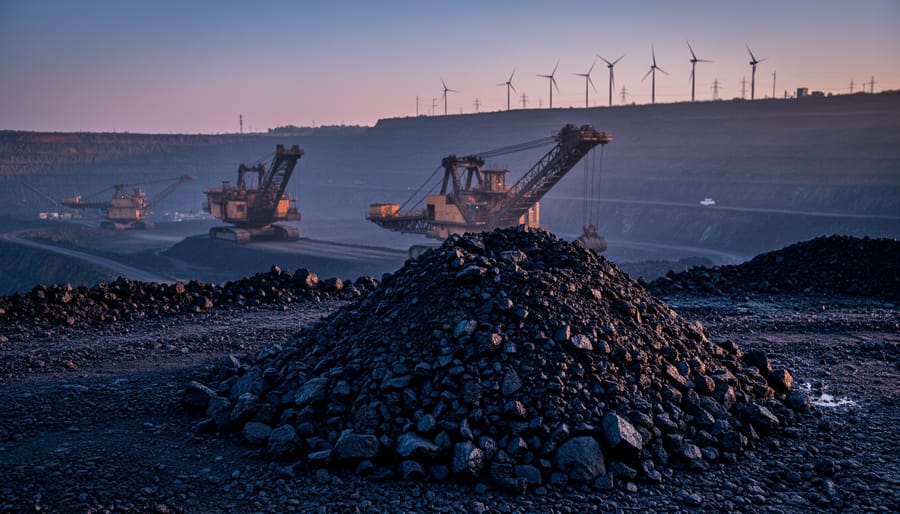
An open-pit coal mine shows the large-scale extraction required to access finite coal deposits.
Coal’s Depletion Reality: What the Numbers Tell Us in 2026
Canada’s Coal Landscape: A Regional Snapshot
Canada’s extractive reality contradicts any notion of coal as a renewable resource. In 2024, Canadian mines pulled 42.6 million tonnes from the ground, material that accumulated over millions of years but will never regenerate on timescales relevant to human civilization. The remaining output wasn’t distributed evenly across the country. British Columbia dominated with 69% of total tonnage, followed by Alberta at 19% and Saskatchewan at 11%, reflecting the geological accident of ancient swamps that left concentrated carbon deposits in these western provinces.
The coal industry production snapshot reveals an industry in managed decline. Of the 2024 production, 67% was metallurgical coal destined for steel production rather than domestic power generation. Coal’s role in electricity generation had shrunk to just 6% by 2023, consuming only 13.1 million tonnes for power. That represents a 68% drop from the 41.1 million tonnes burned in 2011. The gap between what’s mined and what’s burned domestically for electricity underscores that much Canadian coal gets exported for industrial use, while the country has systematically reduced its reliance on coal for power generation.
This shift didn’t happen by accident. Canada inherited an advantage from hydroelectric development in earlier decades, giving it a foundation of renewable capacity that countries locked into coal dependence often lack. By the mid-2020s, roughly 80% of Canadian electricity already came from renewable or non-emitting sources like hydro, wind, and nuclear. Coal’s single-digit contribution represents the tail end of a transition, the last remnants of infrastructure built when the nonrenewable resource seemed limitless and its climate consequences weren’t yet understood. The regional concentration in western provinces means the phase-out creates localized economic disruption even as it advances national climate goals.
The Finite Supply Challenge
As coal seams become depleted, mining operations move deeper underground or to more remote locations where remaining reserves are harder to reach. This shift fundamentally changes the economics and physics of extraction. Thin seams buried thousands of feet below the surface require more complex ventilation, structural support, and equipment than the thick, accessible deposits that fueled the industrial revolution. Each tonne extracted demands more energy, more capital investment, and more time.
The costs escalate in predictable ways. Deeper mines mean longer transport distances from coal face to surface, higher pumping requirements to manage groundwater, and increased risks that demand more sophisticated safety systems. Surface mining of remaining deposits often requires removing ever-greater volumes of overburden, the rock and soil covering the coal, making the energy return on energy invested increasingly marginal. When a coal seam that once sat 30 meters below ground is exhausted, the next viable seam might lie 300 meters down, fundamentally changing project viability.
This depletion dynamic explains why coal-dependent regions face a double burden: rising extraction costs as accessible reserves dwindle, and growing pressure to transition away from a fuel source that becomes economically uncompetitive even before it runs out completely. The question isn’t whether coal will eventually become too costly to extract, but when that tipping point arrives, and whether communities have prepared alternative economic foundations before it does.
- Deeper mining depth requirements as shallow seams are exhausted
- Increased overburden removal for surface operations
- Longer transport distances from coal face to surface
- Greater water pumping needs to manage groundwater infiltration
- Remote location infrastructure costs for accessing marginal deposits
Environmental and Climate Implications of Nonrenewable Coal
Beyond Depletion: The Carbon Legacy
Coal’s nonrenewable nature carries implications far beyond simple scarcity. When we burn coal, we’re combusting organic material that stored atmospheric carbon across tens to hundreds of millions of years of slow geological transformation. That process releases this accumulated carbon, ancient sunlight locked away through epochs, back into the atmosphere in mere moments. A coal-fired power plant converts millennia of carbon sequestration into immediate greenhouse gas emissions, fundamentally altering the atmospheric chemistry faster than natural systems can reabsorb it.
The science behind climate change demonstrates that these released carbon dioxide molecules persist in the atmosphere for centuries, trapping heat and disrupting climate patterns long after the coal seam is exhausted. This temporal mismatch creates what energy policy analysts call a “legacy debt”, the climate consequences of burning nonrenewable coal will outlive the resource itself by generations. A tonne of coal might take 300 million years to form and power a grid for hours, but its carbon emissions will influence global temperatures for 300 years.
This permanence separates coal from truly renewable energy sources in ways that matter for long-term planning. Even after all economically recoverable coal is depleted, its atmospheric legacy continues driving climate impacts. Understanding this temporal dimension reshapes how we evaluate energy transitions, because the clock on climate consequences started counting when we began large-scale coal combustion, not when reserves run dry.
Extraction’s Permanent Footprint
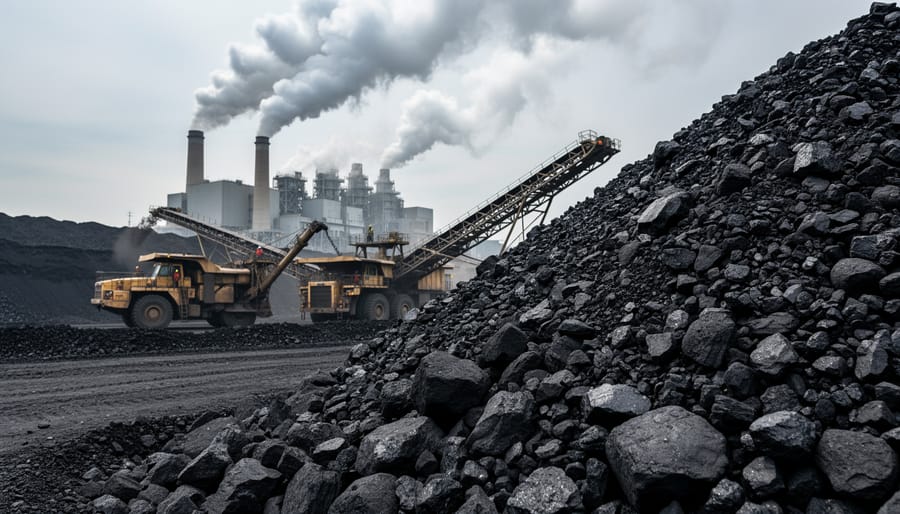
Coal extraction reshapes landscapes in ways that endure long after the last tonne leaves the ground. Surface mining removes entire mountaintops and vegetation layers, leaving behind unstable terrain prone to erosion and landslides. Underground operations create subsidence risks, ground collapse that can damage infrastructure and waterways decades later. In British Columbia and Alberta, where nearly 90% of Canada’s coal is mined, reclamation efforts attempt to restore topsoil and plant cover, but recreating the complex ecosystems that took millennia to develop proves impossible within human lifetimes.
Water systems bear particularly lasting scars. Acid mine drainage occurs when sulfur-bearing minerals in exposed coal seams react with water and air, creating sulfuric acid that leaches heavy metals into streams. This chemical contamination can persist for centuries, requiring ongoing treatment long after mining ceases. Groundwater depletion poses another permanent consequence; extracting coal often requires pumping aquifers dry, lowering water tables that support surrounding wells and wetlands. Communities downstream face reduced water quality and availability that outlasts the economic benefits the mine once provided.
Habitat fragmentation represents perhaps the most intractable legacy. Coal operations create barriers that divide wildlife populations, disrupt migration routes, and eliminate specialized habitats like wetlands and old-growth forests. Species that depend on these ecosystems face local extinction, and biodiversity losses compound over time. Even successful reclamation produces simplified landscapes that lack the structural complexity of the original environment, leaving an impoverished biological inheritance that persists for generations.
Policy Response: Phasing Out Nonrenewable Coal Power
Canada’s Coal Phase-Out Journey
Canada’s federal response to coal’s nonrenewable status began taking shape over a decade ago, when the government introduced its first greenhouse gas regulations specifically targeting coal-fired electricity generation in 2012. These initial rules established performance standards that effectively prevented the construction of traditional coal plants, but existing facilities could continue operating under certain conditions. The regulatory framework recognized what the science made clear: burning a finite resource that took millions of years to form releases carbon accumulations we can’t replace.
On July 1, 2015, Canada’s Emissions Performance Standard entered into effect, tightening the regulatory framework and setting the stage for broader phase-out efforts. The real shift came with Canada’s 2030 phase-out of unabated coal-fired electricity, announced as part of the country’s climate commitments. That word “unabated” carries significant weight. It means coal plants without carbon capture and storage technology that would trap emissions before they enter the atmosphere. In practice, given the economics and technological challenges of retrofitting existing plants with capture systems, the 2030 deadline functions as a full phase-out for most facilities.
The timeline of Canada’s coal phase-out includes these key milestones:
- 2012: Introduction of greenhouse gas regulations targeting coal-fired electricity generation, establishing performance standards that prevented new traditional coal plants.
- July 1, 2015: Canada’s Emissions Performance Standard entered into effect, creating a stronger regulatory baseline for existing facilities.
- 2030: Federal target for phasing out unabated coal-fired electricity generation across Canada, now only four years away.
- 2025 provincial tension: Saskatchewan decided to extend the life of its coal-fired power plants from 2030 to 2050, creating friction with the federal timeline.
This timeline matters because it acknowledges coal’s dual problem: it’s both nonrenewable and carbon-intensive. The 2030 target gives utilities and communities a defined window to transition. From 2012 to 2024, production of all types of coal fell from 66.5 million tonnes to 42.6 million tonnes, a decline of 36% that reflects both declining electricity demand and the shift away from thermal coal. By 2023, coal accounted for just 6% of Canada’s electricity generation.
Provincial cooperation has varied considerably. Some jurisdictions like Ontario eliminated coal power years ahead of the federal deadline, while others with legacy coal infrastructure face tighter timelines to meet the 2030 mark without disrupting grid reliability or local employment. Saskatchewan’s 2025 decision to extend coal plant life to 2050 illustrates the ongoing tension between federal climate policy and provincial energy autonomy.
Building on a Clean Foundation
Canada’s transition away from nonrenewable coal isn’t starting from scratch. The country has long generated the majority of its electricity from renewable or non-emitting sources, primarily hydroelectric power, supplemented by wind, solar, and nuclear. This existing clean foundation transforms coal phase-out from a daunting overhaul into a targeted replacement of a relatively small remaining fraction.
The mathematics work in Canada’s favour. With coal production declining from 66.5 million tonnes in 2012 to 46.2 million tonnes by 2022, the infrastructure challenge is manageable. Most provinces never relied heavily on coal, while those that did, particularly Alberta and Saskatchewan, have decades of hydroelectric expertise to draw upon and expanding renewable capacity already under development.
This head start matters strategically. Countries beginning energy transitions from 60 or 70 percent fossil fuel dependence face simultaneous challenges: building massive new renewable infrastructure, retiring numerous coal plants, managing grid stability, and retraining workforces. Canada sidesteps most of this complexity. The grid already handles variable renewable output. Transmission systems connect clean generation sources. Regulatory frameworks for non-emitting power exist and function.
The Government of Canada’s commitment to phase out unabated coal-fired electricity generation by 2030 reflects this reality. Though Saskatchewan decided in 2025 to extend the life of its coal-fired power plants from 2030 to 2050, federal regulations remain in place. The timeline is ambitious but achievable precisely because the heavy lifting happened earlier, through investments in hydroelectric dams, provincial clean energy commitments, and the 2015 Emissions Performance Standard that began limiting coal plant operations. Canada isn’t building a renewable electricity system; it’s completing one, replacing the final nonrenewable component with resources that regenerate continuously.
Solar and wind infrastructure symbolizes truly renewable energy that can be generated repeatedly on human timescales.
The Renewable Alternative: Why Resource Renewability Matters
The question “is coal renewable or nonrenewable” leads directly to a more practical concern: if coal is finite, what energy sources actually regenerate on timescales we can rely on? The answer reshapes how we think about energy security.
Renewable resources regenerate through natural cycles that operate on human timescales. Solar radiation reaches Earth continuously. Wind patterns replenish daily through atmospheric pressure differences. Rivers flow and refill through seasonal precipitation cycles. These sources don’t deplete through use because natural processes restore them faster than we consume them.
Coal operates on the opposite timeline. Those ancient plant deposits took 300 million years to compress into usable fuel. We’ve extracted and burned substantial portions in roughly 200 years. Once a coal seam is mined, it’s gone. No amount of waiting will regenerate it within any timeframe relevant to human civilization.
| Energy Source | Regeneration Time | Fuel Cost | Long-term Availability |
|---|---|---|---|
| Coal | 300+ million years | Extraction required | Depletes permanently |
| Solar | Continuous (daily) | Zero | 5 billion years (sun’s lifespan) |
| Wind | Continuous (daily) | Zero | Indefinite (atmospheric cycles) |
| Hydro | Seasonal cycles | Zero | Indefinite (precipitation cycles) |
This distinction carries strategic weight. Energy systems built on renewable sources can’t run out in any meaningful human timeframe. Solar panels will still generate electricity in 2075 because the sun will still rise. Wind turbines will spin because atmospheric pressure differences will persist. Countries can plan decades ahead without worrying their energy foundation will disappear.
Nonrenewable resources create inevitable planning problems. Reserves decline. Extraction grows costlier as easily accessible deposits vanish. Price volatility follows supply constraints. Nations dependent on finite fuels face long-term vulnerability, which explains why what happens to coal miners has become a central economic transition question in energy-producing regions.
Canada’s existing 80 percent renewable and non-emitting electricity mix demonstrates this advantage in practice. The country isn’t facing a potential hydro shortage crisis or wondering if wind will stop blowing. Those resources regenerate continuously, providing stable planning foundations that finite coal deposits cannot match.
The renewable classification isn’t just technical taxonomy. It determines whether an energy system can sustain itself indefinitely or must eventually transition. Coal’s nonrenewable status means phase-out isn’t just environmental policy but practical necessity driven by geology itself.
Case Study: Northern Europe’s Transition from Nonrenewable to Renewable Energy
Denmark and Germany have demonstrated that transitioning from nonrenewable coal to renewable energy isn’t a theoretical exercise but a practical reality already underway. Denmark, which once relied heavily on coal for electricity generation, now produces more than 80% of its power from wind and solar. This shift occurred over three decades through deliberate policy frameworks that paired coal plant closures with accelerated renewable deployment and grid modernization.
The transition didn’t happen through government action alone. Denmark’s success relied on partnerships that brought together university research centers, utilities, municipalities, and local communities. Aalborg University’s energy planning programs worked directly with grid operators to solve energy system integration challenges, developing models for balancing intermittent renewable sources that other countries now study and replicate. Meanwhile, citizens became direct stakeholders through the energy cooperative model, where communities collectively own wind turbines and solar installations, creating local economic benefits while advancing national climate goals.
Germany’s Energiewende (energy transition) similarly shows how industrial economies can move beyond nonrenewable coal while maintaining economic competitiveness. The country closed more than half its coal fleet between 2015 and 2025, replacing capacity with offshore wind farms and distributed solar arrays. Critically, the transition included structured support for coal-dependent regions. The Lausitz region in eastern Germany, historically centered on lignite mining, received targeted investment in renewable energy manufacturing, turning former mining communities into hubs for wind turbine production and battery storage facilities.
Employment numbers tell a compelling story. While Germany lost approximately 20,000 coal sector jobs during the transition, the renewable energy industry created over 300,000 positions across manufacturing, installation, maintenance, and grid management roles. This wasn’t automatic, it required workforce retraining programs developed jointly by industry associations, technical colleges, and regional governments that helped coal workers acquire skills for the renewable sector.
These Northern European examples prove that nonrenewable coal dependence isn’t permanent. The partnership model, academic research supporting practical implementation, government policy providing direction and investment, industry driving innovation, and communities participating as stakeholders creates pathways other regions can adapt to their specific contexts. The transitions succeeded because they treated coal’s nonrenewable nature not as a distant problem but as an immediate opportunity to build more sustainable and locally controlled energy systems.
A team working near renewable energy infrastructure illustrates how partnerships can accelerate a transition away from nonrenewable coal.
Coal’s classification as nonrenewable isn’t a technicality, it’s a fundamental constraint that shapes every credible energy strategy. Unlike renewable resources that regenerate on human timescales, coal requires millions of years to form from the remains of decayed plant material under intense pressure and heat. This distinction carries profound implications for energy security, climate stability, and economic planning. Countries betting their futures on finite fossil fuels face inevitable supply constraints and mounting environmental costs, while those investing in genuinely renewable systems build resilience and long-term competitiveness.
The transition from nonrenewable to renewable energy sources represents one of the most significant economic opportunities of this decade. Canada’s commitment to phase out unabated coal-fired electricity generation by 2030, building on a foundation where 80 percent of electricity already comes from renewable or non-emitting sources, demonstrates how resource literacy drives effective policy. Canadian mines produced 42.6 million tonnes of coal in 2024, with 67% designated for metallurgical use. From 2012 to 2022, overall coal production fell from 66.5 million tonnes to 46.2 million tonnes, reflecting a clear trajectory away from dependence on this finite resource. Still, policy remains contested: while federal regulations work toward the 2030 coal phase-out established through Canada’s Emissions Performance Standard in 2015, Saskatchewan extended the life of its coal-fired plants from 2030 to 2050 in 2025, illustrating ongoing tension between national climate commitments and regional energy decisions.
Cross-sector partnerships are accelerating this shift in ways that weren’t possible even five years ago. Universities collaborate with industry to develop grid-scale storage solutions. Governments work with former coal communities to create sustainable employment pathways. Investment flows toward technologies that harness energy from sources that replenish daily, sunlight, wind, moving water, rather than reserves that diminish with every tonne extracted. These collaborations offer ways to contribute to the energy transition regardless of your professional background.
The energy economy models emerging today reflect a maturing understanding that resource renewability determines long-term viability. As coal’s finite nature becomes increasingly apparent through production declines and rising extraction costs, the strategic advantage shifts decisively to systems powered by resources that regenerate. This isn’t just environmental pragmatism, it’s economic realism. The question isn’t whether coal is renewable, but how quickly we can build the systems that are.