
What Is Ocean Acidification (and How Does It Threaten Marine Ecosystems)?
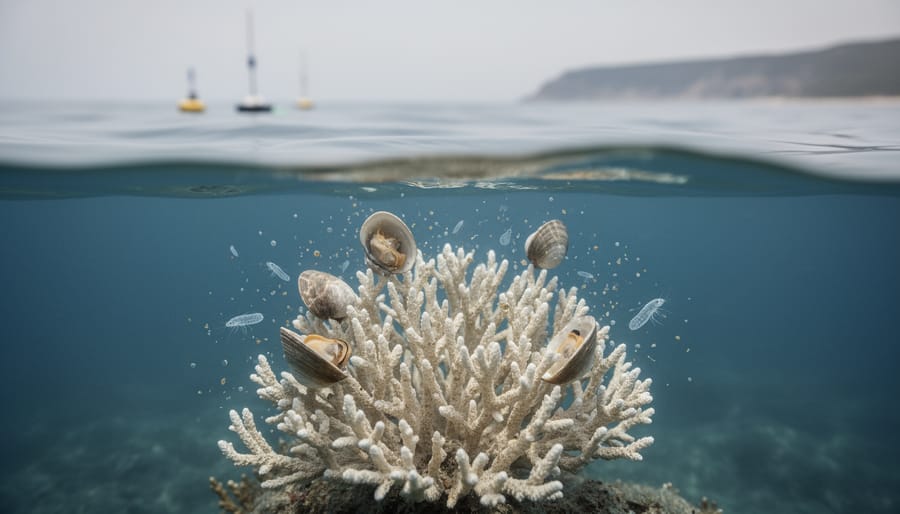
Ocean acidification refers to the ongoing decrease in ocean pH caused by the absorption of carbon dioxide from the atmosphere, fundamentally altering seawater chemistry in ways that threaten marine ecosystems and coastal economies. As our oceans absorb roughly a quarter of human-generated CO2 emissions, they become more acidic, disrupting the ability of shellfish, corals, and plankton to build protective shells and skeletons. This isn’t a distant threat. It’s measurable now through sophisticated monitoring networks, and it’s accelerating alongside fossil fuel consumption.
For professionals working at the intersection of energy policy and environmental stewardship, ocean acidification represents a direct chemical consequence of the same carbon emissions driving climate change science. The connection is straightforward: burn fossil fuels, release CO2, change ocean chemistry. Yet the monitoring, prediction, and mitigation of acidification require cross-sector collaboration between marine scientists, energy planners, policymakers, and coastal industries.
Recent developments underscore both the urgency and the sophistication of current responses. A comprehensive review published in Frontiers in Marine Science in February 2026, authored by 15 researchers across Canadian institutions, synthesized the state of knowledge on ocean acidification in Canada and charted pathways for coordinated action. Meanwhile, NOAA’s Ocean Acidification Program continues expanding data accessibility through initiatives including real-time buoy networks, regional observing systems, and predictive models that translate measurements into ecosystem forecasts.
This explainer walks you through the mechanics of ocean acidification, the monitoring infrastructure capturing its progression, and how energy transitions can slow the chemical transformation of our seas. Whether you’re evaluating carbon policy, managing coastal resources, or designing sustainable energy systems, understanding this issue is no longer optional.
What Ocean Acidification Means: The Chemistry Behind Changing Seas
Ocean acidification begins with a straightforward chemical reaction that has profound consequences for marine life. When carbon dioxide from the atmosphere dissolves in seawater, it sets off a cascade of changes that alter the fundamental chemistry of our oceans.
The process starts when CO2 forms carbonic acid in seawater. This weak acid immediately breaks down into hydrogen ions and bicarbonate ions, triggering a chain reaction that reduces the availability of carbonate ions, the building blocks that marine organisms need to construct shells and skeletons. Think of it like adding vinegar to baking soda: the chemical interaction is rapid and changes the composition of the mixture.
- pH scale
- A measure of acidity or alkalinity ranging from 0 to 14, where lower numbers indicate higher acidity. Pre-industrial ocean surface waters averaged pH 8.2; current levels have dropped to approximately 8.1, representing a 30% increase in acidity.
- Carbonic acid
- The weak acid (H2CO3) formed when carbon dioxide dissolves in water. It quickly dissociates into hydrogen and bicarbonate ions, initiating the chemical changes that characterize ocean acidification.
- Carbonate ions
- Negatively charged molecules (CO3²⁻) that combine with calcium to form calcium carbonate, the material used by corals, mollusks, and many plankton species to build protective structures. Ocean acidification reduces carbonate ion availability, making shell and skeleton formation more difficult.
- Aragonite saturation state
- A measure of how easily calcium carbonate can form in seawater, with values below 1.0 indicating conditions where shells and skeletons dissolve faster than they form. Aragonite saturation as an indicator helps scientists track regional vulnerability and predict biological impacts.
The pH scale measures acidity on a logarithmic scale, meaning each whole-number drop represents a tenfold increase in acidity. Since the beginning of the Industrial Revolution, ocean surface pH has declined from around 8.2 to approximately 8.1, a shift that sounds modest but translates to a 30% increase in ocean acidity. The logarithmic nature makes small numerical changes highly significant.
Carbonate ion depletion creates a double challenge for marine organisms. Not only does reduced carbonate availability make building new shells energetically expensive, but in severely acidified waters, existing calcium carbonate structures can begin to dissolve. The aragonite saturation state quantifies this risk: values above 1.0 indicate conditions favorable for shell formation, while values below 1.0 signal waters where dissolution outpaces construction.
Different ocean regions experience varying baseline chemistry and rates of change. Cold waters naturally hold more dissolved CO2, making polar and deep-ocean ecosystems particularly vulnerable. Upwelling zones that bring nutrient-rich but CO2-laden deep water to the surface also face accelerated acidification, creating regional hotspots where biological impacts appear sooner and more severely.
How Ocean Acidification Works: From Emissions to Ecosystem Impact
The journey from smokestack to seabed begins with a number: atmospheric carbon dioxide concentration, which has climbed from pre-industrial levels of roughly 280 parts per million to over 420 ppm in 2026. About a quarter of this excess CO2 doesn’t linger in the atmosphere but dissolves directly into the ocean’s surface waters. This absorption happens continuously, driven by simple diffusion, CO2 moves from areas of high concentration (the atmosphere) to areas of lower concentration (the ocean) until equilibrium is reached.
Once dissolved, CO2 reacts with seawater in a cascade of chemical transformations. The gas combines with water molecules to form carbonic acid, which quickly dissociates into hydrogen ions and bicarbonate ions. These hydrogen ions are what lower the pH, making the water more acidic. Simultaneously, they react with existing carbonate ions to form additional bicarbonate. The result is a double hit: pH drops while the carbonate ions that marine organisms need for shell-building become scarcer.
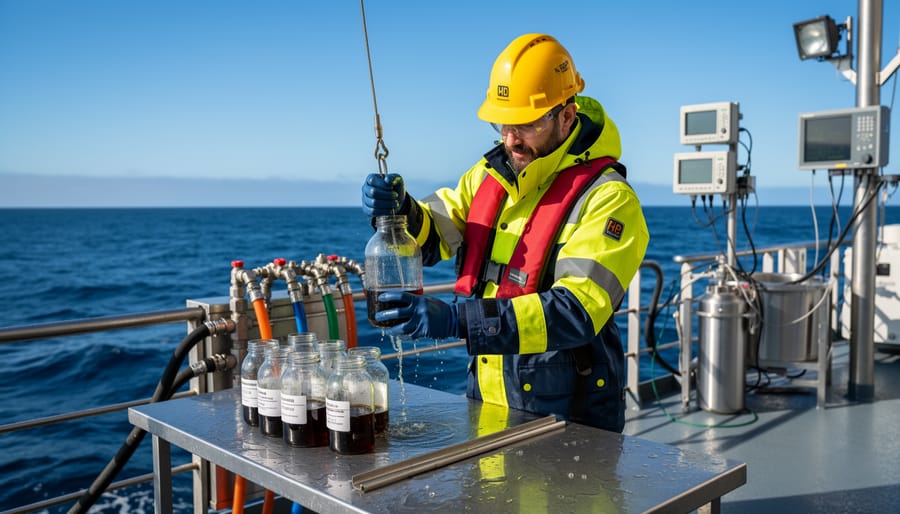
This chemical shift propagates through ocean layers over decades and centuries. Surface waters change first, but the ocean’s thermohaline circulation eventually carries acidified water into the deep ocean and polar regions. Research vessels collecting data for NOAA’s Ocean Acidification Program document these changes through chemical, physical, and biological observations that track pH, carbonate saturation states, and organism responses across varying depths and geographies. The NOAA Ocean Carbon and Acidification Data System manages these diverse datasets, creating a comprehensive picture of how acidification spreads through marine systems.
The timeline presents a sobering challenge. Even if emissions ceased tomorrow, the ocean would continue acidifying for years as it equilibrates with CO2 already in the atmosphere, and centuries would pass before natural processes could fully restore pre-industrial chemistry. This persistence makes acidification fundamentally different from some pollution problems, there’s no quick cleanup, only the slow work of prevention through emissions reduction and adaptation strategies that help vulnerable species and ecosystems survive the transition.
The biological impacts cascade through food webs with remarkable speed compared to the chemistry. Calcifying organisms struggle to build shells in carbonate-depleted water. Fish larvae show altered behavior within weeks of exposure. Coral reefs, which depend on precise aragonite saturation states, face compounding stress. Current monitoring efforts document these responses in real time, establishing baselines that inform everything from aquaculture management to climate model projections like those tracking aragonite saturation through 2100.
Types of Ocean Acidification Impacts Across Marine Systems
Calcifying Organisms Under Stress

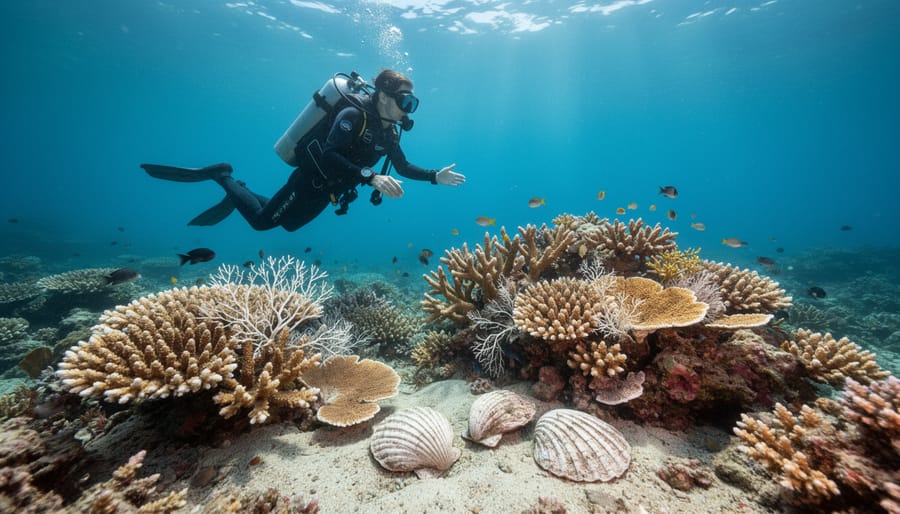
Calcifying organisms, species that build protective shells and skeletons from calcium carbonate, face direct chemical disruption as ocean acidification progresses. When seawater pH drops, the concentration of carbonate ions decreases, making it harder for oysters, mussels, corals, sea urchins, and microscopic plankton like pteropods to construct and maintain their structures. These organisms rely on a chemical process that combines calcium and carbonate ions to form aragonite or calcite, the minerals that comprise their shells.
Aragonite saturation state measures whether seawater contains enough carbonate ions to support shell formation. When this value falls below one, seawater becomes corrosive to existing shells, and building new ones becomes energetically expensive or impossible. Juvenile shellfish are particularly vulnerable during early growth stages, when rapid calcification is essential for survival. Coral reefs, which provide habitat for countless species, experience slower growth rates and weakened skeletal structures as saturation levels decline. The ripple effects extend throughout food webs: pteropods form a critical link in polar ocean ecosystems, supporting fish and marine mammal populations that depend on them as prey.
Behavioral and Physiological Effects on Fish
Emerging research reveals that elevated CO2 levels disrupt critical neurological processes in fish, affecting their ability to navigate, detect threats, and select appropriate habitats. Studies show that acidified conditions interfere with neurotransmitter function in fish brains, particularly the GABA-A receptor system that regulates behavior and sensory processing. This impairment manifests as reduced predator avoidance, juvenile fish exposed to higher CO2 concentrations fail to respond normally to chemical alarm cues and may even be attracted to predator odors they would typically avoid.
Habitat selection also deteriorates under acidification. Fish lose their ability to distinguish between suitable and unsuitable environments, wandering into exposed areas or abandoning protective coral structures. Acoustic orientation becomes compromised as well, with larvae unable to navigate toward reef sounds that typically guide settlement.
These individual-level effects cascade through food webs. When prey fish exhibit riskier behavior, predation patterns shift, altering community structure and energy flow. Recruitment failures in fish populations compound the stress already faced by degraded habitats, threatening the resilience of entire marine ecosystems and the fisheries that depend on them.
Regional Vulnerability Patterns
Ocean acidification does not progress uniformly across the globe. Certain regions experience accelerated changes due to natural oceanographic conditions that compound the effects of rising atmospheric CO2. Understanding these vulnerability patterns is essential for targeting monitoring efforts and developing region-specific adaptation strategies.
Polar seas face particularly rapid acidification because cold water absorbs more CO2 than warm water. Arctic and Antarctic waters naturally have lower carbonate ion concentrations, placing calcifying organisms closer to critical thresholds. As ice melt introduces freshwater, it further reduces the ocean’s buffering capacity. Canada’s February 2026 review article in Frontiers in Marine Science examined the current state of knowledge across Canadian waters, highlighting the accelerated changes documented in Arctic regions where Indigenous communities and marine food webs face compounded risks.
Upwelling zones present a different vulnerability profile. In these areas, deep water rich in dissolved CO2 from organic matter decomposition rises to the surface, bringing naturally acidic conditions that worsen as atmospheric CO2 levels climb. The U.S. West Coast upwelling system has documented periods when surface waters become corrosive to shellfish larvae, creating challenges for both wild populations and aquaculture operations.
Estuaries and coastal waters experience the most variable conditions. Freshwater input, nutrient loading, and biological activity create pH fluctuations that can swing dramatically over hours or days. These dynamic environments make organisms vulnerable to acidification stress while simultaneously complicating monitoring efforts and requiring localized assessment approaches rather than broad ocean-scale models.
How Ocean Acidification Monitoring and Data Are Used Today
Ocean acidification monitoring has evolved from scattered research campaigns into a coordinated global infrastructure that directly shapes resource management and policy decisions. Data collected through NOAA’s Ocean Acidification Program, international networks, and regional observing systems now flow into planning processes across sectors, transforming abstract chemistry readings into actionable intelligence for coastal communities, industries, and governments.
The NOAA Ocean Acidification Program anchors this monitoring ecosystem through systematic data collection and synthesis. OCADS manages observations gathered from research vessels, autonomous instruments, and coastal moorings, compiling chemical, physical, and biological measurements into accessible portals. This infrastructure enables stakeholders to track conditions in their regions without funding independent research programs.
Aquaculture operations represent one of the clearest use cases for acidification data. Shellfish hatcheries in Washington State and British Columbia adjust spawning schedules and water treatment based on upwelling forecasts and pH trends, preventing larval die-offs that cost millions in lost production. These operations rely on regional data portals that translate broad ocean observations into localized conditions relevant to specific bays and inlets.
Climate modelers integrate acidification data to refine projections of future ocean states. Projected ocean acidification scenarios, such as those generated by GFDL’s ESM4 model through 2100, combine historical measurements with carbon cycle simulations to map aragonite saturation states under different emissions pathways. These projections inform everything from coastal development approvals to marine protected area design, showing where ecosystems face compounding stresses.
Policy development increasingly draws on synthesized acidification knowledge. The February 2026 Canadian review article in Frontiers in Marine Science exemplifies this trend, fifteen authors across institutions distilled current understanding into pathways for coordinated action, bridging federal, provincial, and First Nations jurisdictions. Such syntheses translate monitoring results into policy-relevant frameworks that connect energy transitions to ocean health outcomes.
Regional partnerships thrive when data becomes accessible. The proliferation of user-friendly portals, covering everything from Chesapeake Bay conditions to Pacific coral monitoring, enables local governments, Indigenous communities, and industry associations to participate in acidification response without specialized technical capacity. This democratization of information supports the cross-sector collaboration essential for addressing a challenge that spans energy policy, marine management, and economic development.
Pathways Forward: Mitigation and Adaptation Strategies
Addressing ocean acidification demands a dual strategy: tackling the root cause through deep cuts in CO2 emissions while simultaneously building resilience in vulnerable marine systems. Understanding what is mitigation in this context means recognizing that sustainable energy transitions form the backbone of any long-term solution. Fossil fuel combustion drives atmospheric CO2 concentrations upward, and until we fundamentally transform our energy systems, ocean chemistry will continue shifting toward more acidic conditions.
The transition to renewable energy sources stands as the most powerful mitigation tool available. Wind, solar, and other clean energy technologies slash CO2 emissions at the source, preventing additional acidification beyond what decades of past emissions have already locked in. This is where cross-sector collaboration becomes essential. Energy system integration efforts that connect electricity grids with transportation, industry, and heating systems multiply the climate benefits while simultaneously protecting ocean health. Every megawatt-hour generated from renewables rather than coal or natural gas represents CO2 that won’t dissolve into seawater.
Yet mitigation alone can’t reverse acidification on timescales that match the urgency facing marine ecosystems today. Adaptation strategies provide critical near-term protection while emissions reductions take effect. Selective breeding programs offer one promising avenue. Researchers and aquaculture operators are identifying oyster, mussel, and clam strains that tolerate lower pH conditions, then propagating these hardy varieties for commercial production and reef restoration. The Whiskey Creek Shellfish Hatchery in Oregon pioneered this approach after devastating larval mortality events, demonstrating that genetic diversity within species can be leveraged to maintain viable populations under changing chemistry.
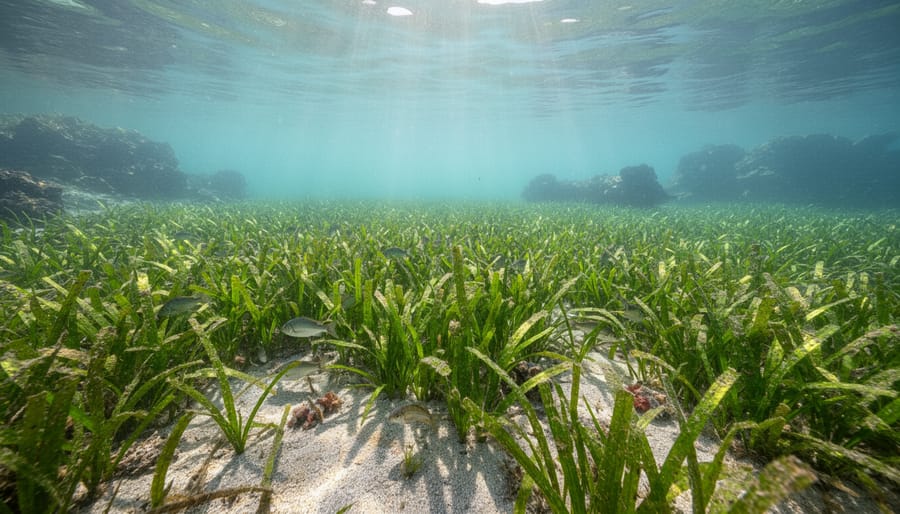
Coastal management interventions create localized refuges. Restoring seagrass meadows and kelp forests buffers pH fluctuations through photosynthetic CO2 uptake during daylight hours, providing calcifying organisms temporary relief in critical growth periods. Strategic placement of shellfish restoration projects in areas with favorable water circulation patterns maximizes their survival odds. These nature-based solutions deliver co-benefits including habitat creation and nutrient cycling improvements.
Early warning systems transform monitoring data into actionable intelligence. The Pacific Northwest hatcheries now receive real-time pH alerts from buoy networks, allowing operators to adjust seawater intake timing or buffer incoming water when particularly corrosive conditions arrive. Similar systems support wild fishery management, helping regulators anticipate when sensitive life stages might face heightened stress.
Canada’s February 2026 review article exemplifies how synthesizing scientific knowledge drives coordinated action. The multi-institutional assessment identified regional vulnerabilities and laid out pathways connecting research to policy implementation, demonstrating that effective responses require integration across disciplines and jurisdictions.
The most successful solutions emerge when energy policy explicitly incorporates ocean health considerations. Marine spatial planning processes that account for acidification vulnerability can guide offshore renewable energy siting to avoid compounding stresses on sensitive ecosystems. Industry partnerships that align decarbonization targets with marine stewardship create reinforcing cycles of environmental benefit. The challenge is solvable, but only through sustained commitment to both transformation and resilience.
Common Questions About Ocean Acidification
What is the current state of ocean acidification monitoring?
Monitoring has expanded significantly through coordinated international efforts. NOAA’s Ocean Acidification Program, working with the Interagency Working Group on Ocean Acidification, now provides easily accessible data through multiple platforms including moored buoys, research vessel observations, and regional portals. The NOAA Ocean Carbon and Acidification Data System manages chemical, physical, and biological observations that track how ocean chemistry is changing across different regions and depths.
What does the pH 8.1 reference point mean?
The pH 8.1 benchmark represents approximate pre-industrial ocean surface conditions, providing a reference against which current acidification is measured. Today’s global average ocean surface pH is roughly 8.05, representing a 0.1 unit decrease that translates to a 30% increase in acidity since industrialization began. This reference helps scientists quantify the rate and extent of change, though specific pH values vary considerably by region, season, and depth.
How do regional acidification conditions vary?
Regions experience vastly different acidification rates and impacts. Cold-water areas and upwelling zones face accelerated changes because colder water absorbs more CO2, while coastal estuaries experience compounded effects from land-based nutrient runoff. Canada’s February 2026 review article synthesizes regional knowledge across Canadian waters, highlighting that Arctic and Pacific coastal regions show particularly rapid shifts in carbonate chemistry, creating varying urgency for adaptation responses.
What pathways for action show the most promise?
The most effective pathway remains reducing CO2 emissions through sustainable energy transitions, the approach championed by organizations like The Coalition. Complementary adaptation strategies include developing early warning systems for vulnerable industries like shellfish aquaculture, selective breeding programs for resilient species, and integrated coastal management that considers acidification alongside other stressors. Professionals across sectors can contribute to change by incorporating ocean health metrics into energy policy frameworks and marine spatial planning.
The knowledge synthesis emerging from initiatives like Canada’s 2026 review demonstrates how coordinated monitoring translates to actionable intelligence. These reviews identify critical gaps, prioritize research investments, and create frameworks that connect scientific understanding to management decisions. For energy sector professionals, this means recognizing that decarbonization strategies directly benefit ocean chemistry, every reduction in fossil fuel emissions slows the rate of pH decline and gives marine ecosystems more time to adapt.
Data accessibility has become central to effective response. Platforms like the NOAA Ocean Acidification Data page consolidate information from diverse sources, from coastal forecast systems to international networks, making it possible for regional partnerships to assess local conditions and plan accordingly. This democratization of ocean chemistry data enables coastal communities, aquaculture operations, and conservation organizations to make informed decisions without requiring specialized oceanographic expertise.
Ocean acidification presents a formidable environmental challenge, yet it remains fundamentally solvable through coordinated action across energy systems, marine policy, and ecosystem management. The same transition away from fossil fuels that addresses atmospheric warming simultaneously addresses the root cause of changing ocean chemistry. Every pathway toward renewable energy deployment, efficiency improvement, and emissions reduction delivers dual benefits for climate stability and ocean health.
The Climate and Energy Coalition’s cross-sector partnership model directly aligns with what acidification science demands. No single entity can tackle a problem that spans atmospheric chemistry, marine ecosystems, coastal economies, and global energy infrastructure. The comprehensive Canadian review published in early 2026 demonstrates how scientific synthesis across institutions creates actionable pathways forward. Similarly, NOAA’s Ocean Acidification Program and its coordinated data systems exemplify how accessible monitoring informs regional decision-making, from aquaculture planning to coastal management strategies.
Addressing acidification requires urgency without resignation. The ocean’s capacity to buffer pH changes is finite, and organisms already face measurable stress. Yet monitoring networks now provide the data needed for adaptive management, selective breeding programs show promise for building resilience in commercial species, and every ton of avoided CO2 emissions prevents further deterioration while allowing gradual recovery over decades to centuries.
The challenge ahead demands integrating ocean health directly into sustainable energy planning rather than treating them as separate concerns. Energy policy decisions made in 2026 will determine ocean chemistry trajectories through 2100 and beyond. The partnerships, data infrastructure, and political will necessary for this integration exist today. The question is not whether ocean acidification can be addressed, but whether stakeholders across sectors will mobilize the coordinated response that science clearly indicates is both necessary and achievable.