
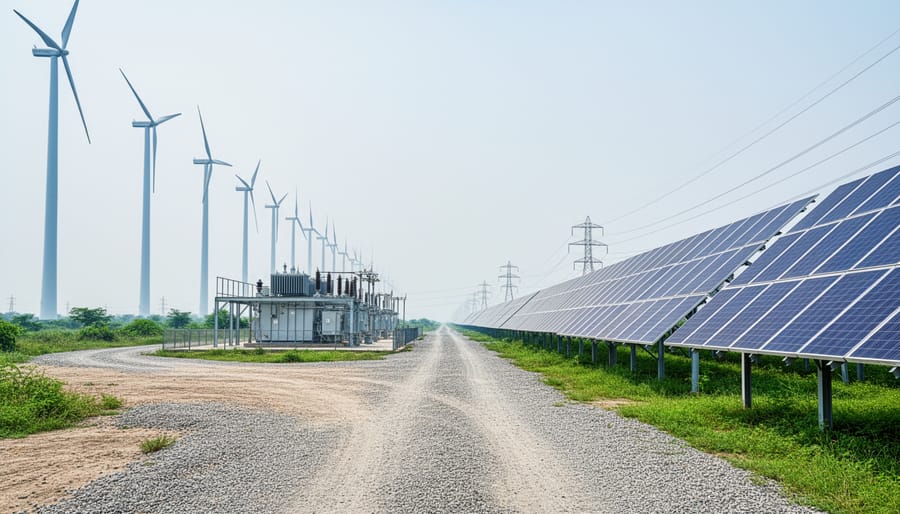
India Renewable Energy Park News Update: What Changed and What to Watch in 2026
India crossed 300 GW of non-fossil fuel power capacity on 31 July 2026, claiming a landmark achievement two decades ahead of the timeline many observers expected when the country first committed to aggressive renewable targets. The milestone confirms that renewable energy parks, large-scale integrated infrastructure zones designed to consolidate solar, wind, and hybrid projects in regions with strong resource potential, have become the fastest route to utility-scale deployment. With total capacity now standing at 300.50 GW across solar (164.59 GW), wind (58.14 GW), hydro (57.24 GW), bio-power (11.75 GW), and nuclear (8.78 GW), India has validated a park-based development model that condenses permitting, transmission build-out, and land acquisition into coordinated corridors.
The July 2026 figure represents more than half the distance to the country’s 2030 target of 500 GW, but the real story lies in the velocity: over the past three years, India has commissioned an average of 30 GW per year, a pace driven largely by the operationalisation of several gigawatt-scale renewable energy parks. These parks offer plug-and-play connectivity, pre-cleared environmental approvals, and pooled infrastructure such as substations and evacuation systems, enabling developers to focus capital on generation assets rather than upstream barriers. For energy professionals, policymakers, and investors tracking India’s clean energy trajectory, understanding which parks are coming online, how transmission capacity is keeping pace, and where the next 200 GW will originate has shifted from strategic interest to operational necessity.
What Changed: India Crosses 300 GW Renewable Capacity Threshold
On 31 July 2026, India crossed a landmark threshold in its energy transition: 300 gigawatts of installed non-fossil fuel power capacity. The country reached 300.50 GW total, a milestone that signals accelerating momentum toward its ambitious clean energy goals and establishes India as a global renewable deployment leader among developing economies.
The achievement reflects a diversified energy portfolio built across five non-fossil sources:
- Solar power: 164.59 GW, the single largest contributor, driven by utility-scale parks and distributed rooftop installations
- Wind power: 58.14 GW, concentrated in states with strong wind resources and established manufacturing ecosystems
- Hydro power: 57.24 GW, including large-scale and small hydro projects across mountainous regions
- Bio-power: 11.75 GW, utilizing agricultural residues, municipal waste, and biomass feedstocks
- Nuclear power: 8.78 GW, providing baseload low-carbon generation alongside variable renewables
Solar’s dominant share underscores how rapidly costs have fallen and how effectively renewable energy parks have channeled investment into large, grid-connected projects. Wind follows as the second renewable pillar, while hydro, long the backbone of India’s clean capacity, remains a stabilizing force.
This 300 GW mark puts India past the halfway point toward India’s 2030 500 GW target a commitment central to the country’s climate pledges and energy security strategy. Reaching 500 GW means adding another 200 GW within four years, roughly 50 GW annually, a pace that will test financing mechanisms, grid infrastructure, and land availability. The July milestone proves the institutional capacity exists to deploy clean energy at scale; sustaining that rate will determine whether India’s energy transition moves from achievement to transformation.
Key Developments: Renewable Energy Parks Driving Scale and Speed
1. Utility-Scale Solar and Wind Parks Dominate New Installations
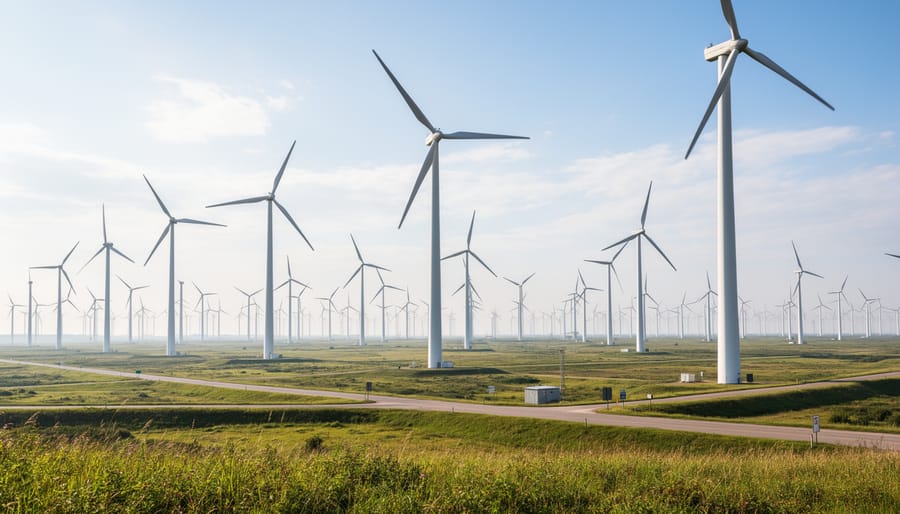
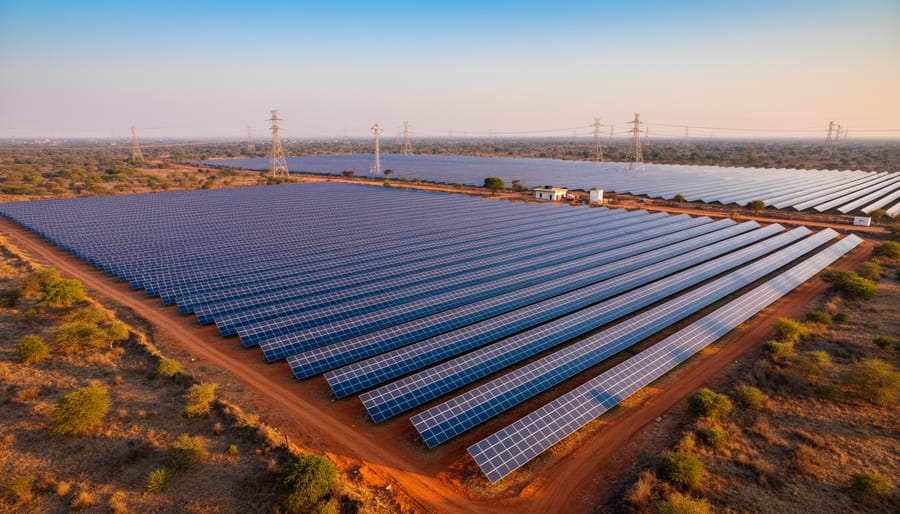
India’s rapid climb to 300.50 GW of non-fossil fuel capacity rests on a deliberate infrastructure strategy: building utility-scale renewable energy parks rather than scattering thousands of small projects across the landscape. Solar power’s commanding 164.59 GW share demonstrates this model’s effectiveness. By concentrating installations in dedicated zones, developers share transmission lines, substations, and evacuation infrastructure, cutting per-megawatt connection costs and accelerating timelines. Land acquisition becomes simpler when state governments designate contiguous renewable energy zones with clear titling and minimal displacement, avoiding the patchwork negotiations that slow standalone projects.
Streamlined permitting follows the same logic. A single environmental clearance and grid integration study can cover an entire park hosting multiple developers, compared to processing hundreds of individual applications. This institutional efficiency explains why India added gigawatts at unprecedented speed in 2025 and 2026. The parks also create scale economies for understanding solar technology deployment, operation, and maintenance, attracting international module manufacturers and engineering firms. Wind installations within these zones benefit identically: shared met masts, coordinated turbine layouts, and bulk procurement of balance-of-plant components. The result is a national clean energy build-out moving faster than fragmented, site-by-site development could achieve, with renewable energy parks functioning as industrial platforms purpose-built for the 500 GW target.
2. Hybrid Parks Combine Solar, Wind, and Storage for Grid Stability
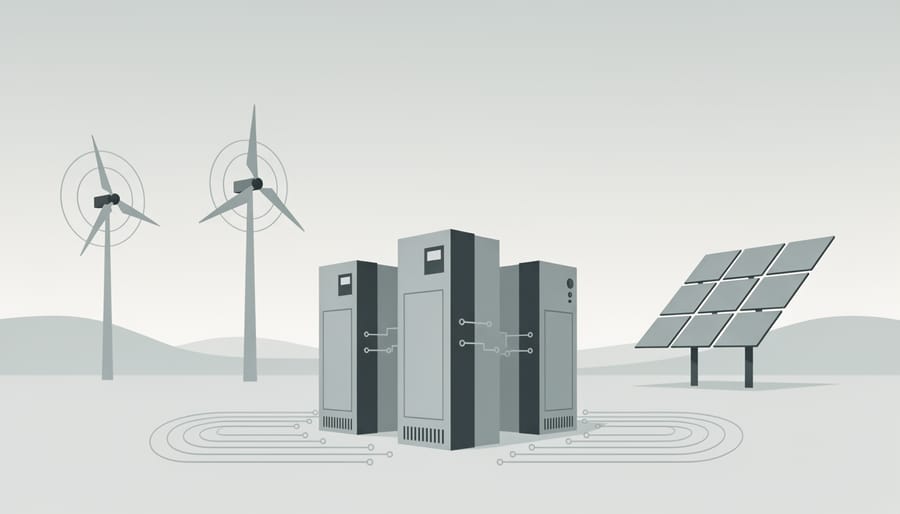
India’s renewable energy parks are evolving beyond single-technology installations. The newest generation co-locates solar panels, wind turbines, and battery systems on the same site, creating hybrid facilities that generate power around the clock. This approach directly tackles renewable energy’s intermittency problem: solar peaks during daylight hours, wind often strengthens at night, and energy storage fills the gaps when neither source is producing.
The hybrid model delivers two critical advantages for grid operators. First, it smooths output variability. When solar generation drops in the evening, wind and stored energy maintain supply, reducing the sharp ramps that destabilize grids. Second, it makes renewable power dispatchable, grid controllers can release stored energy during demand peaks, just as they would with conventional plants.
For India’s modernization goals, this matters enormously. The country is adding over 20 GW of renewable capacity annually to reach its 500 GW target by 2030, and every gigawatt must integrate without compromising reliability. Hybrid parks reduce the need for costly transmission upgrades and fossil fuel backup plants. They also maximize land use efficiency: shared infrastructure, substations, roads, security, lowers per-megawatt costs compared to building separate solar and wind sites.
Several state governments now prioritize hybrid projects in their renewable energy zones, offering streamlined approvals and grid access. The combination of complementary generation profiles and on-site storage is becoming the template for large-scale renewable deployment across India.
3. State-Level Renewable Energy Zones Attract Private Investment
State governments across India have turned renewable energy zones into strategic instruments for capital mobilization, designating large tracts of land with pre-cleared environmental approvals and transmission infrastructure commitments. These zones reduce upfront project risk by bundling land acquisition, grid connectivity studies, and regulatory clearances, tasks that historically delayed projects by months or years. When a state announces a renewable energy park with guaranteed evacuation capacity, it signals investment readiness to both domestic conglomerates and international developers.
Competitive reverse auctions within these zones have driven tariffs downward while accelerating deployment timelines. Developers bid for long-term power purchase agreements, typically 25 years, knowing the offtake is secured before construction begins. This financing certainty attracts institutional investors who require predictable cash flows. States sweeten the proposition with tax holidays, land lease discounts, and single-window clearance systems that compress approval cycles from 18 months to six.
The model works because it aligns incentives: states meet renewable purchase obligations, developers secure bankable contracts, and investors access a pipeline of shovel-ready projects. Gujarat, Rajasthan, and Karnataka have demonstrated that well-structured zones with transparent auction processes can pull in multi-billion-dollar commitments within a single fiscal year. The result is a conveyor belt of gigawatt-scale projects that contribute directly to national capacity targets like the 500 GW milestone by 2030.
Why This Milestone Matters for India’s Energy Transition
India’s achievement of 300.50 GW non-fossil fuel capacity represents far more than a numerical target reached ahead of schedule. This milestone fundamentally reshapes the country’s energy security posture by reducing dependence on imported coal and natural gas, insulating the economy from volatile global fossil fuel markets. With solar at 164.59 GW and wind at 58.14 GW forming the backbone of this capacity, India demonstrates that rapid decarbonization at scale is feasible for large developing economies without sacrificing growth.
The economic implications extend across multiple dimensions. Renewable energy parks and associated infrastructure projects have created employment across manufacturing, construction, operations, and maintenance sectors. Solar panel manufacturing hubs, wind turbine supply chains, and grid modernization projects employ hundreds of thousands directly while supporting millions in ancillary industries. Every gigawatt of renewable capacity displaces fossil fuel imports, keeping capital within domestic markets and improving trade balances.
From an environmental and climate perspective, crossing 300 GW accelerates India’s trajectory toward meeting its Nationally Determined Contributions under the Paris Agreement. The shift away from coal-fired generation reduces air pollution in urban centers, delivering immediate public health benefits alongside long-term climate mitigation. India’s success provides a replicable model for other developing nations balancing energy access, economic development, and climate commitments.
Perhaps most significantly, this milestone repositions India’s role in global climate discussions. No longer framing renewable deployment as a distant aspiration, the country now speaks from a position of demonstrated execution at unprecedented speed and scale. This credibility matters in international negotiations around climate finance, technology transfer, and differentiated responsibilities, establishing India as a leader among developing economies navigating the energy transition.
What to Watch: The Path from 300 GW to 500 GW by 2030
India’s journey from 300 GW to 500 GW by 2030 requires sustained momentum across infrastructure, policy, and investment. The country must add approximately 50 GW of renewable capacity annually over the next four years to meet its target, a pace that will test the scalability of renewable energy parks and supporting systems.
Transmission infrastructure expansion stands as the most critical bottleneck to watch. The existing grid was designed for centralized fossil fuel generation, not for distributed renewable energy parks spread across multiple states. New high-voltage transmission corridors, inter-state connectivity upgrades, and grid integration technologies will determine whether solar and wind capacity can reach demand centers without curtailment or instability.
Energy storage deployment will prove equally decisive. Battery systems co-located with renewable energy parks can smooth supply fluctuations and provide dispatchable power, but India’s current storage capacity remains minimal relative to the intermittency challenge ahead. Watch for announcements on gigawatt-scale battery projects and emerging storage mandates tied to new renewable installations.
Policy consistency and financing mechanisms require close attention. Sustained tariff structures, streamlined land acquisition processes, and access to low-cost capital through domestic and international sources will either accelerate or stall project timelines. Open questions persist around land availability in prime solar and wind zones, especially as parks compete with agricultural and conservation priorities, and around whether technology innovation in panel efficiency and turbine capacity can offset geographic constraints.
Common Questions About India’s Renewable Energy Parks and Milestones
What exactly counts as non-fossil fuel capacity in India’s 300 GW milestone?
India’s non-fossil fuel capacity includes solar power (164.59 GW), wind power (58.14 GW), hydro power (57.24 GW), bio-power (11.75 GW), and nuclear power (8.78 GW). The 300.50 GW total announced on 31 July 2026 represents installed capacity from these five sources.
How do renewable energy parks differ from standalone renewable projects?
Renewable energy parks are dedicated zones where multiple generators share common infrastructure such as grid connectivity, land preparation, and transmission networks. This pooled approach reduces per-megawatt costs, accelerates permitting, and attracts larger-scale investment compared to dispersed standalone projects.
What annual capacity additions are required to reach India’s 500 GW target by 2030?
With 300.50 GW achieved by July 2026, India needs to add approximately 200 GW over the next three and a half years, translating to an annual run rate of roughly 55-60 GW. This pace requires sustained investment, accelerated transmission build-out, and continued deployment of utility-scale parks.
Why are hybrid parks combining solar, wind, and storage gaining traction?
Hybrid parks address the intermittency challenge by co-locating complementary generation technologies and battery storage in a single zone. This configuration smooths output fluctuations, improves grid stability, and makes renewable power more dispatchable, supporting India’s goal of integrating high renewable shares into the electricity system.
What financing models support renewable energy park development in India?
State governments typically designate park zones and auction capacity allocations through competitive bidding, with power purchase agreements providing revenue certainty for developers. Domestic and international private capital enters through equity, green bonds, and development finance, de-risked by policy incentives and long-term offtake contracts.
These questions reflect the priorities of energy professionals and investors tracking India’s transition. Understanding capacity definitions clarifies what the 300 GW milestone represents and how it maps to the 500 GW target. Distinguishing parks from standalone projects explains the infrastructure logic driving recent capacity growth. The hybrid park question addresses a technical evolution reshaping project design, while the financing query speaks to the capital mobilization challenge ahead. Each answer grounds policy aspirations in the operational realities of building gigawatt-scale renewable infrastructure at speed.
India’s journey to 300.50 GW of non-fossil fuel capacity stands as compelling evidence that developing economies can drive the global energy transition at scale. This milestone, achieved in July 2026, wasn’t the result of scattered efforts or incremental adjustments. Renewable energy parks emerged as the essential infrastructure platform that made rapid, gigawatt-scale deployment both feasible and financially viable across diverse geographies and resource conditions.
These parks delivered what individual projects couldn’t: shared transmission access, streamlined land acquisition, reduced permitting friction, and concentrated investment that attracted domestic and international capital. They transformed renewable energy from niche installations into India’s dominant source of new power capacity, proving that speed and scale are achievable when infrastructure, policy, and investment align.
The path to 500 GW by 2030 demands sustained collaboration across government, private developers, technology providers, and international partners. Our coalition remains committed to connecting these actors and sharing the insights that keep momentum building. India’s success offers a blueprint for emerging economies worldwide, and the next 200 GW will test whether the renewable energy park model can maintain its pace through the challenges ahead.