

When Will Climate Change Be Irreversible? Understanding Tipping Points and Timelines
Climate change irreversibility refers to the crossing of critical thresholds, known as tipping points, beyond which Earth’s natural systems undergo profound, self-perpetuating transformations that cannot be undone within human timescales. These aren’t abstract future scenarios. At 1.4°C of global warming in 2026, we’re already witnessing warm water coral reefs cross their thermal tipping point, experiencing unprecedented dieback that signals we’re operating within the danger zone scientists have warned about for decades.
Understanding when climate change becomes irreversible matters because the answer shapes every energy investment, policy decision, and infrastructure plan made today. The science behind climate change reveals that tipping points can trigger between 1°C and 2°C of warming, with recent assessments identifying 1.5°C as the threshold where ice sheet melting in critical regions may become unstoppable. Current projections indicate we’ll likely reach or exceed 1.5°C within the next 20 years, placing us on the doorstep of cascading changes.
Some impacts are already locked in. Continued sea level rise, for instance, will persist for hundreds to thousands of years regardless of our actions today. Yet irreversibility isn’t binary. While certain processes have crossed points of no return, others remain within our power to influence, and stabilizing global temperatures could take 20 to 30 years once emissions peak.
This article examines what irreversibility means in climate science, how tipping point mechanisms function, the specific thresholds we face, and the timelines that should inform strategic planning across energy sectors and policy frameworks. Rather than presenting doom, we’re equipping professionals with the scientific clarity needed to act decisively during the narrow window that remains open.
What Climate Tipping Points Mean
A climate tipping point marks the moment when a natural system crosses a critical threshold and begins to change in ways that become difficult or impossible to reverse. Unlike gradual warming that might be slowed or stabilized, a tipped system enters a new trajectory, often accelerating toward a dramatically different state regardless of subsequent human intervention.
Think of it as pushing a boulder up a hill: for a while, you can slow its roll or even stop it, but once it crests the top, gravity takes over. The boulder’s own momentum drives it downward, and no amount of effort will return it to its starting point without extraordinary intervention. In Earth’s climate systems, this threshold behavior means small additional changes in temperature can trigger outsized, self-reinforcing shifts.
- Tipping Point
- A threshold beyond which small changes can lead to significant and often irreversible change in a natural system.
- Global Tipping Points
- Harmful tipping points in the natural world that threaten humanity by disrupting life support systems and societal stability.
- Irreversibility
- The state where changes to a system, once triggered, cannot be undone on human timescales, persisting for decades, centuries, or millennia.
- Feedback Loop
- A self-reinforcing process where an initial change amplifies itself, accelerating the system’s transformation.
Global tipping points pose the gravest threat precisely because they affect systems upon which civilization depends: ice sheets that regulate sea levels, ocean currents that distribute heat and moisture, forests that produce oxygen and store carbon, and coral reefs that anchor marine ecosystems. When these life support systems tip, the consequences ripple across continents and generations.
The science reveals we operate within narrow margins. Recent IPCC assessments suggested that tipping points could be reached between 1°C and 2°C of warming, a range humanity has nearly exhausted. Already at 1.4°C of global warming, warm water coral reefs are crossing their thermal tipping point and experiencing unprecedented dieback. This isn’t a distant scenario but an ongoing transformation, offering a stark preview of what happens when we breach these thresholds. Understanding where these boundaries lie and which systems sit closest to their breaking points becomes essential for navigating the climate challenge ahead.
How Climate Tipping Points Work
Feedback Loops and Acceleration
Feedback loops transform manageable warming into accelerating change. When initial warming triggers a response that amplifies the original forcing, the cycle becomes self-reinforcing. Arctic sea ice offers a stark example: as ice melts, dark ocean water absorbs more solar radiation instead of reflecting it back to space. This reduces albedo and feedbacks drive further warming, which melts more ice. Each cycle tightens the spiral.
Permafrost thaw demonstrates how one feedback can cascade into another. Warming soil releases methane and carbon dioxide locked in frozen ground for millennia. These greenhouse gases intensify atmospheric heating, which thaws more permafrost. The cycle accelerates beyond the pace of the original temperature increase.
These mechanisms explain why reversing climate change grows harder over time. A system caught in positive feedback doesn’t simply respond proportionally to emissions cuts. It continues its trajectory even as we reduce the initial forcing. The momentum built through multiple reinforcing loops means stabilization lags behind policy action by decades.
At 1.4°C of warming already achieved, several feedbacks are active. Limiting additional triggers becomes urgent because each new loop compounds existing acceleration. The mathematics of compound warming, where each effect amplifies the next, underscores why crossing thresholds between 1°C and 2°C carries disproportionate long-term consequences.
From Gradual to Sudden Change
Climate systems can deceive us with their apparent stability. A forest thrives for decades, ice sheets persist for millennia, ocean currents flow in predictable patterns. Then, seemingly overnight, everything changes. This non-linear behavior defines tipping points and distinguishes them from the gradual warming trends that dominate public understanding of climate change.
The key is understanding that Earth systems resist change until they can’t. They absorb stress through internal adjustments, maintaining their fundamental structure even as conditions shift. A coral reef bleaches during a heat wave, then recovers when waters cool. Permafrost thaws in summer, refreezes in winter. These recovery cycles create an illusion of resilience, masking the accumulation of strain beneath the surface.
But resilience has limits. Once the accumulated stress exceeds a system’s capacity to self-correct, the transition to a new state can occur with startling speed. The Amazon rainforest doesn’t gradually thin over centuries of warming; it reaches a moisture threshold where the ecosystem can no longer generate its own rainfall, and vast sections convert to savanna within decades. The Greenland ice sheet doesn’t shrink uniformly; it hits a geometry where surface melting accelerates faster than snowfall can compensate, locking in sea level rise for centuries regardless of subsequent cooling.
This suddenness matters because it compresses the window for intervention. When systems appear stable at 1.4°C of warming, we might assume we have time to adjust. We don’t. The threshold could be just tenths of a degree away, and the shift to irreversibility can unfold faster than our capacity to respond.
Types of Climate Tipping Points
Ice Sheet and Glacier Tipping Points
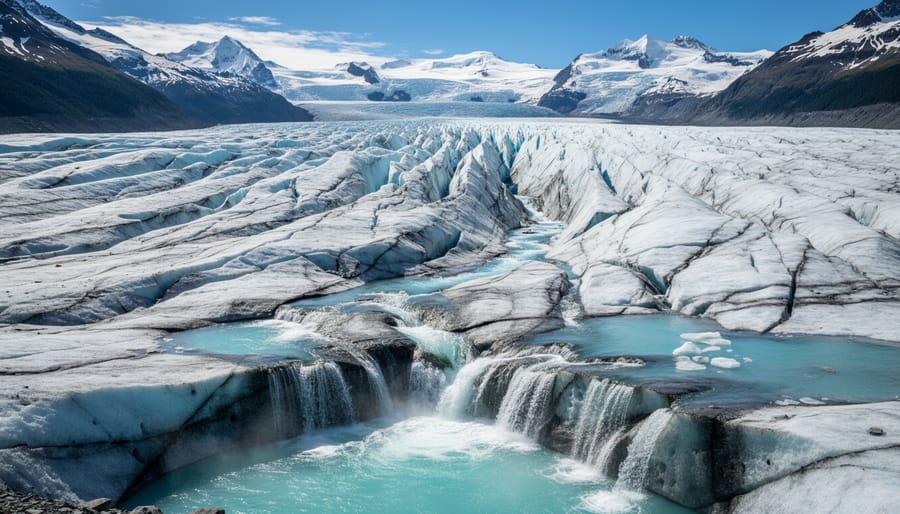
The Greenland ice sheet sits at a critical junction. Scientists have determined that the 1.5°C threshold for Greenland represents the point beyond which its complete melting becomes inevitable, regardless of subsequent cooling efforts. With current warming already at 1.4°C, we are approaching this line faster than many anticipated.
The consequences unfold over centuries rather than years. Once triggered, Greenland’s ice sheet would raise global sea levels by roughly seven metres, reshaping coastlines and displacing hundreds of millions of people. The Antarctic ice sheets present an even larger risk, containing enough frozen water to raise oceans by nearly sixty metres, though their thresholds vary by region and remain less precisely defined.
What makes these tipping points particularly concerning is their irreversibility timeline. Unlike ecosystems that might recover within decades if conditions improve, ice sheet dynamics operate on geological timescales. The physics of ice sheet collapse means that once retreat begins at certain points, self-reinforcing mechanisms take over: darker surfaces absorb more heat, accelerating melt; ice shelves that once buttressed glaciers disappear, allowing faster flow to the ocean.
For policy makers and infrastructure planners, this presents a stark reality: some degree of sea level rise is already locked in for centuries ahead.
Ecosystem Tipping Points
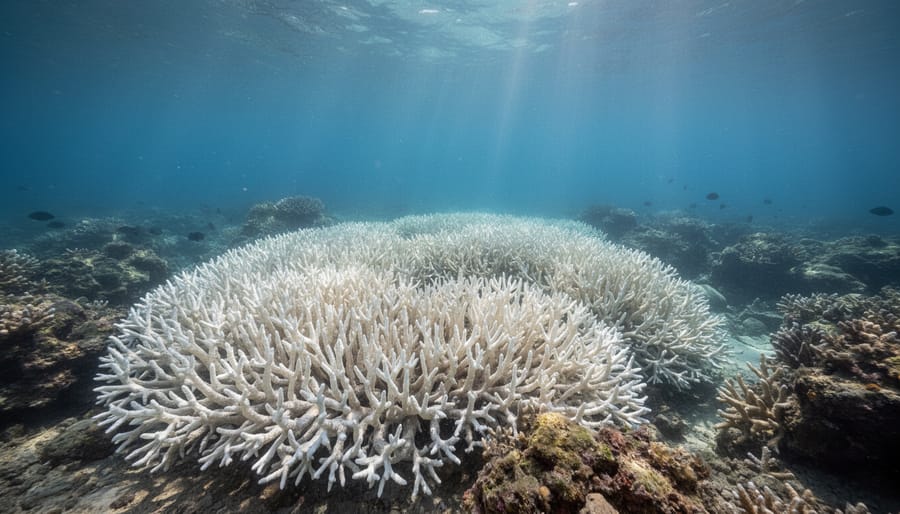
Warm water coral reefs stand as a stark warning: at the current 1.4°C of warming, these ecosystems have coral reefs already crossed their thermal threshold. Repeated marine heatwaves now trigger mass bleaching events from which many reefs cannot recover, compounded by ocean acidification that weakens coral skeletons. This isn’t a future threat, it’s an already-crossed tipping point demonstrating how ecosystems can collapse before we reach the widely cited 1.5°C target.
The Amazon rainforest faces a similar threshold. Deforestation and prolonged droughts are pushing sections toward a tipping point where the forest can no longer generate enough rainfall to sustain itself, potentially flipping vast areas from carbon sink to carbon source through dieback and savannification.
Arctic permafrost presents a different urgency. As frozen ground thaws, it releases methane and carbon dioxide, greenhouse gases locked away for millennia. This creates a feedback loop: warming thaws permafrost, which releases gases that drive further warming, which thaws more permafrost. Unlike coral reefs where we can observe the damage directly, permafrost thaw operates as a slower-motion tipping point with centuries-long consequences already set in motion.
Ocean and Atmospheric Circulation Systems
Ocean circulation systems and atmospheric patterns represent some of the most consequential climate tipping points because their collapse would cascade across continents, reshaping weather and agriculture far from the systems themselves. The Atlantic Meridional Overturning Circulation, the ocean current network that includes the Gulf Stream, redistributes heat from the tropics toward Europe and influences rainfall patterns across Africa and South America. If AMOC weakens beyond its threshold, Europe could experience cooler temperatures even as the planet warms, while the West African monsoon could shift, threatening food production for hundreds of millions. The monsoon systems that deliver seasonal rainfall to Asia and Africa depend on temperature gradients between land and ocean; as warming alters these gradients, monsoon timing and intensity become less predictable. A collapse in the Indian monsoon, for instance, would devastate crops that feed over a billion people, while changes to the West African monsoon have already contributed to regional food insecurity. Unlike ice sheet melting, which unfolds over centuries, circulation disruptions can alter growing seasons and water availability within decades of crossing their threshold, making them immediate concerns for global food systems and regional stability.
Critical Temperature Thresholds and Current Status
The scientific community has converged on a narrow, ominous band: many climate tipping points lie between 1°C and 2°C of warming above pre-industrial levels. The IPCC’s recent assessments place several critical Earth systems within this range, transforming what once seemed like a comfortable buffer into a tightrope we’re already walking. At 1.4°C today, we’re not approaching the danger zone. We’re in it.
That 1.4°C figure isn’t abstract. Warm water coral reefs worldwide are crossing their thermal tipping point now, experiencing mass dieback that won’t reverse even if we stabilize temperatures tomorrow. What appears as incremental tenths of a degree on paper translates to systemic collapse in practice. The difference between 1.4°C and 1.5°C, or between 1.5°C and 2°C, isn’t merely statistical precision. These fractions represent the margin between preserving and losing entire planetary systems.
Consider Greenland’s ice sheet, which faces irreversible melting at 1.5°C of warming. We’re one-tenth of a degree away, and the IPCC projects we’ll reach that threshold within the next 20 years under current trajectories. Once triggered, this tipping point commits us to meters of eventual sea level rise, regardless of subsequent emissions cuts. The ice sheet doesn’t reset; it enters a self-reinforcing melt cycle that persists for centuries.
The 1 to 2 degree range matters because it’s where multiple tipping points cluster. Below this band, most Earth systems show resilience and potential for recovery. Within it, we start crossing thresholds. Above 2°C, the risk of triggering cascading, interlinked tipping points rises sharply. Each tenth of a degree of additional warming doesn’t just add incrementally more risk; it can unlock entirely new categories of irreversible change.
These aren’t hypothetical future scenarios. Some changes, including continued sea level rise from thermal expansion and ice already committed to melting, are irreversible over hundreds to thousands of years. The temperature thresholds define not whether we’ll see impacts, but how many systems we lose and how rapidly transformation unfolds. Understanding where we stand relative to these thresholds clarifies both the urgency of emission reductions and the reality that adaptation must accompany mitigation.
Timeline: When Irreversibility Occurs

The question of when climate change becomes irreversible does not have a single answer, because different Earth systems cross their tipping points at different times and their consequences unfold over vastly different timescales. The IPCC projects that global temperatures will reach 1.5°C within 20 years marking the threshold where several major systems face irreversible disruption. This is not a distant future scenario. We are living through the early stages of that transition now.
Crossing 1.5°C matters because it triggers changes that cannot be undone within human timescales. The Greenland ice sheet, for instance, reaches its melting threshold at 1.5°C, setting in motion centuries of sea level rise even if warming later stabilizes. Warm water coral reefs are already crossing their thermal tipping point at the current 1.4°C of warming, experiencing dieback that no amount of cooling can reverse for generations. These systems do not snap back once a threshold is breached.
The timeline splits into two distinct phases: when we trigger tipping points, and when we see their full effects. Triggering happens fast. If emissions continue on current trajectories, we breach the 1.5°C threshold within two decades, activating feedback loops in ice sheets, permafrost, and ocean circulation. The full manifestation of those changes, however, plays out over centuries. Sea level rise from ice sheet collapse will continue for hundreds to thousands of years, reshaping coastlines long after the warming that started the process.
Even if humanity achieves net-zero emissions tomorrow, temperature stabilization could take 20-30 years due to the climate system’s thermal inertia. The oceans store heat slowly and release it slowly, meaning the atmosphere remains warm for decades after emissions peak. This lag underscores why understanding what mitigation means and implementing mitigation strategies now is critical. The earlier emissions peak, the lower the eventual stabilization temperature and the fewer tipping points we trigger.
Some changes are already irreversible over timescales that matter to human civilization. The sea level rise set in motion by warming to date will persist for centuries, regardless of future emissions cuts. But “irreversible” does not mean “uninfluenceable.” Every tenth of a degree matters. Holding warming to 1.6°C versus 2°C prevents additional tipping points from activating and limits the severity of changes already underway. The timeline is tight, but the window for reducing harm remains open.
What Irreversibility Means in Practice
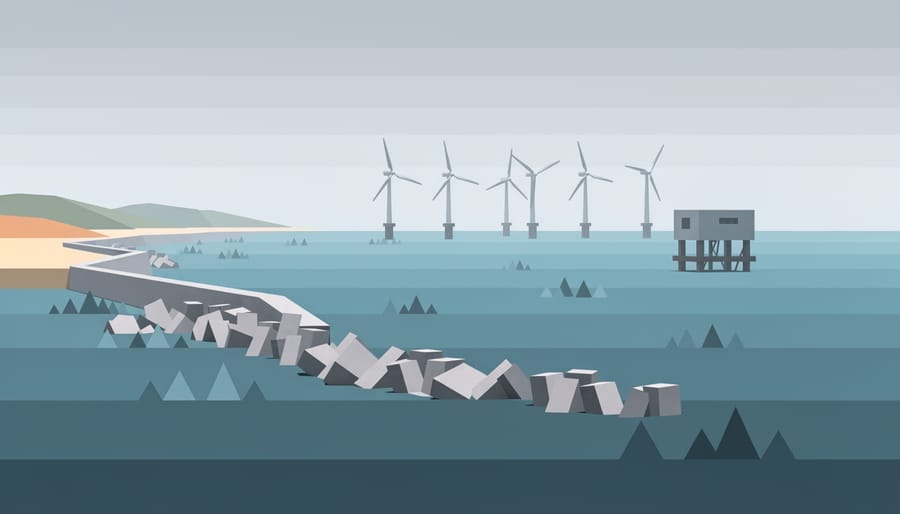
Understanding climate irreversibility reshapes how organizations plan, invest, and operate. For policy makers and industry leaders, this science translates into three concrete imperatives: immediate adaptation measures for changes already locked in, aggressive mitigation to prevent crossing additional thresholds, and accelerated investment in sustainable energy infrastructure.
Adaptation planning now operates under different assumptions. Sea level rise, already irreversible over hundreds to thousands of years, requires coastal infrastructure redesign and relocation strategies spanning decades. Energy sector professionals must factor in shifting weather patterns when siting renewable installations or planning grid resilience. Once warm water coral reefs cross their thermal tipping point at current 1.4°C warming, fisheries and coastal protection strategies must adapt to that permanent loss rather than assume recovery.
Mitigation urgency intensifies when tipping points enter the equation. The IPCC’s projection that 1.5°C warming will be reached within the next 20 years creates a compressed timeline for action. Industry leaders face a stark calculation: emissions reductions implemented today determine whether Greenland’s ice sheet crosses its 1.5°C melting threshold or monsoon systems destabilize. The difference between incremental change and systemic transformation becomes the difference between managing a crisis and triggering cascading, irreversible shifts.
This urgency drives the business case for rapid sustainable energy transition. Waiting for gradual market forces risks crossing thresholds between 1°C and 2°C of warming where multiple systems tip simultaneously. Energy sector investment decisions made this decade will either accelerate decarbonization fast enough to avoid these thresholds or lock in emissions trajectories that breach them. The 20-30 year stabilization period after emissions peak means that deployment speed matters as much as technology choice.
For professionals shaping energy policy and infrastructure, irreversibility science removes the luxury of incremental approaches. Each year of delayed action narrows the window for preventing additional tipping points, making bold commitments to renewable energy, grid modernization, and fossil fuel phase-out not aspirational but essential responses to the timeline the science reveals.
Coalition Perspectives: Turning Knowledge Into Action
Understanding tipping point science is one thing. Translating that urgency into coordinated action is another. Across Northern Europe, coalitions of researchers, policymakers, and energy companies are demonstrating how cross-sector partnerships can accelerate the transition before additional thresholds are breached.
Denmark’s offshore wind sector offers a template. Government-backed research centers work directly with turbine manufacturers and grid operators, compressing the timeline from prototype to deployment. This isn’t abstract climate policy, it’s engineers and academics solving voltage stability challenges together, then training technicians to maintain the infrastructure at scale. The model reduces friction between innovation and implementation, addressing the 20-30 year stabilization window the IPCC identifies.
In Sweden, forest bioenergy initiatives bring together forestry scientists, power utilities, and regional governments to balance carbon sequestration with sustainable fuel production. The collaboration addresses a dual challenge: maintaining forest ecosystems that store carbon while meeting energy demands during the transition away from fossil fuels. Joint research programs evaluate which management practices preserve forest resilience as warming approaches the 1.5°C threshold linked to tipping points.
Germany’s Energiewende demonstrates how policy frameworks can mobilize private capital toward green technology when backed by clear regulatory commitments. Industrial partnerships between automotive manufacturers and battery researchers have accelerated electric vehicle adoption, while utility-scale storage projects integrate intermittent renewables into baseload power. The initiative couples emissions reduction targets with workforce retraining programs, recognizing that technological shifts require human capacity building.
These coalitions share common elements: transparent data sharing between sectors, regulatory environments that reward innovation, and explicit recognition that the tipping point timeline demands compressed development cycles. They treat climate science not as a warning to file away, but as a design constraint that shapes investment priorities and collaborative structures. The coral reef dieback at current 1.4°C warming serves as a reminder that some thresholds are already behind us, motivation to prevent the next cascade.
Common Questions About Climate Irreversibility
What is a tipping point?
A tipping point is a threshold beyond which small changes can lead to significant and often irreversible change. These critical thresholds represent moments when Earth systems shift from one stable state to another, often with cascading effects that become self-reinforcing.
How close are we to climate tipping points?
We are already experiencing some tipping points firsthand. At the current 1.4°C of global warming, warm water coral reefs are crossing their thermal tipping point and experiencing unprecedented dieback, demonstrating that certain thresholds have already been breached.
Could climate tipping points be reached between 1°C and 2°C of warming?
Yes. Recent IPCC assessments suggested that tipping points could be reached between 1°C and 2°C of warming, meaning we are operating within the danger zone right now. For context, a 1.5°C increase in average temperatures could be the threshold at which Greenland’s ice sheet melting would become irreversible.
When will climate change be irreversible?
Some aspects are already irreversible: changes like continued sea level rise are locked in over hundreds to thousands of years. The IPCC says global temperature is expected to reach or exceed 1.5°C of warming within the next 20 years, which will trigger additional irreversible changes. However, it could take 20-30 years to see global temperatures stabilize even after emissions peak, meaning the window to prevent further tipping points from being crossed is narrowing rapidly.
These questions reflect the concerns of professionals grappling with climate risk in their planning horizons. Understanding that irreversibility operates on multiple timescales helps clarify why both immediate emission reductions and long-term adaptation strategies matter. The coral reef threshold we’ve already crossed serves as a sobering example of what happens when we delay action past critical points, while the projected 1.5°C threshold within two decades underscores the urgency facing energy sector decision-makers and policy architects today.
The distinction between triggering a tipping point and experiencing its full effects matters for strategic planning. When we talk about ice sheet collapse becoming irreversible at 1.5°C, we’re discussing a commitment to centuries of sea level rise, not an overnight event. This layered understanding of irreversibility transforms abstract climate science into concrete planning parameters for infrastructure, investment, and innovation timelines.
The science is clear: we are operating within a narrow window where our choices will determine which climate tipping points we cross. With global temperatures already at 1.4°C above pre-industrial levels and the 1.5°C threshold projected within the next 20 years, the urgency is measurable and immediate. Some changes, like continued sea level rise, are already irreversible over hundreds to thousands of years. Yet understanding these thresholds is not a reason for despair; it is a catalyst for decisive action.
Knowledge of tipping points transforms abstract climate projections into concrete timelines that demand response. When we recognize that critical systems could destabilize between 1°C and 2°C of warming, and that temperature stabilization will take 20 to 30 years after emissions peak, the path forward sharpens: accelerate the transition to sustainable energy systems now, before additional thresholds are breached.
This is where collaboration becomes essential. No single sector, government, or institution can address tipping point risks alone. By connecting researchers, policy makers, industry leaders, and energy professionals, we create the conditions for solutions that match the scale of the challenge. The transition to renewable energy, the development of carbon-neutral technologies, and the implementation of adaptive strategies all gain momentum when diverse expertise converges with shared purpose.
The clock is counting down to critical thresholds, but our response is not predetermined. Understanding when irreversibility occurs empowers us to act before it does.