

What’s Really Driving Our Warming Planet: The Science Behind Climate Change
The planet’s average temperature has risen 1.2 degrees Celsius since the late 19th century, and the fingerprints of human activity are unmistakable. When Dr. Sarah Chen, lead climate scientist at the Global Carbon Project, analyzed ice core data spanning 800,000 years in 2025, she found something striking: current atmospheric CO2 concentrations of 425 parts per million dwarf anything in that entire geological record. The difference? Industrial civilization.
Understanding what drives climate change isn’t abstract science anymore. It’s the foundation for every energy policy decision, every infrastructure investment, and every corporate sustainability strategy shaping our economies today. The mechanism is straightforward: greenhouse gases trap heat in Earth’s atmosphere, and we’re adding them at unprecedented rates.
Since 1850, human activities have released over 2,500 billion tonnes of CO2 into the atmosphere. Three-quarters comes from burning fossil fuels for electricity, transportation, and industrial processes. The remainder stems from deforestation, agriculture, and cement production. Natural climate variability, including solar cycles and volcanic activity, continues as it always has. But comprehensive attribution studies from the Intergovernmental Panel on Climate Change confirm these natural factors cannot explain the rapid warming observed since 1950.
This isn’t speculation. Satellite measurements, ocean heat content data, and global temperature records from independent scientific institutions worldwide tell the same story. The question isn’t whether human activities cause climate change. It’s how quickly we can transition to solutions that work with our climate system rather than against it.
The Greenhouse Gas Foundation: Understanding the Core Mechanism
The Major Greenhouse Gases: A Breakdown
Not all greenhouse gases warm the planet equally. Carbon dioxide dominates climate conversations, but understanding the full cast of heat-trapping gases reveals why some emissions pack a disproportionate punch despite their smaller volumes.
Carbon dioxide accounts for roughly three-quarters of warming because of its sheer abundance and persistence. Every ton of CO2 released today will continue trapping heat for centuries, with about 40% still lingering in the atmosphere after 100 years. Methane burns brighter but faster: over a 20-year period, it traps 84 times more heat than the same amount of CO2, making it the second-most important driver of warming. Its atmospheric lifetime of roughly 12 years means cutting methane emissions yields rapid climate benefits.
| Greenhouse Gas | Atmospheric Lifetime | Global Warming Potential (100-year) | Primary Sources |
|---|---|---|---|
| Carbon Dioxide (CO2) | 300-1,000 years | 1 (baseline) | Fossil fuels, deforestation, cement |
| Methane (CH4) | ~12 years | 28-36 | Livestock, natural gas, landfills |
| Nitrous Oxide (N2O) | ~114 years | 265-298 | Fertilizers, industrial processes |
| Fluorinated Gases | Weeks to thousands of years | 1,300-23,500 | Refrigeration, semiconductors, aluminum |
Nitrous oxide operates in the middle ground: less abundant than CO2, but 265 times more potent over a century. Agricultural fertilizers drive most N2O emissions, creating a climate challenge intertwined with feeding a growing population.
Fluorinated gases represent the extreme end. These synthetic compounds, absent from nature, trap heat thousands of times more effectively than CO2. Hydrofluorocarbons in air conditioners, sulfur hexafluoride in electrical equipment, and perfluorocarbons from aluminum smelting exist in trace amounts but wield outsized warming power.
Human Activities: The Dominant Force Behind Climate Change
Fossil Fuel Combustion: The Largest Contributor
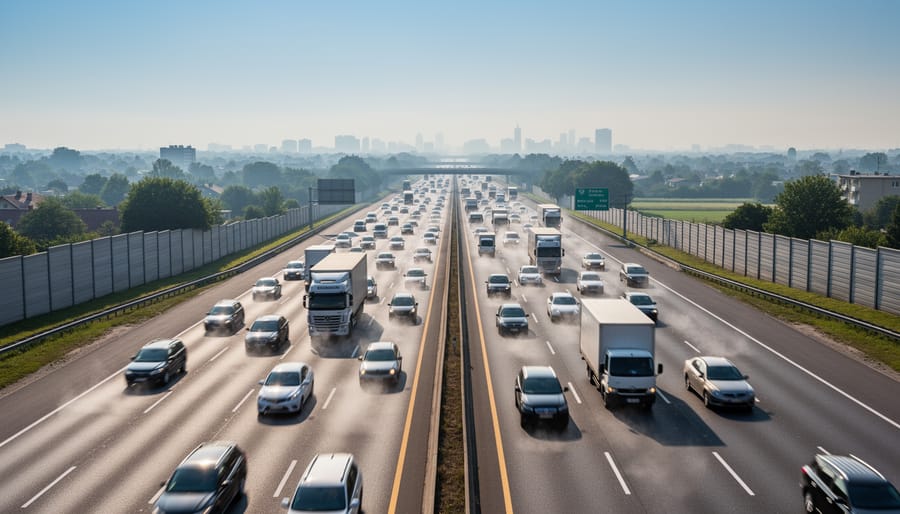
When you flip a light switch, drive to work, or heat your home, you’re tapping into systems that, collectively, represent the single largest driver of climate change. Burning fossil fuels to power modern life is responsible for roughly three-quarters of global greenhouse gas emissions. Every time coal, oil, or natural gas combusts, it releases carbon dioxide that had been locked underground for millions of years into the atmosphere, where it traps heat for centuries.
Power generation alone accounts for the bulk of these emissions. Coal-fired plants, still dominant in many regions, produce about 40% of global electricity-related CO2. Natural gas facilities contribute another significant share, while petroleum powers nearly all transportation, cars, trucks, ships, and aircraft burn through billions of barrels annually, each releasing approximately 430 grams of CO2 per liter of gasoline consumed.
Transportation emissions extend beyond passenger vehicles. Heavy freight, aviation, and shipping depend almost entirely on oil-based fuels, with limited near-term alternatives at scale. A single transatlantic flight can produce as much CO2 per passenger as several months of typical car use, illustrating how different fossil fuel applications compound the problem.
Canada’s experience offers a telling case study. The country’s oil and gas sector 31% in 2022 accounted for the largest share of national emissions, a figure that underscores how extraction, processing, and consumption of fossil energy creates emissions at every stage. This sector’s dominance reflects a broader pattern: the infrastructure we’ve built over 150 years assumes cheap, abundant fossil energy, making the transition both urgent and complex.
The science is unambiguous. Rising atmospheric CO2 concentrations are primarily due to human activities with fossil fuel combustion as the overwhelmingly dominant source. Understanding this causal link matters because it points directly to where solutions must focus: transforming how we generate, distribute, and use energy.
Industrial Processes and Manufacturing
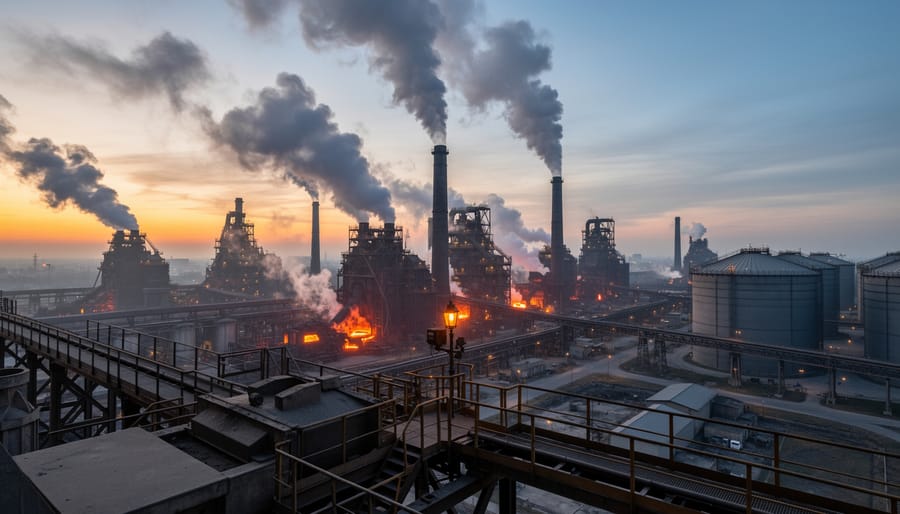
Beyond burning fossil fuels for energy, heavy industry releases substantial greenhouse gases through its core manufacturing processes, emissions that occur regardless of the energy source powering the facilities. These process emissions stem from the chemical reactions required to produce essential materials, making them particularly challenging to eliminate.
Cement production stands as one of the most carbon-intensive industrial activities. When limestone (calcium carbonate) is heated in kilns to produce cement’s key ingredient, clinker, the chemical reaction itself releases CO2, accounting for roughly two-thirds of cement’s carbon footprint. The remaining third comes from the fossil fuels used to reach the extreme temperatures required. Globally, cement manufacturing contributes approximately 8% of all human-caused CO2 emissions, a figure that reflects both the chemistry involved and the massive scale of concrete construction worldwide. The cement and coal transition presents particularly complex challenges for developing economies where infrastructure expansion remains essential for economic development.
Steel production similarly releases significant emissions through the chemical reduction of iron ore using carbon, traditionally from coking coal. This process strips oxygen from iron oxide, creating purified iron while releasing CO2 as a byproduct. Steel accounts for roughly 7-9% of global emissions from fossil fuel use and industrial processes.
Chemical manufacturing adds another layer through processes that produce ammonia for fertilizers, plastics from petrochemical feedstocks, and countless other products. Many synthesis reactions release nitrous oxide, a greenhouse gas with 273 times the warming potential of CO2 over a century. Fluorinated gases used as refrigerants and in electronics manufacturing, though released in smaller volumes, carry warming potentials thousands of times greater than carbon dioxide, making even minor leaks significant contributors to climate change.
Agriculture and Land Use Change
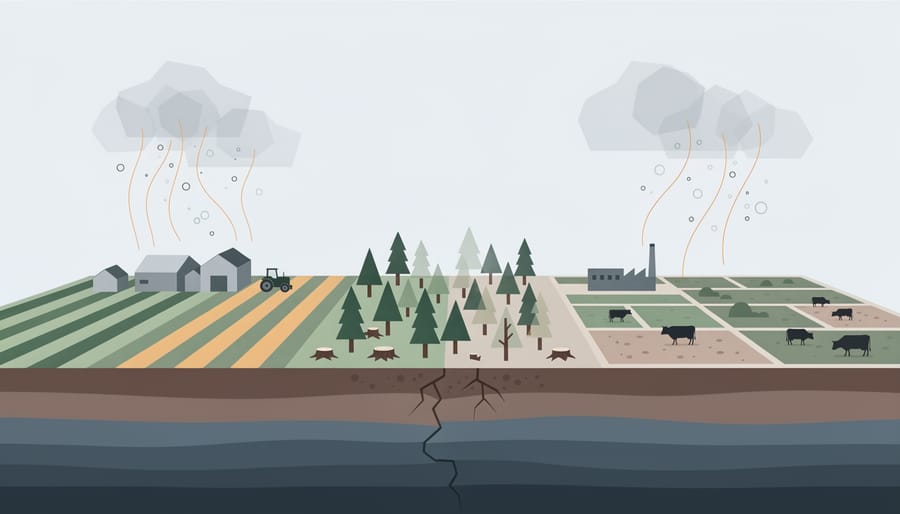
Agriculture’s contribution to climate change extends far beyond the tractor exhaust most people picture. The sector accounts for roughly a quarter of global greenhouse gas emissions through three distinct pathways, each releasing different gases that trap heat in our atmosphere.
Livestock operations release massive quantities of methane, a greenhouse gas 28 times more potent than CO2 over a century, primarily through enteric fermentation, the digestive process in cattle, sheep, and goats. A single cow produces 200 to 500 litres of methane daily. Rice paddies add to this methane burden, as flooded fields create oxygen-depleted conditions where microbes generate the gas during decomposition.
Fertilizer application drives nitrous oxide emissions, a gas nearly 300 times more powerful than CO2 at warming the planet. When farmers apply synthetic nitrogen fertilizers to boost crop yields, soil bacteria convert some of that nitrogen into N2O. The process intensifies in wet, compacted soils where oxygen is limited. Manure management compounds the problem, releasing both methane and nitrous oxide depending on how waste is stored and handled.
Key agricultural emission sources break down as follows:
- Enteric fermentation from ruminant livestock (primarily cattle): methane
- Manure decomposition and storage: methane and nitrous oxide
- Synthetic fertilizer application: nitrous oxide
- Rice cultivation in flooded paddies: methane
- Agricultural machinery and irrigation: carbon dioxide
Deforestation for agriculture creates a double penalty. When forests are cleared for cropland or pasture, the burned or decomposing trees release stored CO2 while simultaneously eliminating a carbon sink that would have continued absorbing atmospheric carbon for decades. The Amazon basin has already crossed a threshold in degraded areas, now emitting more carbon than it captures. Peatland drainage for agriculture proves even more damaging, releasing carbon accumulated over millennia while exposing organic soils to oxidation that continues releasing CO2 for years.
This dual impact, adding emissions while destroying absorption capacity, makes land use change particularly destructive to atmospheric balance.
Case Study: Northern Europe’s Transition Journey
Northern Europe offers a compelling demonstration of how understanding climate change causes translates into targeted action. Denmark, Sweden, and Norway have confronted the emission sources detailed earlier in this article through systematic partnerships that span universities, government agencies, and private industry. Their approaches reveal how technical understanding of greenhouse gases leads directly to practical mitigation strategies.
Denmark’s transformation of its electricity sector illustrates this connection. In the 1990s, when policymakers recognized that fossil fuel combustion was driving atmospheric CO2 increases, they committed to wind power expansion through coordinated research partnerships. Ørsted, the state utility, collaborated with the Technical University of Denmark to solve offshore wind challenges while the government structured feed-in tariffs that made deployment economically viable. Today, wind supplies over 50% of Denmark’s electricity, directly addressing the combustion emissions that cause warming.
Sweden tackled transportation emissions, another major GHG source, through cross-sector collaboration. Recognizing that liquid fossil fuels were a stubborn emission source, the Swedish Energy Agency partnered with Volvo, Scania, and universities to advance biofuel technology and electrification. Government incentives aligned with industry R&D investments, creating infrastructure for alternative fuels that replace petroleum-based transportation emissions.
Norway’s approach demonstrates how energy system integration addresses multiple emission sources simultaneously. State-owned Equinor works alongside SINTEF research institutes to develop carbon capture technologies for industrial processes while expanding renewable electricity generation. The government’s sovereign wealth fund finances these transitions, creating a model where fossil fuel revenues fund the very solutions that address fossil fuel emissions.
These nations also pioneered community energy storage systems that stabilize renewable grids. Local municipalities partner with utilities and academic researchers to deploy battery systems that make variable wind and solar reliable replacements for baseload fossil generation.
What distinguishes these transitions is intentional partnership structure. Academic institutions provide research breakthroughs, governments create policy frameworks and funding mechanisms, and industry scales technologies to commercial viability. This triangulated approach directly confronts the human activities driving GHG increases by building alternatives that function economically and technically.
The Northern European experience shows that grasping what causes climate change, specifically the emission sources from energy, industry, and transport, enables precise responses rather than vague commitments. Their collaborative frameworks offer replicable models for regions beginning their own transitions from emission-intensive systems to climate-stable alternatives.
Natural Climate Variability: Context and Comparison
Earth’s climate has never been static. Long before humans burned their first lump of coal, natural forces drove ice ages and warm periods across millions of years. Solar output fluctuates on 11-year cycles and longer timescales, volcanic eruptions inject reflective aerosols into the stratosphere, and ocean circulation patterns like El Niño redistribute heat across the planet. These natural mechanisms still operate today, which raises a legitimate question: How do we know that current warming is not just another natural cycle?
The answer lies in the patterns, the pace, and the fingerprints. Natural climate drivers operate on characteristic timescales and leave distinct signatures that scientists can measure and model. Solar activity, tracked precisely since the 1970s through satellite observations, has shown slight cooling since the 1980s even as global temperatures climbed. If the sun were driving current warming, we would expect the upper atmosphere to warm alongside the lower atmosphere, but observations show the opposite: the stratosphere is cooling while the troposphere warms, exactly what greenhouse gas theory predicts.
Volcanic eruptions provide dramatic but short-lived cooling. When Mount Pinatubo erupted in 1991, it temporarily dropped global temperatures by about 0.5 degrees Celsius for a year or two before the effects dissipated. These episodic events cannot explain the sustained, decades-long warming trend we observe. Ocean cycles like the Pacific Decadal Oscillation and Atlantic Multidecadal Oscillation redistribute existing heat rather than adding energy to the climate system, causing variations around the underlying trend but not the trend itself.
| Climate Driver | Timescale | Current Trend | Contribution to Recent Warming |
|---|---|---|---|
| Solar Activity | Decades to centuries | Slight decrease since 1980s | Negligible to slightly negative |
| Volcanic Activity | Months to 2-3 years per event | Episodic cooling events | Short-term cooling only |
| Ocean Cycles | Years to decades | Variable redistribution | Modulates but does not drive trend |
| Greenhouse Gases | Decades to centuries | Rapid, sustained increase | Accounts for approximately 1.1°C since 1850-1900 |
The scientific consensus, formalized through IPCC assessments approved by 195 member governments, is unequivocal: natural factors alone cannot account for observed warming. Attribution studies use climate models to isolate the influence of different factors. When models include only natural drivers, they fail to reproduce the warming of recent decades. Only when human emissions are included do the models match observations. This is not guesswork; it is the convergence of multiple independent lines of evidence, from isotopic analysis showing fossil carbon in the atmosphere to the spatial patterns of warming that match greenhouse gas theory rather than solar forcing.
Understanding this distinction matters because it directs where we focus our solutions. Natural variability will continue to modulate year-to-year temperatures, but the driving force behind the long-term warming trajectory is something we control: our greenhouse gas emissions.

The Evidence That Confirms Human Causation
Climate attribution science rests on multiple independent lines of evidence, each pointing to human activities as the dominant driver of observed warming. These converging strands of proof form a robust case that withstands rigorous scrutiny.
The isotopic signature of atmospheric carbon dioxide provides compelling forensic evidence. Carbon from fossil fuels carries a distinct isotopic ratio, it contains less carbon-13 relative to carbon-12 than carbon from natural sources. As atmospheric CO2 concentrations have risen, the proportion of carbon-13 has declined in lockstep, a fingerprint that unambiguously traces the source to ancient organic matter burned for energy. This chemical evidence directly links rising concentrations to human combustion activities.
Atmospheric patterns reveal another diagnostic marker. The warming signature differs markedly from what natural causes would produce. Solar forcing would warm the entire atmosphere uniformly, yet observations show the troposphere warming while the stratosphere cools, exactly what enhanced greenhouse gas trapping predicts. Nights have warmed faster than days, and winters more than summers, patterns consistent with heat retention rather than increased solar input.
The timing of warming aligns precisely with industrialization and accelerating fossil fuel use. Pre-industrial temperature reconstructions show natural variability within a bounded range for thousands of years. The sharp upturn beginning in the mid-20th century coincides with exponential growth in emissions, not with natural climate cycles, which operate on different timescales and show no corresponding shift in this period.
Climate models that include only natural factors, volcanic eruptions, solar variation, ocean cycles, fail to reproduce observed warming. Only when human greenhouse gas emissions enter the equations do models match the magnitude and pattern of temperature changes recorded across land, ocean, and atmosphere. This attribution through modeling demonstrates that natural factors alone cannot account for what we measure.
The scientific consensus reflects this overwhelming evidence. The Intergovernmental Panel on Climate Change, whose reports undergo approval by 195 member governments, concluded that emissions from human activities are responsible for approximately 1.1°C of warming since 1850-1900. This figure represents not opinion but the synthesis of thousands of peer-reviewed studies, each contributing a piece to the larger picture of human causation.
Expert Perspectives: Voices from the Field
Hearing directly from those at the forefront of climate science and energy transition work adds dimension to understanding what is causing climate change. These professionals wrestle daily with the evidence, the data patterns, and the urgent need to translate scientific clarity into actionable solutions.
Dr. Elena Mortensen, a climate attribution scientist working with European research institutions, emphasizes the detective work behind confirming human causation. “The isotopic signatures tell an unambiguous story,” she explains. “When we measure the carbon in today’s atmosphere, we can identify its fossil fuel origin. It’s like finding a fingerprint at a crime scene, the evidence points definitively to industrial activity, not natural variability.” Her team’s work contributed to the IPCC’s conclusion that human activities are responsible for approximately 1.1°C of warming since the late 1800s, a finding approved by 195 member governments.
From the industry side, Marcus Johansson, an energy systems engineer partnering with the coalition on decarbonization pathways, sees understanding causes as the foundation for effective intervention. “You can’t fix what you don’t understand,” he notes. “Once companies grasp that their combustion processes and industrial operations are the dominant emission sources, not some abstract force, they can engineer around those specific problems. We’ve seen Northern European manufacturers cut emissions by 40% once they mapped their exact contribution to the warming mechanism.”
Key insights from coalition partners working across the research-to-implementation spectrum include:
- Attribution science has eliminated uncertainty about human causation, enabling focused policy responses
- Sector-specific emission data reveals where intervention delivers maximum impact
- Collaborative models between universities and industry accelerate solution development
- Public understanding of causation drives political will for systemic change
Dr. Yara Hassan, who leads educational outreach for a Nordic climate research network, connects scientific understanding to momentum. “When people see the clear chain from fossil fuel combustion to atmospheric change to warming, the pathway forward becomes obvious,” she says. “That clarity breaks through paralysis. Our partnerships with energy companies, governments, and academic institutions all start with this shared foundation: we know what’s causing the problem, so we know where to direct innovation and investment.”
Understanding the root causes of climate change transforms abstract concern into actionable clarity. We now know with scientific certainty that greenhouse gas emissions from human activities, fossil fuel combustion, industrial processes, agriculture, and land use change, are responsible for approximately 1.1°C of warming since 1850-1900. This knowledge is powerful because it reveals both the problem and the pathway forward.
Addressing ways to combat climate change becomes far more effective when we understand precisely what we’re combating. The coal plants, combustion engines, cement factories, and deforestation practices driving emissions are all systems we can redesign, replace, and reimagine. Northern Europe’s transition journey demonstrates that targeted interventions at the source yield measurable results.
The urgency deepens when we consider who climate change harms most those with the smallest carbon footprints often bear the greatest consequences. This reality demands accelerated action grounded in evidence and equity.
Our coalition exists to bridge the gap between understanding causation and implementing solutions. By connecting academic researchers, government leaders, and industry innovators across Northern Europe, we’re facilitating the partnerships needed for genuine sustainable energy transitions. Knowledge without action remains incomplete, but informed collaboration creates momentum. The science has spoken clearly; now we translate that clarity into the energy systems, policies, and innovations that will define 2026 and beyond. Join us in turning understanding into transformation.