
Albedo is Reshaping How We Think About Solar Energy and Climate
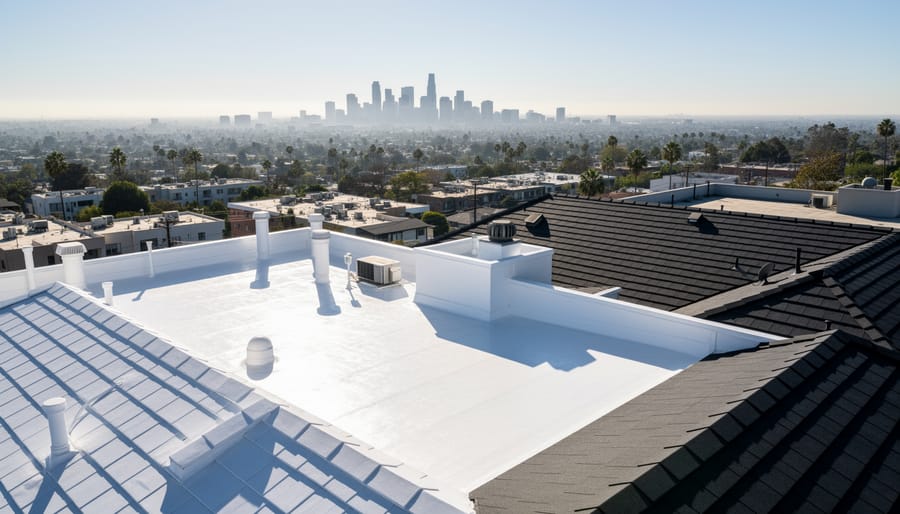
A white rooftop in Los Angeles reflects up to 80% of incoming sunlight back into space, while a standard dark roof absorbs nearly the same percentage. This difference, quantified by a measurement called albedo, is reshaping how energy professionals approach everything from building design to utility-scale solar placement. The concept is deceptively simple: albedo represents the fraction of solar radiation reflected by a surface, expressed on a scale from 0 (total absorption) to 1 (complete reflection). Yet its implications ripple through climate modeling, urban heat management, and renewable energy optimization in ways that demand attention from anyone working at the intersection of energy and environment.
Dr. Sarah Chen, a climate physicist at MIT, discovered this firsthand while consulting for a solar farm developer in Arizona. The project team initially selected a site based purely on solar irradiance data. But when Chen analyzed the surrounding desert’s albedo values, ranging from 0.25 to 0.40 depending on soil composition, she identified how ground reflection was unexpectedly boosting panel efficiency by 3-7% through additional diffuse radiation. That finding changed the project’s financial projections and sparked a broader question: why aren’t more energy professionals factoring albedo into their planning?
The answer increasingly matters because albedo sits at the nexus of challenges facing the sector today. Urban heat islands cost U.S. cities an estimated $6.7 billion annually in excess cooling energy. Solar installations must account for how surface reflectance affects both panel performance and local temperature. Climate models depend on accurate albedo measurements to project future warming scenarios. As these domains converge, understanding albedo transitions from academic curiosity to practical necessity for professionals designing our energy future.
Understanding Albedo: The Science Behind Surface Reflectivity
From Ice Sheets to Solar Farms: Albedo Across Surfaces
The range of albedo values across natural and human-made surfaces reveals why energy professionals need to consider reflectivity in project planning. Understanding these differences helps assess both the performance implications and environmental footprint of renewable infrastructure.
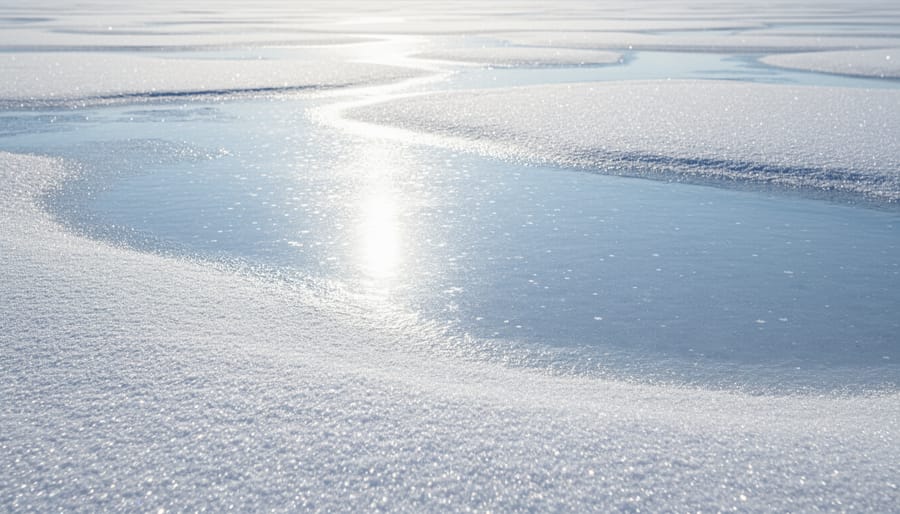
Fresh snow tops the albedo scale at 0.8 to 0.9, reflecting most of the sun’s power back to space. This high reflectivity explains why Arctic regions play an outsized role in global climate regulation. At the other extreme, water bodies absorb nearly all incoming radiation with albedo values around 0.06, making oceans significant heat sinks.
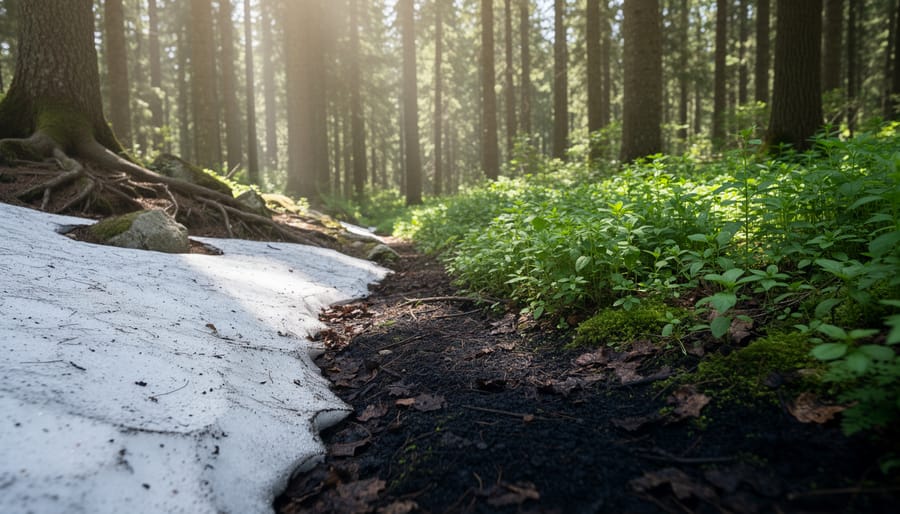
Between these extremes lie the surfaces that matter most for energy siting decisions. Desert terrain, often targeted for utility-scale solar development, reflects 0.3 to 0.4 of incoming radiation. Forests absorb more energy with albedo values of 0.1 to 0.15, while grasslands and croplands typically fall between 0.15 and 0.25 depending on vegetation density and soil moisture.
| Surface Type | Albedo Range | Energy Absorption |
|---|---|---|
| Fresh snow/ice | 0.8-0.9 | Low (10-20%) |
| Desert sand | 0.3-0.4 | Moderate (60-70%) |
| Forest canopy | 0.1-0.15 | High (85-90%) |
| Solar panel arrays | 0.05-0.1 | Very high (90-95%) |
| Water bodies | 0.06 | Very high (94%) |
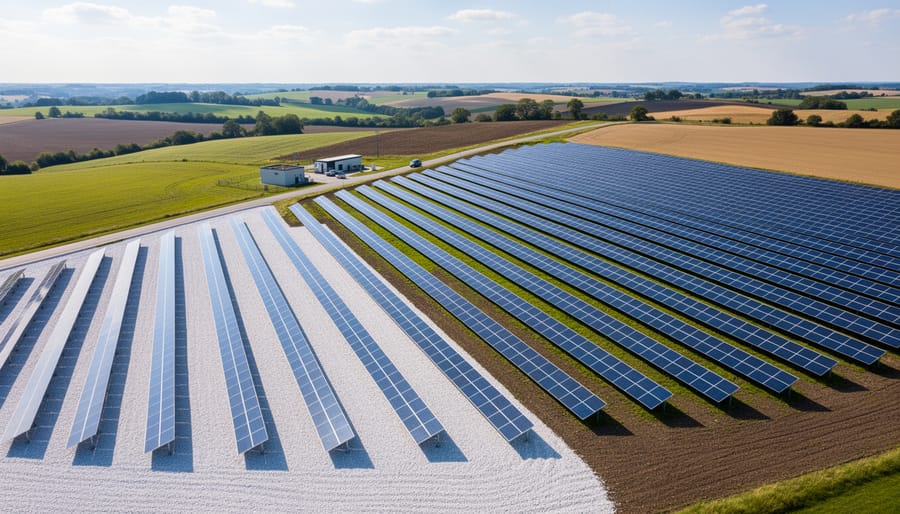
Solar panel arrays rank among the lowest-albedo surfaces at 0.05 to 0.1, designed specifically to maximize absorption for electricity generation. This dramatic reduction in surface reflectivity when installing solar farms on higher-albedo terrain like deserts or grasslands creates local heating effects that project developers must now account for in environmental assessments, though claims about the magnitude of these effects often lack no supporting evidence from rigorous field studies.
The albedo of renewable infrastructure matters beyond the panels themselves. Access roads, substations, and other supporting structures each modify local reflectivity, creating a patchwork of surfaces that collectively alter how a site interacts with incoming solar radiation.
Why Energy Professionals Are Paying Attention Now
Lessons from Canada’s Renewable Energy Operators
At Canada’s sixth annual CanREA Operators Summit on February 11-12, 2026, more than 350 operators, asset managers, technicians, and service providers managing wind, solar, and energy storage facilities gathered in Toronto for what organizers described as Canada’s premier conference devoted to renewable energy operations and maintenance. While the formal agenda focused on established operational challenges, corridor conversations and workshop discussions increasingly turned to a less traditional topic: how surface reflectivity affects both site performance and environmental assessment processes.
Operators managing solar installations in Ontario and Alberta reported fielding questions from local planning authorities about albedo changes during environmental reviews. These weren’t theoretical inquiries. Municipalities wanted to understand whether replacing agricultural land or natural grassland with low-albedo solar arrays would measurably affect local surface temperatures, particularly in communities already experiencing heat stress during summer months.
The challenge extends beyond regulatory compliance. Several operators noted that albedo considerations now appear in stakeholder engagement sessions, where community members raise concerns about land-use changes and microclimate effects. One operator managing a proposed 200-megawatt solar project in southern Alberta described spending substantial time explaining the difference between panel surface reflectivity and the overall site albedo, which includes spaces between panel rows where vegetation often establishes.
Wind farm operators face different questions. In northern regions where snow cover persists for months, turbine foundations and access roads create dark patches against reflective backgrounds. While the footprint is relatively small compared to the turbine spacing, environmental monitors have begun documenting these albedo modifications in wildlife impact studies, particularly where infrastructure intersects with caribou habitat.
Storage facility managers reported the least albedo-related scrutiny, though several noted that battery enclosure materials and site surfacing choices now warrant consideration in integrated renewable energy parks where solar, wind, and storage infrastructure coexist. The operational reality is that what began as an academic consideration has become a practical variable in site design, regulatory navigation, and community relations.
Albedo Effects on Solar Energy Infrastructure
The Local Cooling Debate: Solar Farms and Microclimates
The question of whether solar farms warm or cool their immediate surroundings has moved from academic curiosity to practical concern for operators and communities. When solar panels replace natural vegetation or bare ground, they lower the surface albedo, absorbing more sunlight that would otherwise reflect away. This absorption creates heat at the panel surface, but the panels also shade the ground beneath them, preventing soil from heating as intensely as it would under direct sun. The net effect depends on what the panels replaced, how they’re mounted, and local conditions affecting air circulation.
Recent field studies have documented both outcomes. Some large installations over grassland or crop fields show slight localized warming during daylight hours, particularly in summer when panel temperatures can exceed 60°C. Other projects, especially those on previously bare or dark soil, demonstrate modest cooling effects because the shaded ground beneath arrays remains cooler than it would otherwise. The height of panel mounting matters: ground-mounted systems with adequate clearance allow airflow that moderates temperature, while low-profile installations trap more heat.
These microclimate shifts influence more than environmental assessments. Operators tracking performance have noted that local temperature variations affect winter vs summer output patterns differently than regional climate alone would predict. Community concerns about agricultural land conversion now often include questions about whether solar farms will alter growing conditions on adjacent parcels or affect local humidity.
For site selection, this means baseline albedo measurements and microclimate modeling are becoming standard practice. Projects that incorporate vegetation beneath and around arrays, maintaining higher albedo surfaces while generating electricity, can address both performance optimization and stakeholder concerns about land-use change. The debate continues, but operators now recognize that surface reflectivity interacts with thermal management in ways that merit careful planning from the earliest design stages.
Albedo Management as a Climate Strategy
Urban Albedo: Cool Cities and Energy Savings
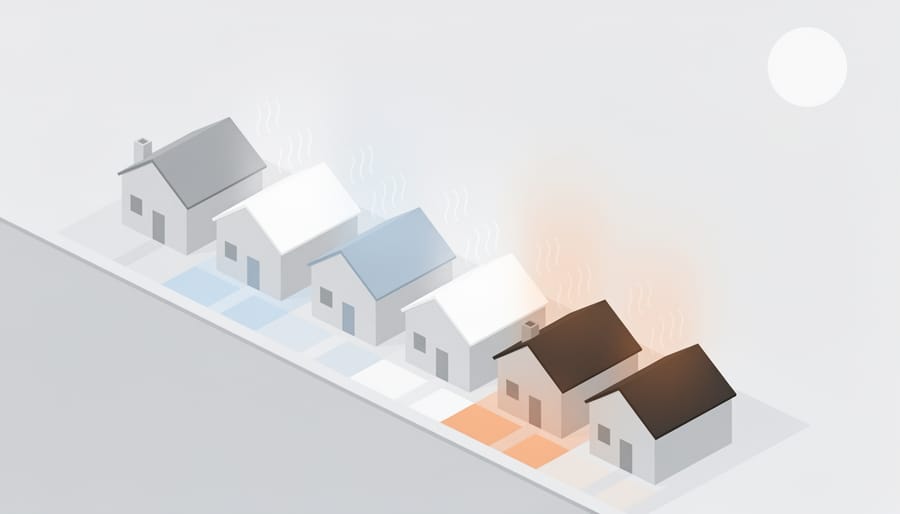
Cities worldwide are deploying high-albedo materials as a practical strategy to combat urban heat islands while simultaneously reducing energy consumption. Light-colored roofs, reflective pavements, and pale building facades can lower surface temperatures by 10-20°C compared to conventional dark materials, cutting air conditioning loads by 20-40 percent in hot climates. Los Angeles, for instance, has coated over 200 lane-miles of streets with reflective sealants that stay 6-8°C cooler than standard asphalt, directly reducing the cooling burden on adjacent buildings.
The energy savings extend beyond individual structures. When deployed at neighborhood scale, high-albedo surfaces reduce ambient temperatures across entire districts, lowering peak electricity demand during heat waves, the moments when grid strain is most acute. New York’s cool roof initiative, which has treated over 10 million square feet of rooftops, demonstrates how municipal programs can deliver measurable reductions in summer energy use while extending roof lifespan by limiting thermal stress.
For energy infrastructure, these benefits compound. Lower ambient temperatures improve the efficiency of rooftop solar panels, which lose 0.4-0.5 percent output for every degree Celsius above 25°C. Electrical transformers and distribution equipment also operate more efficiently in cooler microclimates, reducing transmission losses. Urban planners in Phoenix and Abu Dhabi now incorporate albedo targets into building codes, recognizing that reflective surfaces function as passive cooling infrastructure that requires no operational energy input.
The approach faces implementation challenges, initial costs run 10-30 percent higher than conventional materials, and some reflective pavements increase glare or degrade faster under heavy traffic. Yet as cities confront rising temperatures and peak cooling loads, albedo management offers a durable co-benefit: infrastructure that simultaneously reduces energy demand and improves urban resilience.
Case Study: Integrating Albedo Considerations in Northern Europe
In Sweden’s Norrbotten region, a 2024-2025 collaborative project demonstrated how albedo analysis could inform solar farm planning in high-latitude environments where snow cover persists for extended periods. The initiative brought together researchers from Luleå University of Technology, the Swedish Energy Agency, and a consortium of three solar developers planning installations across the region. Their stated objective was to quantify how seasonal albedo variations, particularly the high reflectivity of snow-covered ground, affected both energy yields and local environmental impacts.
The assessment methodology combined satellite-derived albedo data with ground-level measurements across twelve months. Researchers deployed spectroradiometers at proposed sites to capture hourly surface reflectivity changes, comparing vegetated terrain (baseline albedo 0.15-0.20 in summer, 0.75-0.85 under snow) against modeled post-installation values for bifacial solar arrays (0.05-0.10). They integrated these measurements with production simulations that factored in rear-side generation gains from reflected radiation. The team also conducted thermal imaging to track localized temperature effects where panels would replace snow-covered ground.
Results revealed a 12-18% increase in winter energy production for bifacial installations compared to initial monofacial projections, directly attributable to snow reflection. However, thermal analysis indicated that replacing high-albedo snow surfaces with lower-albedo panels could create localized warming of 0.8-1.2°C during peak winter months, a finding that shaped subsequent environmental impact discussions with regional authorities and Sami communities whose reindeer herding grounds overlapped proposed sites.
The project’s research and innovation approach influenced permitting outcomes. Developers adjusted site layouts to preserve snow-covered buffer zones between panel rows, balancing production gains with reduced albedo modification. Two of the three planned installations received expedited approvals in early 2025 after incorporating these mitigation measures and sharing albedo data transparently with stakeholders. The Swedish Energy Agency subsequently referenced this methodology in updated guidance for renewable energy projects in northern regions.
This case illustrates practical integration of albedo considerations without stalling project timelines. The collaborative structure, academia providing measurement expertise, government offering regulatory clarity, industry contributing operational knowledge, created a model that other northern European regions have since adapted for wind and solar planning on reflective landscapes.
Navigating the Challenges: What Energy Leaders Need to Know
Assessment Tools and Methodologies
Assessing albedo effects in renewable energy projects requires a combination of remote sensing, field measurements, and computational modeling. The tools available in 2026 span multiple scales and price points, making albedo analysis accessible to projects of varying scope.
Satellite platforms form the foundation of large-scale albedo assessment. NASA’s MODIS instruments provide global albedo data at 500-meter resolution, while the European Space Agency’s Sentinel-2 satellites offer finer detail at 10-20 meters, sufficient for analyzing individual solar farms or urban development zones. These datasets are freely available and allow project teams to establish baseline albedo values for proposed sites and track changes over time.
Ground-based measurement fills the gap between satellite coverage and site-specific needs. Pyranometers paired with albedometers measure incoming and reflected solar radiation directly, providing precise albedo values for specific surfaces. These instruments cost between $2,000 and $15,000 depending on accuracy requirements, making them practical for projects conducting environmental impact assessments or performance optimization studies.
Simulation platforms integrate albedo data into broader energy modeling. Tools like PVsyst and SAM now include bifacial panel models that account for ground albedo in yield predictions. For urban-scale analysis, platforms such as ENVI-met simulate how surface modifications affect local temperatures and energy demand, helping cities evaluate cool roof programs or reflective pavement installations.
The most robust approach combines these methodologies: satellite data for regional context, ground measurements for validation, and simulation models for scenario testing. This integrated strategy allows energy professionals to quantify albedo impacts with confidence, whether optimizing panel placement or assessing environmental tradeoffs.
Regulatory and Stakeholder Landscapes
Regulatory frameworks incorporating albedo considerations remain in early stages across most jurisdictions, though momentum is building. Environmental impact assessments in several European countries now request albedo data for large-scale renewable installations, particularly where projects affect high-reflectivity landscapes like grasslands or coastal areas. California’s energy commission has begun including surface reflectivity analysis in solar project reviews, examining both the albedo reduction from panel installation and potential benefits from reflective ground cover between arrays.
The technical nature of albedo presents unique communication challenges when engaging communities near proposed energy projects. Residents readily understand visual impact or noise concerns, but explaining how surface reflectivity affects local temperature requires different approaches. Successful projects use visual comparisons, showing albedo values for familiar surfaces like asphalt versus grass, and focus on tangible outcomes like microclimate effects rather than abstract reflectivity coefficients.
Energy developers are finding that proactive albedo assessments, even where not legally required, strengthen stakeholder relationships and streamline permitting. Projects that demonstrate consideration of reflectivity alongside traditional environmental factors often encounter less resistance. Several renewable energy associations now offer guidance documents helping members communicate albedo concepts to non-technical audiences, recognizing that regulatory requirements will likely expand as understanding of these effects deepens across the energy sector.
The conversations at Toronto’s CanREA Operators Summit this past February reflect a broader shift happening across the renewable energy sector. What was once a niche concern for climate scientists has become a practical consideration for the professionals designing, siting, and operating clean energy infrastructure. Albedo isn’t replacing traditional metrics like capacity factor or levelized cost, but it’s earning a place alongside them in how we evaluate project performance and environmental impact.
For energy professionals, this represents both a challenge and an opportunity. The challenge lies in incorporating another variable into already complex planning processes, from environmental impact assessments to stakeholder engagement. The opportunity is in the optimization potential that albedo awareness unlocks. Understanding how surface reflectivity affects local temperatures, energy yields, and broader climate dynamics allows for smarter decisions about where we place solar arrays, how we design them, and what materials we use in surrounding infrastructure.
The integration of albedo considerations aligns with the comprehensive approach that next-generation energy systems demand. Climate solutions don’t exist in isolation. A solar farm changes local albedo, which influences microclimate, which affects panel performance and community perception. These interconnections matter, and professionals who grasp them will design better projects.
This is where cross-regional knowledge exchange becomes valuable. Northern European projects facing snow cover teach us different lessons than desert installations in North Africa or urban rooftop arrays in Southeast Asia. Each geography offers insights about managing albedo alongside energy production. The professionals who incorporate surface reflectivity into their planning toolkit today are positioning themselves to deliver infrastructure that performs better and integrates more successfully into the landscapes and communities it serves.