
How Education Innovation Is Reshaping the Workforce for a Zero-Carbon Future
The renewable energy sector faces a critical bottleneck: a shortage of qualified workers equipped with both technical expertise and systems-thinking capabilities needed for the clean energy transition. By 2030, the global green economy will require 30 million additional workers, yet current educational frameworks remain largely anchored to fossil fuel paradigms. This gap represents not just an employment challenge, but a fundamental obstacle to achieving climate targets.
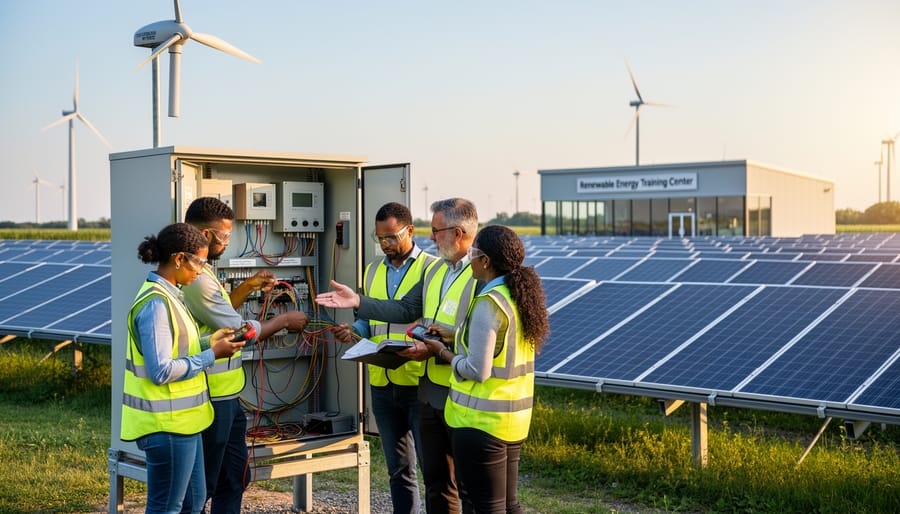
Education innovation has emerged as the strategic lever to bridge this divide. Forward-thinking institutions are abandoning traditional siloed curricula in favor of integrated learning models that combine engineering fundamentals with climate science, policy analysis, and entrepreneurship. At Germany’s Renewable Energy Academy, students design microgrids while studying energy economics and community engagement—producing graduates who understand that installing solar panels requires navigating regulatory frameworks as much as electrical systems.
The transformation extends beyond curriculum redesign. Technical colleges in Kenya are partnering directly with off-grid solar companies, creating apprenticeship pathways where students gain certifications while solving real electrification challenges in rural communities. These models prove particularly effective in regions where formal higher education remains inaccessible, demonstrating that innovation lies not in replicating Western academic structures but in creating contextually relevant learning ecosystems.
Yet success metrics must evolve alongside pedagogy. Rather than measuring enrollment numbers alone, leading programs track graduate placement in green industries, skill retention rates, and the multiplier effect of knowledge transfer within communities. When a wind technician trained through innovative programs returns home to establish local maintenance networks, education becomes infrastructure for the energy transition itself—a recognition that classroom walls matter far less than the competencies cultivated within and beyond them.
The Skills Gap Crisis in Sustainable Energy
What Traditional Education Gets Wrong About Energy Transition
Traditional educational institutions face a sobering reality: their energy programs are graduating students for an industry that no longer exists. According to Dr. Maria Chen, Director of Workforce Development at the International Renewable Energy Agency, “We’re still teaching grid management as if it’s 1985, while the industry desperately needs professionals who understand distributed energy resources, blockchain-enabled trading platforms, and AI-optimized storage systems.”
The problem stems from rigid curriculum approval processes that can take three to five years, while energy technologies evolve in months. Engineering programs continue emphasizing fossil fuel extraction techniques, with renewable energy courses relegated to electives rather than core requirements. A 2023 analysis of 150 universities across North America and Europe revealed that only 18% had updated their energy curricula within the past three years to reflect the accelerating transition.
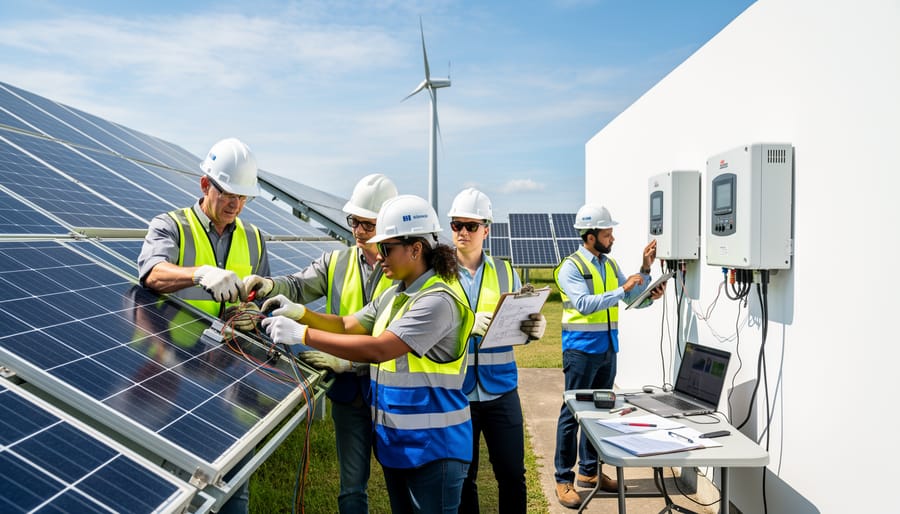
This institutional inertia creates a devastating skills gap. Industry leaders consistently report that recent graduates lack practical experience with solar installation, wind turbine diagnostics, and battery management systems. The disconnect extends beyond technical skills to soft competencies like circular economy thinking and stakeholder engagement for community energy projects.
Consider the case of Germany’s Energiewende initiative, where utilities struggled to find qualified professionals despite robust academic programs. The disconnect? Universities focused on theoretical knowledge while industry needed practical problem-solvers who could navigate regulatory frameworks, community opposition, and rapid technological change simultaneously. This mismatch costs both students and the planet valuable time we cannot afford to waste.
The Real-World Competencies Missing from the Talent Pipeline
The renewable energy sector faces a skilled workers shortage that extends beyond technical credentials. Hiring managers consistently report that graduates possess theoretical knowledge but lack the practical competencies demanded by rapidly evolving industries.
Systems-thinking abilities top the list of missing skills. Energy professionals increasingly need to understand how electrical grids, policy frameworks, and community needs intersect. Maria Rodriguez, workforce development director at a solar installation company in Arizona, explains: “We need technicians who can troubleshoot a malfunctioning inverter while understanding how their repair affects grid stability and customer contracts. That holistic perspective is rarely taught.”
Interdisciplinary collaboration capabilities present another critical gap. The energy transition requires professionals who can work across engineering, finance, social science, and policy domains. Yet traditional education silos persist. A wind farm project manager in Denmark notes that recent engineering graduates excel at turbine mechanics but struggle to communicate technical constraints to financial stakeholders or community liaisons.
Data literacy for sustainability applications also remains underdeveloped. Employers seek professionals who can analyze energy consumption patterns, interpret lifecycle assessments, and translate complex datasets into actionable recommendations. These applied analytical skills differ substantially from purely academic statistical training.
Adaptive problem-solving rounds out employer concerns. The green economy evolves too rapidly for curriculum to remain current. Professionals need frameworks for continuous learning and creative solution-finding rather than memorized procedures. As one renewable energy consultant observed: “We hire for learning agility, not just what someone knows today.”
Breaking the Mold: New Educational Models for Green Technology
Academia-Industry Partnerships That Actually Work
The most transformative education innovations emerge not from isolated academic towers or corporate training rooms, but from the fertile ground where these worlds intersect. Successful academia-industry partnerships are rewriting the playbook for energy workforce development, moving beyond transactional internship programs toward deeply integrated collaborations that benefit students, institutions, and companies alike.
At Denmark’s Technical University (DTU), the partnership with Ørsted demonstrates this evolution. Rather than simply offering student placements, the program embeds industry professionals directly into curriculum design. Energy engineers from Ørsted co-teach advanced courses on offshore wind operations, ensuring students graduate with skills that match real-world demands. The university gains cutting-edge industry knowledge, while Ørsted secures a talent pipeline of graduates who require minimal onboarding.
This model extends beyond classroom integration. Students undertake capstone projects addressing actual technical challenges facing Ørsted’s operations, creating immediate value while developing problem-solving capabilities that textbooks alone cannot build.
Similar success characterizes MIT’s collaboration with Shell through the Energy Initiative. This partnership funds shared research facilities where graduate students work alongside company researchers on breakthrough battery technologies and carbon capture solutions. The arrangement accelerates innovation cycles while giving students unprecedented access to industrial-scale equipment and datasets.
The University of Texas at Austin’s partnership with multiple energy companies exemplifies another dimension: rapid curriculum adaptation. Industry advisory boards meet quarterly to review program content, ensuring courses reflect emerging technologies like green hydrogen production and grid-scale storage. This responsiveness transforms universities from lagging indicators of industry needs into proactive workforce developers, creating graduates equipped not just for today’s jobs, but for tomorrow’s energy landscape.
Project-Based Learning for Real Energy Challenges
Students at Technical University of Denmark aren’t just learning about energy efficiency in textbooks—they’re redesigning heating systems for actual Copenhagen apartment buildings. This represents a fundamental shift in how institutions prepare the next generation of sustainability professionals: through direct engagement with real-world challenges that demand innovative solutions.
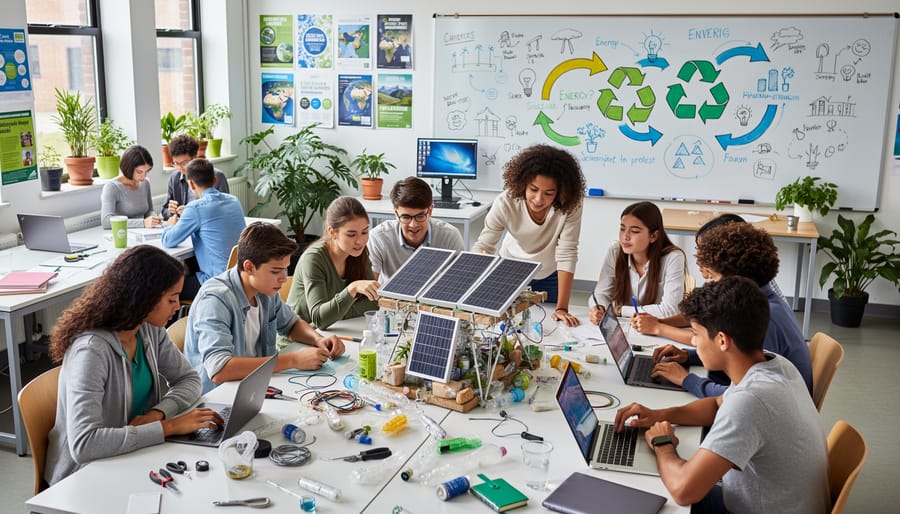
Project-based learning programs connecting students with genuine energy problems are transforming educational experiences across the globe. At Arizona State University, engineering students partner with local tribes to develop solar microgrids for remote communities, addressing energy poverty while gaining hands-on experience with renewable installation, grid integration, and stakeholder communication. These aren’t simulations—the systems they design get built, tested, and must perform.
“When students know their work will actually impact people’s lives, the level of engagement skyrockets,” explains Dr. Maria Santos, who directs sustainability programs at MIT. “They’re not solving hypothetical problems for grades. They’re confronting real constraints—budgets, regulations, community concerns—and that creates exceptional learning opportunities.”
Corporate partnerships amplify this model’s effectiveness. Siemens collaborates with German vocational schools, presenting students with operational challenges from their renewable energy portfolio. Students analyze wind turbine performance data, propose maintenance optimizations, and present findings to company engineers. Several projects have led to implemented improvements, demonstrating that student contributions can deliver genuine value.
The benefits extend beyond technical competency. Students develop critical soft skills—project management, cross-cultural communication, ethical reasoning—that employers consistently identify as gaps in traditional graduates. They learn to navigate the complexity inherent in sustainability work: balancing environmental goals with economic realities, engaging diverse stakeholders, and adapting when initial approaches fail.
This pedagogical approach scales across educational levels. High school students in Barcelona audit neighborhood businesses for energy waste. Community college students in California retrofit low-income housing. Each project builds problem-solving capacity while addressing urgent sustainability needs, creating a workforce genuinely prepared for the energy transition’s challenges.
Bridging Regions: Knowledge Transfer for Global Impact
What Northern Europe Can Teach the World About Energy Education
Northern Europe has emerged as a living laboratory for energy education innovation, demonstrating how intentional partnerships and forward-thinking policies can reshape workforce development for the green economy. The region’s approach offers valuable lessons that transcend geography.
Denmark’s Technical University has pioneered what they call “living labs”—integrated learning environments where sustainability courses aren’t confined to classrooms. Students work directly with energy companies on real grid optimization challenges while simultaneously studying renewable systems theory. This dual-track model has produced graduates who arrive at their first jobs already fluent in both technical competencies and industry workflows.
“We realized that teaching energy systems without teaching systems thinking was creating specialists who couldn’t collaborate,” explains Dr. Kirsten Halsnæs, who helped design Denmark’s integrated sustainability curriculum. “Now our mechanical engineers understand policy frameworks, and our policy students can read technical specifications.”
The Baltic nations have taken a different but equally instructive path. Estonia’s lifelong learning framework recognizes that energy transition demands continual skill updating. Workers in traditional energy sectors can access government-subsidized micro-credentials in solar installation, energy auditing, or smart grid management—often delivered through modular online platforms that accommodate shift work schedules.
Sweden’s tripartite model brings together government agencies, universities, and energy corporations in formal coalitions that align curriculum development with actual workforce needs. When Vattenfall identified gaps in offshore wind expertise, Uppsala University launched specialized programs within 18 months—a response time unimaginable in more fragmented education systems.
These innovations share common DNA: they treat education as infrastructure rather than afterthought, embed industry deeply in academic planning, and recognize that energy transition requires whole-population engagement, not just elite technical training.
Localizing Global Best Practices
Educational innovation cannot follow a one-size-fits-all approach when preparing workforces for the energy transition. What succeeds in Germany’s vocational training system may require fundamental adaptation in Southeast Asia or Sub-Saharan Africa, where energy infrastructure, economic structures, and cultural learning traditions differ dramatically.
Consider Rwanda’s approach to renewable energy education. Rather than importing Western curriculum wholesale, the country’s polytechnic institutions partnered with local solar companies to design training programs specifically addressing off-grid solutions—the predominant energy reality for rural communities. Students learn to install and maintain systems scaled for agricultural cooperatives and health clinics, not utility-scale installations. This localization ensures graduates immediately contribute to their communities’ actual energy needs.
Similarly, Brazil’s SENAI training network adapted international best practices in wind energy education to reflect the country’s unique coastal geography and strong manufacturing base. By embedding Portuguese language instruction, regional labor market analysis, and partnerships with domestic turbine component manufacturers, the program produces technicians ready for Brazil’s specific renewable energy landscape rather than generic global markets.
Dr. Maria Santos, education director at the International Renewable Energy Agency, emphasizes this principle: “Effective energy education honors local context while maintaining rigorous technical standards. We’ve seen programs fail when they ignore regional grid configurations, available materials, or traditional knowledge systems that communities trust.”
The key lies in identifying transferable principles—systems thinking, safety protocols, problem-solving methodologies—while customizing content, delivery methods, and assessment approaches. Indigenous communities in Canada, for instance, have successfully integrated traditional ecological knowledge with modern energy efficiency training, creating culturally resonant programs that achieve both preservation and innovation goals.
Research-Driven Innovation in Energy Education
Living Laboratories: Campus as Testing Ground
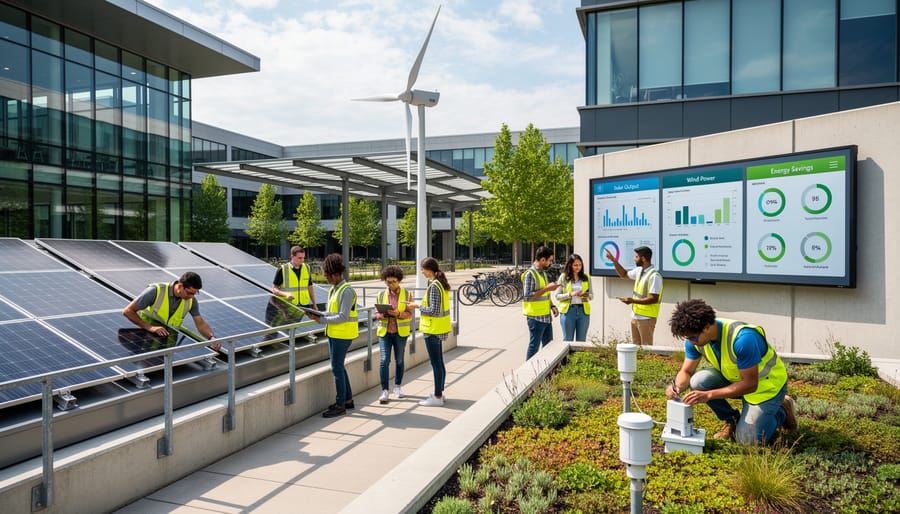
University campuses are transforming into dynamic living laboratories where sustainability theories meet real-world application. These institutions are leveraging their physical infrastructure as testing grounds for renewable energy systems, smart grids, and innovative environmental technologies, while simultaneously providing students with hands-on research opportunities that bridge classroom learning and professional practice.
Arizona State University exemplifies this approach through its comprehensive microgrid system that integrates solar arrays, battery storage, and advanced energy management software across campus buildings. Students from engineering, environmental science, and business programs actively monitor performance data, optimize energy flows, and develop predictive maintenance protocols. “Our campus doesn’t just teach sustainability; it demonstrates it in real-time,” explains Dr. Sarah Chen, Director of Campus Sustainability Initiatives. “Students graduate having actually managed utility-scale renewable systems, giving them immediate credibility in the job market.”
The University of British Columbia has taken campus experimentation further by installing experimental green building technologies in student residences, including novel heat recovery systems and adaptive lighting controls. Graduate researchers collect continuous performance data while residents provide feedback on user experience, creating a feedback loop that informs both academic research and industry product development.
These campus laboratories generate tangible outcomes beyond education. Stanford University’s Energy System Innovations program has reduced campus emissions by 68 percent while producing peer-reviewed research that influences policy frameworks across California. Meanwhile, participating students develop technical competencies and systems-thinking capabilities that traditional curricula cannot replicate, positioning them as implementation-ready professionals capable of accelerating the energy transition from day one of their careers.
Student Researchers Driving Industry Innovation
Student-led research initiatives are increasingly bridging the gap between academic exploration and commercial application in sustainable energy. At Stanford University, graduate students developed a breakthrough in perovskite solar cell stability that attracted venture capital funding and spawned a startup now partnering with major manufacturers. The technology, which emerged from a capstone project, addresses one of solar energy’s most persistent challenges: long-term durability in varying climates.
Similarly, engineering students at the Technical University of Denmark created an AI-powered wind turbine optimization system during their master’s thesis work. The algorithm, which increases energy output by 12% through predictive maintenance scheduling, caught the attention of Vestas, leading to a licensing agreement and ongoing collaboration. “What started as academic curiosity became an industry standard,” noted their faculty advisor.
These examples reflect a broader trend where universities are structuring research programs to encourage commercialization pathways. Incubators, industry mentorship programs, and flexible intellectual property frameworks enable students to translate theoretical knowledge into practical solutions. The impact extends beyond individual products; student researchers bring fresh perspectives that challenge established industry assumptions, accelerating the pace of innovation crucial for meeting climate targets.
Reskilling the Existing Workforce: Education Beyond the Classroom
Fast-Track Programs for Career Transition
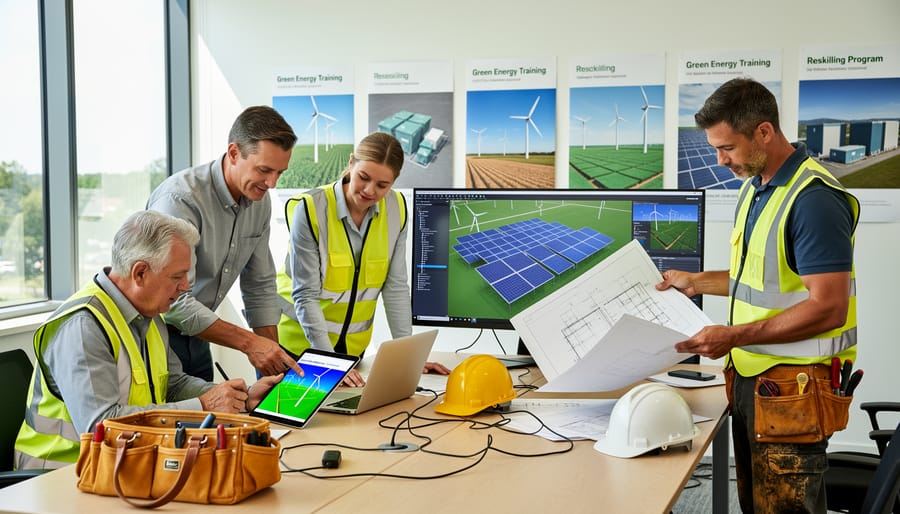
The traditional four-year degree no longer represents the only pathway into the green energy sector. Accelerated training programs and micro-credentials are revolutionizing how professionals transition into renewable careers, compressing years of education into intensive, targeted learning experiences that meet urgent workforce demands.
Consider the journey of Maria Chen, a former petroleum engineer who completed a six-month solar energy certification program while still employed. “I couldn’t afford to step away for two years,” she explains. “The stackable credential model let me build expertise incrementally, earning industry-recognized badges that employers immediately valued.” Chen now leads solar installation projects for a major utility company, her transition enabled by modular education that prioritized practical skills over theoretical foundations.
These fast-track programs typically range from twelve weeks to nine months, focusing on high-demand competencies like wind turbine maintenance, energy storage systems, or green building design. Organizations like the Solar Energy International and various community colleges have pioneered certification frameworks that allow learners to stack credentials progressively, each module providing immediate employability while building toward comprehensive expertise.
Dr. James Rodriguez, workforce development director at a leading technical college, notes that “micro-credentials serve as currency in the green economy, where demonstrated competency often matters more than pedigree.” His institution has partnered with energy companies to co-design curricula, ensuring alignment between classroom learning and job-site requirements.
The stackable approach particularly benefits mid-career professionals who bring transferable skills from adjacent industries. By recognizing prior learning and focusing on sector-specific knowledge gaps, these programs reduce barriers to entry while accelerating the talent pipeline essential for meeting aggressive decarbonization timelines.
Corporate-Led Learning Initiatives
Leading corporations are no longer waiting for traditional education systems to catch up with sustainability workforce needs—they’re building their own pathways. Through internal academies and strategic partnerships with universities, forward-thinking companies are creating powerful models that directly address the skills gap in the energy transition.
Ørsted, the Danish renewable energy giant, exemplifies this approach through its “Green Skills Academy,” launched in 2021. The program retrains workers from fossil fuel industries, particularly offshore oil and gas, to transition into offshore wind careers. “We realized we couldn’t simply hire our way to net-zero,” explains Chief People Officer Maria Hjorth. “We needed to create our own talent pipeline while helping communities navigate economic transformation.” The academy has already graduated over 800 professionals, with 92% retention rates after two years.
Similarly, Siemens Gamesa has partnered with vocational schools across Spain and Germany to develop curriculum for wind turbine technicians. Their “dual education” model combines classroom learning with paid apprenticeships, ensuring graduates possess immediately applicable skills. This collaboration has reduced the company’s time-to-productivity for new hires by 40%.
In the United States, utility company Duke Energy invested $60 million in its “Nuclear Innovation Institute,” partnering with North Carolina State University to prepare engineers for next-generation reactor technologies. These corporate-led initiatives demonstrate a crucial insight: when companies invest directly in education, they create both competitive advantage and broader sectoral transformation, proving that workforce development can simultaneously serve business interests and climate imperatives.
Technology as Education Enabler
The convergence of digital innovation and energy education is fundamentally reshaping how we prepare the workforce for the clean energy transition. Today’s technologies are not merely supplementing traditional learning—they are democratizing access to specialized knowledge and creating immersive experiences previously confined to costly laboratories and field sites.
Virtual reality platforms are bringing renewable energy installations directly into classrooms worldwide. Students in landlocked regions can now experience offshore wind farm operations, navigating turbine maintenance procedures through VR headsets. At the Technical University of Denmark, engineering students use VR simulations to practice grid management scenarios, making real-time decisions about integrating variable renewable sources without the risk or expense of physical infrastructure. This technology compresses years of theoretical learning into experiential hours, building intuition alongside technical competence.
Artificial intelligence is personalizing the learning journey in unprecedented ways. Adaptive learning platforms assess individual knowledge gaps and adjust curriculum difficulty in real-time, ensuring that a solar installer in rural India and a utility engineer in Germany both receive instruction calibrated to their existing expertise and learning pace. The Stanford Online platform has deployed AI tutors that provide instant feedback on complex energy modeling exercises, accelerating comprehension while freeing instructors to focus on higher-order thinking and innovation challenges.
Remote collaboration tools have transformed geographical barriers into bridges. The Energy Transition Academy in Berlin connects mentors from established energy companies with students across Africa and Southeast Asia through structured virtual apprenticeships. These platforms enable knowledge transfer that respects local context while maintaining global standards, creating what Dr. Maria Santos, Director of Sustainable Education Initiatives at the International Renewable Energy Agency, calls “distributed expertise networks that honor both universal principles and regional realities.”
This technological democratization is producing measurable results. Online energy certification programs have reduced credentialing costs by 60 percent while expanding reach fivefold, training technicians in regions where traditional educational infrastructure remains underdeveloped yet renewable energy potential soars.
Measuring Success: Outcomes That Matter
Measuring the true impact of educational innovation in the sustainable energy sector requires looking beyond graduation rates and test scores. While traditional academic metrics remain relevant, they tell only part of the story when preparing professionals for an economy fundamentally transformed by climate imperatives.
The most meaningful indicators extend into real-world outcomes. Employment data reveals whether graduates successfully transition into renewable energy roles, with programs at institutions like Arizona State University’s School of Sustainability reporting 92% job placement rates in green economy positions within six months of graduation. Innovation outputs matter equally—tracking patents filed, startups launched, and collaborative research projects demonstrates whether educational experiences foster genuine problem-solving capacity.
To systematically evaluate program effectiveness, forward-thinking institutions now monitor several critical dimensions:
- Workforce Integration Rate
- The percentage of graduates securing positions aligned with energy transition goals within their first year, including roles in renewable deployment, efficiency consulting, and climate adaptation planning.
- Cross-Sector Collaboration Index
- Measures how frequently graduates and faculty engage with industry partners, government agencies, and community organizations to address regional sustainability challenges.
- Innovation Pipeline Metrics
- Quantifies tangible outputs including peer-reviewed publications, technology patents, policy recommendations adopted, and social enterprises established by students and alumni.
- Regional Decarbonization Contribution
- Assesses the program’s measurable impact on local emissions reduction, renewable energy capacity additions, and just transition initiatives within the institution’s geographic footprint.
These indicators collectively paint a comprehensive picture of educational value creation. During a recent interview, Dr. Maria Santos from the International Renewable Energy Agency emphasized that “educational institutions must demonstrate their direct contribution to accelerating the energy transition, not simply producing credentials.” This accountability drives continuous improvement and ensures that innovation in pedagogy translates to innovation in practice—precisely what our climate crisis demands.
The convergence of education innovation, sustainable energy development, and workforce transformation represents more than an opportunity—it stands as an imperative for our collective future. Throughout our exploration, we’ve witnessed how forward-thinking educational institutions, innovative training programs, and strategic partnerships are reshaping the talent pipeline that will power the renewable energy revolution. From Germany’s dual vocational training system producing skilled technicians to Kenya’s solar training cooperatives empowering rural entrepreneurs, the evidence is clear: education serves as the primary catalyst enabling communities to participate meaningfully in the energy transition.
The interconnected nature of education, research, and innovation creates a virtuous cycle. Universities conducting breakthrough research in battery technology simultaneously train the engineers who will commercialize these advances. Community colleges partnering with solar installers don’t just fill immediate job vacancies—they establish sustainable career pathways that lift entire regions economically while accelerating decarbonization efforts. Dr. Maria Santos, Director of Workforce Development at the International Renewable Energy Agency, emphasizes this synergy: “Every dollar invested in quality renewable energy education generates returns across multiple dimensions—economic resilience, environmental protection, and social equity.”
This transformational moment demands bold action from all stakeholders. Policy makers must prioritize funding for proven educational models and remove regulatory barriers preventing rapid scaling. Industry leaders should deepen their commitment to workforce partnerships, recognizing that talent development represents strategic infrastructure as critical as transmission lines or charging stations. Educational institutions must embrace agility, continuously adapting curricula to meet emerging needs in green hydrogen, energy storage, and smart grid technologies.
The window for decisive action remains open, but it won’t stay that way indefinitely. By investing in education innovation today, we ensure tomorrow’s workforce possesses both the technical competence and adaptive capacity to navigate an evolving energy landscape—creating prosperity while safeguarding our planet for future generations.