
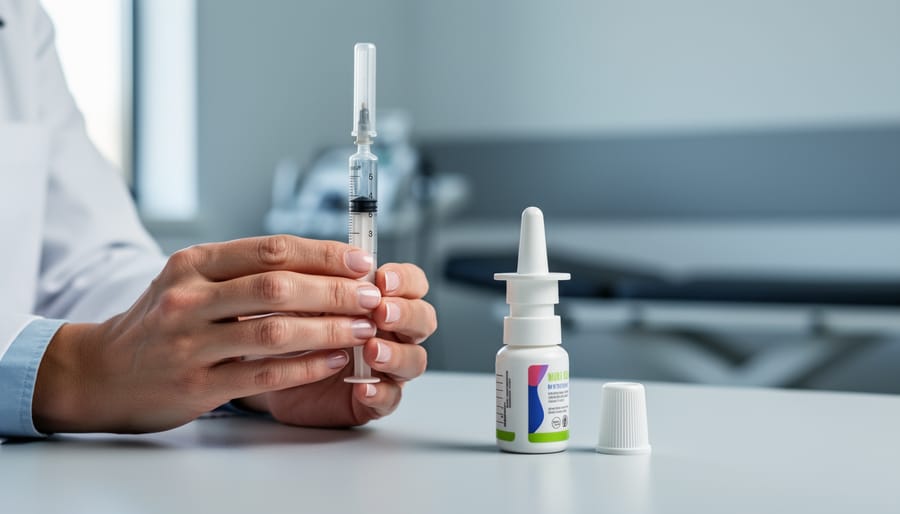
NAD+ Nasal vs. Injectable Research Comparison: Key Differences and Which Fits Your Needs
Neither route has earned a clear win on current evidence, but injectable NAD+ holds the stronger research position, while nasal delivery is the more practical option for people who want to avoid needles. The reason is simple: injections bypass the digestive tract and deliver a measurable dose, and most of the published human work on NAD+ delivery has used that approach. Products like NAD+ Nasal by Kylo trade that certainty for convenience, and the nasal literature is thinner.
This comparison is for readers who evaluate options the way an energy analyst evaluates a new technology. Think of a pilot solar array versus a proven grid connection. One promises easier deployment, the other has years of performance data behind it. Neither claim means much until you ask the same questions: how much of the input actually arrives, what does the evidence say, what are the risks, and how hard is it to use day to day?
Below, we define each delivery route in plain terms, compare them dimension by dimension, and flag where the research is solid and where it’s still a gap. This is an educational review of the research, not medical advice.
Nasal vs. Injectable NAD+ at a Glance
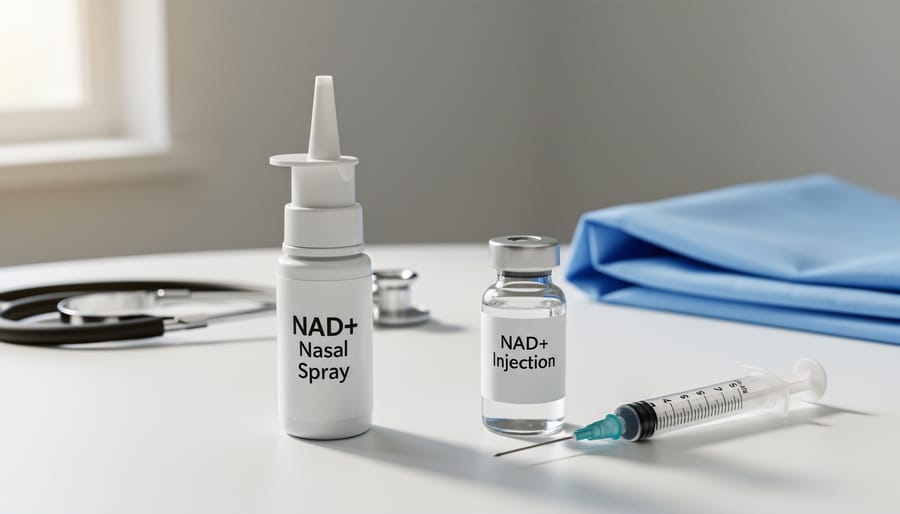
Before the detail, here is the short version. Injectable NAD+ has the longer research and clinical record, while nasal NAD+ rests mostly on mechanistic reasoning and early-stage work. Neither route is a proven treatment for any condition, and the table below summarizes how they compare.
| Factor | Nasal NAD+ | Injectable NAD+ |
|---|---|---|
| Route and absorption pathway | Intranasal spray; proposed uptake through the nasal mucosa, including a theoretical nose-to-brain route | Subcutaneous, intramuscular, or intravenous; bypasses digestion and enters tissue or circulation directly |
| Human evidence | Limited; mostly preclinical or early-stage research | Broader, though many studies are small or observational |
| Regulatory and quality status | Largely unregulated products with variable purity | Administered in clinical settings; product quality still varies by supplier |
| Convenience | Self-administered, no needles | Usually needs professional supervision, and IV sessions can be lengthy |
| Key limitation | Uncertain absorption and few human trials | Injection-site and infusion-rate reactions; higher cost and access barriers |
Think of it as a pilot-stage technology next to a more established one. Injectable NAD+ has more data behind it, but “more” is relative, and much of the published work is still limited in size and design. Nasal NAD+ has an appealing rationale, yet the human evidence has not caught up with it. The sections that follow unpack each row, so you can judge how much weight the research can actually carry.
What Each NAD+ Delivery Route Is
NAD+ and Cellular Energy: Why Delivery Route Matters

Think of a cell as a small power station. NAD+ (nicotinamide adenine dinucleotide) works like a shuttle that carries electrons through the energy pathway inside mitochondria, where fuel from food becomes usable cellular energy. It also supports DNA repair enzymes, which is why researchers tie it to both energy metabolism and cellular maintenance.
Here are the terms that matter most for this comparison:
- Coenzyme
- A helper molecule that enzymes need in order to do their work. NAD+ is one of the most widely used coenzymes in the body.
- Bioavailability
- The share of a substance that actually reaches the bloodstream or target tissue in usable form.
- Precursor
- A building block the body converts into NAD+, such as NMN (nicotinamide mononucleotide) or NR (nicotinamide riboside).
- Intranasal delivery
- Administration through the nasal lining, which is the route nasal NAD+ formats rely on.
- Subcutaneous injection
- An injection into the fatty layer just beneath the skin, one of several injectable routes.
Why does the route matter at all? Because the body is protective about NAD+. Swallowed NAD+ is largely broken down during digestion, so very little arrives intact. That’s the reason scientists study alternatives that bypass the gut: injections, which place NAD+ directly into the body, and nasal delivery, which targets absorption through mucosal tissue. Each route changes how much NAD+ actually gets where it’s needed, and that difference is what the research tries to measure.
How Injectable NAD+ Is Used and Studied

Injectable NAD+ reaches the body by three routes. Intravenous infusion delivers the coenzyme directly into the bloodstream, usually in a clinic over an extended period, since faster drip rates are commonly linked with flushing, nausea, and chest tightness. Subcutaneous injection places it under the skin, and intramuscular injection places it in muscle tissue. Both are quicker to administer and are sometimes self-managed, though supervision and sourcing quality still matter.
The published record here is real but uneven. Much of what we know about circulating NAD+ and its metabolites comes from controlled studies of precursors such as nicotinamide riboside and nicotinamide mononucleotide, which are easier to measure and standardize. Direct NAD+ administration has a thinner body of peer-reviewed human work, with a heavier share of clinic-based observations, case series, and practitioner reports. Those are useful for generating questions, but they cannot settle them.
Researchers tend to ask a consistent set of questions about this route. How much intact NAD+ survives in circulation before being broken down? Does it raise NAD+ levels inside tissues, or mainly in blood? What dosing and infusion speeds are tolerable? And do changes in biomarkers translate into outcomes anyone can actually measure? For comparison, the emerging Intranasal nose-to-brain route raises a different set of questions, which we take up next.
How Nasal NAD+ Is Used and Studied

Intranasal NAD+ is typically delivered as a liquid spray absorbed through the nasal lining. The appeal rests on two ideas. First, the nasal mucosa is thin and richly supplied with blood vessels, so some compounds can bypass the digestive tract, where oral NAD+ is largely broken down. Second, researchers have long explored a “nose-to-brain” pathway, in which certain molecules travel along olfactory and trigeminal nerve routes toward the central nervous system, skipping the blood-brain barrier.
Think of it as a pilot-stage distribution corridor: promising in design, but not yet proven at scale.
The research behind this route is early. Most of what exists comes from animal models and cell-based work on intranasal delivery in general, plus studies of other molecules that show the pathway can work. Direct, peer-reviewed human trials measuring how much intact NAD+ reaches the bloodstream or brain after a nasal dose are scarce. Much of the public discussion draws on practitioner reports and product marketing rather than controlled data.
Several questions remain open: how large NAD+ molecules cross the nasal lining, how stable they are in solution, how consistent dosing is from spray to spray, and whether any brain delivery occurs at meaningful levels in people. Until those gaps close, nasal NAD+ is best viewed as an area of active inquiry rather than an established delivery method.
Nasal vs. Injectable NAD+, Dimension by Dimension
Absorption and Bioavailability Compared
Think of bioavailability as the share of a dose that actually arrives where it can do work, the way grid engineers track how much generated power survives transmission. For NAD+ that share is hard to pin down, and the honest answer is that it differs sharply by route.
Injectable delivery has the clearer logic. Intravenous administration places NAD+ directly into circulation, so, by definition, the full dose enters the bloodstream. Subcutaneous and intramuscular routes add an absorption step, and published pharmacokinetic data on how much intact NAD+ reaches blood or tissue remain limited. Even with IV delivery, the molecule is large and charged, and much of what is studied is how quickly it is broken down into smaller components such as nicotinamide, rather than whether intact NAD+ enters cells.
Nasal delivery rests on a different premise: that nasal mucosa could absorb NAD+ directly, possibly with some nose-to-brain transport. That idea is mostly supported by preclinical work, including rodent studies, and by mechanistic reasoning. Rodent nasal anatomy and dosing differ substantially from human, so those results cannot be read as human absorption figures. Direct, well-controlled human measurements of nasal NAD+ uptake are, as far as the published literature shows, scarce.
The practical takeaway is a caution about extrapolation. Comparing “how much gets in” across routes is not yet possible with confidence, because the data for each route were generated under different conditions, in different species, and with different outcome measures.
Evidence Quality and Research Maturity
When scientists judge a delivery route, they start with the same question engineers ask of any pilot project: how much was tested, by whom, and under what conditions? On that measure, the two routes sit at very different stages of research maturity.
Injectable NAD+, particularly the intravenous form, has a longer paper trail. It appears in published clinical observations, small human studies, and case reports, mostly in supervised settings. Even so, the trials are often modest in size, short in duration, and uneven in design. Few are large, randomized, placebo-controlled studies, so the findings are better read as early signals than settled conclusions.
Nasal NAD+ rests on a thinner foundation. The rationale for mucosal absorption and nose-to-brain transport comes largely from preclinical work and from research on other intranasal compounds, not from direct human trials of NAD+ itself. That is a plausible hypothesis, but a hypothesis is not a result.
It also helps to separate evidence tiers. Peer-reviewed trials report methods, sample sizes, and limitations. Practitioner reports describe experience without controls. Marketing claims often borrow the language of science without the data behind it. Treat each tier accordingly, and notice how rarely a head-to-head comparison of the two routes exists.
Where do the gaps lie? Larger randomized studies, standardized dosing, and direct route comparisons are the clearest needs.
Safety, Tolerability, and Side Effects
Tolerability is where the two routes diverge most visibly, and also where the evidence is least evenly distributed. Injectable NAD+ has been administered in clinical and practitioner settings long enough that its common reactions are reasonably well described. Nasal NAD+ has far fewer documented observations, so “no reported problems” often just means “not much studied.”
Here are the main considerations reported or reasonably anticipated for each route:
- Injection-site reactions, such as redness, soreness, or swelling, are commonly noted with subcutaneous and intramuscular use.
- Flushing, chest tightness, nausea, or general discomfort are frequently linked to rapid intravenous administration, which is why slower infusion rates are typical.
- Nasal irritation, dryness, or a burning sensation is the main concern for intranasal delivery, since the mucosa is sensitive to formulation and concentration.
- Long-term safety data are limited for both routes, and especially thin for nasal use.
- Product purity and dosing accuracy vary widely in unregulated supply, which can add risks unrelated to NAD+ itself.
Think of it like commissioning a new grid component: a system can look fine in early trials and still reveal stress points under sustained load. That is why professional oversight matters. A qualified clinician can adjust administration speed, screen for individual risk factors, and recognize when a reaction needs attention. Self-directed use removes that safety net, particularly for injectables.
Convenience, Cost, and Access
Practical differences between the two routes start with where and how each one is given. Injectable NAD+, especially intravenous infusion, is typically administered in a clinic by trained staff. Sessions can run for hours because rapid infusion is associated with flushing, nausea, and chest tightness, so the rate is deliberately slowed. Subcutaneous and intramuscular injections are shorter, but they still raise questions about sterile technique, dosing accuracy, and who is supervising.
Nasal products look more convenient on paper. They are usually self-administered, need no needles, and don’t require a clinic visit. That convenience carries a trade-off, though. Without professional oversight, the user is responsible for storage, dosing, and noticing problems early.
Cost patterns differ too. Clinic-based infusions generally involve per-session fees, while nasal products are often sold as ongoing supplies.
Supply quality is the bigger concern. Many NAD+ products sit in a regulatory gray area, sold as compounded preparations or research-grade materials rather than approved drugs. Purity, concentration, and sterility can vary widely between suppliers, and labels aren’t always verified by independent testing. Ask for third-party certificates of analysis, confirm the preparer’s licensing, and treat any product with vague sourcing as a red flag.
A Case Study in Reading the Evidence: Lessons from Energy Technology Evaluation
Picture a promising solar-storage prototype that posts spectacular numbers in a controlled lab. Investors get excited. Then an independent group tests it in the field, and the results land far below the brochure. That story repeats across energy technology, and the lesson is simple: a strong delivery claim is not the same as validated performance.
Energy evaluators learned to ask a short list of questions. Was the result independently reproduced? How large and how long was the pilot? Does it hold up outside ideal conditions? Those same questions apply to NAD+ delivery routes. Injectable NAD+ has the longer research record, much like a technology that has cleared several pilot stages. Nasal NAD+ resembles an early prototype: the nose-to-brain rationale is interesting, but the supporting data is thin, and a plausible mechanism is not proof of benefit.
Building this habit of evidence-based learning helps readers separate genuine progress from marketing gloss. Pilot-stage caution is not pessimism. It is how good technologies earn trust.
A note for editors: if a researcher familiar with NAD+ delivery studies can be interviewed, a short expert perspective on route-specific evidence would strengthen this section considerably.
Which NAD+ Route Should You Choose? Matching the Research to Your Situation
Choosing between routes is less about a winner and more about matching your priorities to what the research can actually support. Think of it as a decision framework, not a prescription, and bring these questions to a qualified clinician.
Someone who weights how to read evidence carefully might lean toward injectable if:
- They want the route with the deeper published record and more defined dosing research.
- They are comfortable with supervised administration in a clinical setting.
- They accept injection-site or infusion-rate reactions as a known trade-off.
Someone who prioritizes convenience may lean toward nasal if:
- They are uncomfortable with needles and accept that the evidence is still early.
- They understand that nose-to-brain claims rest largely on preclinical work.
- They can verify product purity and sourcing independently.
Talk to a clinician first if:
- You are pregnant, nursing, or managing a chronic condition.
- You take prescription medications that could interact with supplementation.
- You are considering unregulated or unverified products.
Whichever way you lean, remember that every emerging approach carries risk and uncertainty. A good clinician will help you weigh both against your own situation, which is exactly the conversation this research is meant to inform.
Frequently Asked Questions About Nasal and Injectable NAD+
Is nasal NAD+ as effective as injectable NAD+?
The research can’t say yet. Injectable formats have a broader body of published work, while nasal delivery rests largely on early or preclinical inquiry, so direct, head-to-head human comparisons are still missing.
Can NAD+ be absorbed orally?
Oral NAD+ is largely broken down during digestion, which is why many researchers study precursors instead. Whether those precursors raise NAD+ levels in the tissues that matter is an active question, not a settled one.
How can I judge a product’s NAD+ claims?
Look for peer-reviewed human trials, not testimonials or practitioner reports. Be wary of products that promise dramatic results, skip purity testing, or borrow evidence from a different delivery route.
When should I speak with a clinician?
Before you start any NAD+ format, especially if you have a medical condition or take medication. A qualified professional can weigh the evidence against your situation, which a research overview cannot do.
Treat those answers the way an energy analyst treats pilot-stage data: useful for framing better questions, not for declaring a winner. The honest summary is that route matters, evidence is uneven, and anyone offering certainty is probably ahead of the science.
Conclusion
The research record tells a clear story. Injectable NAD+ rests on the deeper body of evidence, while nasal delivery is still an early, promising area of inquiry that hasn’t yet earned the same confidence. Neither route is a shortcut past the need for good data, and the gap between them is a reminder that how something is delivered shapes what we can actually know about it.
The same discipline that moves a clean-energy technology from pilot to proven deployment applies here: independent validation, honest uncertainty, patience. Evidence-led evaluation is what turns possibility into progress, in health and in energy alike. Before acting on any of it, talk with a qualified professional who can weigh the research against your circumstances.