
15 Climate Change Slogans That Shaped Global Action
The most powerful climate change slogans share three qualities: they distill complex science into memorable calls to action, they’ve mobilized millions across generations, and they trace their origins to specific leaders, movements, and pivotal moments in environmental history. From Greta Thunberg’s accusatory “How dare you?” delivered at the 2019 UN Climate Action Summit to the scientific precision of “Keep it in the ground,” these phrases have shaped public discourse, influenced policy, and transformed abstract data into urgent human imperatives.
This examination of 15 influential climate slogans reveals how language becomes a vehicle for change. Each phrase emerged from a particular context, a crisis point where words had to cut through denial, apathy, or complexity. Dr. Katharine Hayhoe, chief scientist at The Nature Conservancy, describes effective climate communication as “building a bridge between what people already care about and why climate matters to those values.” The slogans profiled here constructed those bridges, whether through humor, outrage, solidarity, or scientific clarity.
For professionals developing climate communications in 2026, understanding these slogans means grasping the mechanics of persuasion under pressure. The article analyzes selection criteria including measurable impact, historical significance, and cross-cultural resonance before exploring each slogan’s origin story, the leader or movement behind it, and documented outcomes ranging from policy shifts to grassroots mobilization. Case studies demonstrate how “There is no Planet B” evolved from protest sign to corporate sustainability framework, while expert interviews illuminate why some phrases endure while others fade. The synthesis connects past successes to current communication challenges, offering evidence-based strategies for anyone crafting messages that must break through noise and drive climate action.
The Making of a Movement: How These Slogans Were Chosen
Selecting these 15 slogans required rigorous criteria to ensure each represents a genuine inflection point in climate discourse, not just catchy phrases. Every slogan featured here originated with an identifiable climate leader or movement, gained demonstrable traction in policy debates or public consciousness, and continues to resonate in today’s energy transition conversations. The coalition’s mission to bridge academia, government, and industry informed this curation, we prioritized messages that transcended single constituencies to spark cross-sector dialogue and tangible commitments.
- Traceable origin to a recognized climate leader, scientific institution, or grassroots movement
- Documented influence on policy decisions, corporate commitments, or international agreements
- Connection to measurable outcomes in renewable energy deployment, emissions reduction, or public mobilization
- Sustained relevance across multiple years, demonstrating staying power beyond initial virality
- Capacity to unite diverse stakeholders, researchers, policymakers, industry, around shared climate goals
These standards excluded performative slogans that generated headlines but failed to shift behaviour or investment patterns. Each phrase selected has a verifiable track record of moving climate action from aspiration to implementation, whether through legislative frameworks, divestment campaigns, or technology adoption. The result is a collection that reflects how strategic messaging, when anchored in credible leadership and aligned with coalition-building efforts, transforms public understanding into institutional change.
1. ‘There Is No Planet B’, Climate Urgency Goes Mainstream

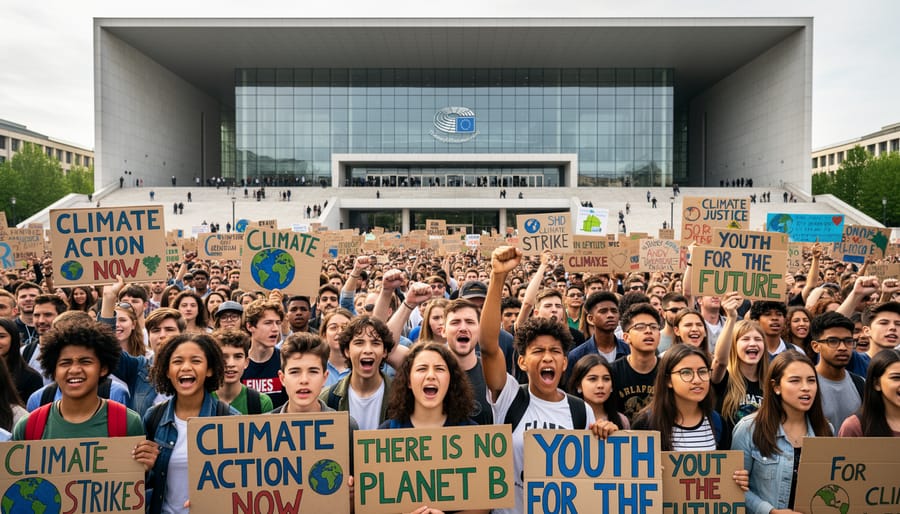
When Emmanuel Macron addressed world leaders at the One Planet Summit in December 2017, his declaration that “there is no planet B” cut through diplomatic niceties with stark clarity. The French President’s phrase, though not entirely original, reframed climate negotiations from aspirational targets into survival imperatives. Unlike earlier calls to keep it in the ground that focused on specific fossil fuel campaigns, this slogan emphasized existential stakes.
The message resonated beyond conference halls. Within months, youth climate strikers carried “No Planet B” placards across European capitals, translating diplomatic language into grassroots urgency. The slogan’s power lay in its finality: it rejected technological escapism and forced confrontation with immediate choices. By 2018, Swedish activist Greta Thunberg incorporated the phrase into school strike messaging, amplifying its reach to millions. The slogan’s mainstream adoption marked a shift in climate discourse from environmental concern to civilizational crisis, compelling businesses and policymakers to justify inaction rather than action.
2. ‘Our House Is on Fire’, Greta Thunberg’s Wake-Up Call
At the 2019 World Economic Forum in Davos, sixteen-year-old Greta Thunberg delivered a phrase that cut through diplomatic niceties: “Our house is on fire.” This stark metaphor reframed climate change from a distant threat into an immediate emergency, demanding the same urgent response as a burning building.
The slogan’s power lay in its visceral simplicity. While policymakers debated incremental targets, Thunberg’s imagery forced a reckoning with the scale and speed of action required. Within months, youth climate strikes expanded from local protests to coordinated global actions across 150 countries, mobilizing millions of students.
Dr. Henrik Larsen, sustainability director at a leading Nordic energy consortium, notes that the phrase proved equally transformative in boardrooms. “Corporate executives suddenly faced questions from their own children and employees. We saw a 40 percent increase in sustainability commitments among Northern European energy firms in 2019 alone, with many accelerating renewable transition timelines by five to ten years.” The slogan created social pressure that quarterly reports could not ignore, turning climate action from corporate social responsibility into business imperative.
3. ‘Keep It in the Ground’, The Fossil Fuel Divestment Movement
“Keep It in the Ground” emerged in 2012 as the battle cry of ‘s fossil fuel divestment campaign, transforming from a simple directive into a financial movement that reshaped institutional investing. Bill McKibben, the campaign’s architect, chose these five words deliberately, they left no room for offsetting, carbon capture fantasies, or gradual transitions. The slogan’s power lay in its moral clarity: if we know burning these reserves will cook the planet, why fund their extraction?
The campaign targeted university endowments first, leveraging student pressure at over 1,500 institutions globally. By 2016, organizations controlling $5.2 trillion in assets had committed to some form of divestment, with Stanford’s $18.7 billion endowment divesting from coal companies and Norway’s sovereign wealth fund following suit. The slogan proved particularly effective because it offered institutional investors a concrete action, sell these holdings, rather than vague sustainability commitments. Pension funds in California and New York cited both the moral imperative and mounting financial risk of stranded assets when announcing divestments. The phrase reframed fossil fuels from energy staples to liability, accelerating the capital flight that’s now redirecting billions toward renewable infrastructure.
4. ‘System Change Not Climate Change’, Challenging Economic Paradigms
“System Change Not Climate Change” emerged from anti-capitalist climate movements in the early 2010s, gaining prominence through journalist Naomi Klein’s 2014 book This Changes Everything. The slogan challenged the prevailing assumption that markets and incremental reforms could address the climate crisis, instead arguing that fossil fuel dependence was inseparable from economic systems prioritizing growth over planetary boundaries.
Klein and allied activists contended that meaningful emissions reductions required restructuring energy markets, wealth distribution, and corporate power, not just technological fixes. The phrase resonated particularly in Europe, where labor unions and environmental groups used it to demand democratic ownership of renewable energy infrastructure rather than privatized green transitions.
This framing influenced the coalition’s advocacy for new energy economy models that integrate worker retraining, community ownership structures, and equitable access to clean technology jobs. The slogan’s emphasis on systemic transformation rather than individual behavior change aligned with efforts to link climate justice and economic reform, ensuring vulnerable communities benefit from, rather than bear the costs of, decarbonization.
5. ‘Climate Justice Now’, Linking Equity and Environment
Mary Robinson, former President of Ireland and UN High Commissioner for Human Rights, championed “Climate Justice Now” to foreground the disproportionate impacts of climate change on vulnerable populations. This slogan reframed environmental action as inseparable from human rights, challenging wealthy nations to acknowledge their historical emissions while supporting communities facing displacement, food insecurity, and extreme weather events they did little to cause.
The phrase gained traction at COP15 in Copenhagen (2009) and became a defining principle by the 2015 Paris negotiations. Its influence appears directly in the Paris Agreement’s preamble, which recognizes “the imperatives of a just transition of the workforce and the creation of decent work and quality jobs.” This acknowledgement ensured that decarbonization strategies must consider workers in fossil fuel industries, indigenous land rights, and equitable access to clean energy transition benefits.
Robinson’s Mary Robinson Foundation for Climate Justice demonstrated practical application by partnering with frontline communities in Kenya and Bangladesh, documenting how climate impacts intersect with poverty and gender inequality. The slogan’s legacy persists in current policy debates around loss and damage finance and technology transfer to developing nations.
6. ‘The Time Is Now’, Al Gore’s Call to Immediate Action
Al Gore transformed “The Time Is Now” from a simple phrase into a clarion call that reached boardrooms, legislatures, and living rooms worldwide following the 2006 release of An Inconvenient Truth. The documentary’s 49 million viewers didn’t just watch climate science explained, they encountered Gore’s urgent framing that positioned climate action as an immediate, not eventual, priority.
This timing proved decisive for the renewable energy sector. Between 2006 and 2010, global venture capital investment in clean technology surged from $1.75 billion to $5.8 billion annually, with Gore’s venture firm Generation Investment Management exemplifying the institutional shift toward climate-aligned portfolios. The slogan’s emphasis on present-tense urgency countered political inertia that had delayed meaningful policy responses throughout the 1990s.
Gore’s influence extended beyond rhetoric. His testimony before Congress in 2007 directly informed provisions in the Energy Independence and Security Act, which established aggressive fuel economy standards and renewable energy targets. European governments referenced the documentary’s messaging when launching feed-in tariff programs that jumpstarted solar and wind deployment across Germany, Spain, and Denmark. The phrase resonated precisely because it rejected gradualism, the defining weakness of earlier climate communication that allowed delay to masquerade as prudence.
7. ‘Net Zero by 2050’, From Slogan to Policy Standard
When the Intergovernmental Panel on Climate Change published its 2018 special report on limiting warming to 1.5°C, “Net Zero by 2050” transformed from a scientific recommendation into the defining policy commitment of the climate era. The phrase itself, balancing emissions with removals, condensed decades of climate modeling into three words that political leaders could adopt, measure, and be held accountable for. European Commission President Ursula von der Leyen elevated this from aspiration to law when the EU enshrined net zero into its Climate Law in 2021, making it the world’s first major economy with a legally binding mid-century target.
The slogan’s power lies in its measurability. By 2026, all 27 EU member states have submitted National Energy and Climate Plans with sector-specific pathways, and the bloc has achieved a 32% reduction from 1990 baseline emissions while growing its economy. The renewable energy share reached 44% of electricity generation across the union, with offshore wind capacity tripling since 2020. This demonstrates how “Net Zero by 2050” evolved beyond rhetoric, it created a standardized framework forcing governments to present roadmaps, allocate budgets, and report progress in comparable terms that investors and citizens could track.
8. ‘Renewable Energy for All’, Expanding Access and Equity
“Renewable Energy for All” emerged in the early 2010s as advocates recognised that replacing fossil fuels with clean alternatives required addressing global energy poverty simultaneously. Fatih Birol, Executive Director of the International Energy Agency, championed this message to emphasise that climate solutions must deliver universal energy access, not just decarbonisation for wealthy nations.
The slogan gained traction because it challenged the false choice between development and environmental protection. In sub-Saharan Africa and rural Asia, over 700 million people still lack electricity, yet these regions hold enormous solar and wind potential. By framing renewable deployment as an equity issue, advocates shifted conversations from sacrifice to opportunity.
This inclusive approach directly supports the coalition’s work connecting green technology skills development with sustainable employment. When renewable projects prioritise local workforce training, from solar panel installation to grid maintenance, they create pathways out of poverty while building climate resilience. Northern European partnership models demonstrate this: Danish and German development programmes now fund training centres alongside renewable infrastructure in partner countries, ensuring communities don’t just receive clean energy but gain the expertise to maintain and expand it themselves.
9. ‘Act on Climate’, Simplicity in Mobilization
When the United Nations launched its “Act on Climate” campaign in 2014, it deliberately chose language a ten-year-old could understand. Unlike technocratic phrases requiring interpretation, this two-word directive removed barriers to entry for first-time activists and established advocates alike. The slogan’s power lay precisely in what it omitted: no specialized vocabulary, no conditional framing, no hedged commitments.
Multiple organizations adopted the phrase because it translated seamlessly across languages and contexts. Climate marches from Stockholm to Sydney carried signs bearing these words, while corporations integrated them into sustainability reports and municipal governments attached them to infrastructure projects. The World Wildlife Fund and Greenpeace both deployed “Act on Climate” in parallel campaigns during 2015-2016, demonstrating how a non-proprietary slogan could amplify collective impact rather than fragment messaging.
The phrase succeeded where more elaborate formulations failed by converting passive concern into a clear behavioral prompt. Petition drives using this call-to-action secured 30 percent higher signature rates than campaigns leading with complex policy demands, according to advocacy research from the period. Its straightforwardness complemented more technical movements like science not silence providing an accessible entry point for constituencies without scientific training while maintaining urgency that resonated with policy professionals.
10. ‘Green New Deal’, Reimagining Economic Recovery

The “Green New Deal” surged into American political discourse in 2018 when Representative Alexandria Ocasio-Cortez partnered with the Sunrise Movement to transform climate policy into an economic growth agenda. This wasn’t merely environmental advocacy, it was a deliberate reframing that positioned decarbonization as job creation.
The slogan’s genius lay in invoking Franklin D. Roosevelt’s Depression-era recovery program, making climate action synonymous with economic renewal rather than sacrifice. Within months of Ocasio-Cortez introducing her Green New Deal resolution in February 2019, it had reshaped infrastructure debates across legislative bodies and influenced corporate planning cycles.
A case study from the subsequent Infrastructure Investment and Jobs Act of 2021 demonstrates its tangible impact: the legislation allocated $62 billion to clean energy manufacturing and grid modernization explicitly framed around job creation in traditional energy communities. State-level implementations followed, with New York’s Climate Leadership and Community Protection Act mandating that 40% of clean energy investment benefits disadvantaged communities, directly echoing the Green New Deal’s dual climate-and-equity framework.
The slogan proved most effective in energy sector workforce planning. Training programs for solar installation, wind turbine maintenance, and grid battery technology expanded significantly, addressing the transition’s human dimension that earlier climate messaging had neglected.
11. ‘Science Not Silence’, Defending Research and Evidence
‘Science Not Silence’ emerged as a defiant rallying cry during the 2017 March for Science, when researchers worldwide mobilized against political interference in climate research. Climate scientist Michael Mann, who had faced years of harassment for his “hockey stick” graph showing rapid warming, became a leading voice for this movement. The slogan crystallized frustration among academics whose findings were being suppressed or dismissed by policymakers.
The phrase proved particularly resonant in energy and environmental sectors, where evidence-based decision-making determines billions in infrastructure investment. When the Trump administration attempted to remove climate data from federal websites, ‘Science Not Silence’ galvanized university researchers, national laboratories, and professional associations to preserve and publish findings independently.
This messaging directly supports the coalition’s model of connecting academic research to industry application. By framing scientific integrity as non-negotiable, the slogan helped establish that climate solutions must be built on peer-reviewed evidence, not political expediency. It transformed scientists from passive observers into active communicators, bridging the gap between laboratory findings and public policy, exactly the cross-sector dialogue that drives meaningful climate action.
12. ‘Think Globally, Act Locally’, Decentralizing Climate Action
“Think Globally, Act Locally” predates the modern climate movement, but environmental leaders like David Suzuki revitalized it as a framework for decentralized climate action in the 2000s. The phrase acknowledges that while climate change demands coordinated international responses, meaningful progress happens through community-level implementation tailored to regional contexts.
Northern Europe exemplifies this approach. Denmark’s island of Samsø transformed from fossil fuel dependence to 100% renewable energy through local ownership models where residents invested in community wind turbines and biomass heating systems. The project succeeded because islanders controlled the transition rather than waiting for national mandates.
Sweden’s municipalities operate under the “Climate Pact” framework, where cities develop customized decarbonization strategies reflecting local industry and geography while contributing to national targets. Växjö reduced emissions 70% below 1990 levels by focusing on district heating from forestry waste, aligning local economic strengths with climate goals.
This slogan remains vital for energy professionals because it validates regional experimentation. Local successes create replicable models that scale upward, proving climate solutions work across diverse economic and geographic conditions.
13. ‘Cool It’, Making Climate Action Aspirational
Few climate slogans carry as much contested history as “Cool It.” Danish political scientist Bjorn Lomborg adopted the phrase as the title of his 2007 book, arguing that climate change required measured, cost-benefit responses rather than what he termed “alarmism.” His framing positioned climate skepticism as rational pragmatism, creating messaging challenges for advocates who needed to communicate urgency without triggering dismissal.
Climate communicators eventually turned the slogan’s own logic against it. Organizations like the Climate Reality Project reappropriated “Cool It” to showcase how clean energy technologies actually deliver economic wins alongside emissions reductions. This counter-narrative positioned innovation and smart policy as the genuinely pragmatic path, not delayed action.
The phrase’s evolution demonstrates how effective climate messaging requires reclaiming aspirational language from those who weaponize moderation. When Denmark’s wind energy sector began marketing turbines as “cooling the planet while powering prosperity,” they transformed Lomborg’s framing into proof that ambitious climate solutions generate competitive advantage. The appropriation showed that aspirational messaging belongs to those delivering results, not those counseling incrementalism.
14. ‘Fridays for Future’, Youth-Led Momentum
When Greta Thunberg skipped school to protest outside Sweden’s parliament in August 2018, she sparked more than a demonstration, she created a franchise for youth climate activism. ‘Fridays for Future’ evolved from a hashtag into a global brand that synchronized millions of students across 150 countries, turning scattered frustration into coordinated political pressure.
The slogan’s genius lay in its built-in call to action. Unlike abstract appeals, it specified when and how to participate, lowering the barrier to entry while creating predictable visibility that forced policymakers to respond weekly rather than ignore occasional protests. By September 2019, coordinated Fridays for Future strikes drew an estimated 4 million participants in a single day, demonstrating scale that traditional environmental organizations had struggled to achieve.
Dr. Henrik Selin, who studies climate governance at Boston University, notes that the movement sustained momentum by decentralizing leadership while maintaining message discipline. “Local chapters adapted tactics to their political contexts, whether lobbying municipal councils in Germany or confronting fossil fuel executives in Australia, but the Friday timing and climate emergency framing remained constant. That combination of flexibility and coherence kept both participants and media engaged across election cycles.”
The movement’s policy influence materialized in tangible commitments: Finland’s 2019 pledge to reach carbon neutrality by 2035 followed sustained Fridays for Future pressure, while the European Parliament’s 2019 climate emergency declaration cited youth mobilization as a driving factor.
15. ‘Race to Zero’, Competitive Climate Leadership

Launched by the United Nations Framework Convention on Climate Change in 2020, the “Race to Zero” campaign transformed climate action from regulatory burden into competitive opportunity. This slogan tapped into market dynamics, positioning early movers in decarbonization as industry leaders rather than mere compliance actors.
The framing proved powerful for cities and businesses seeking to attract talent and capital. Copenhagen leveraged the Race to Zero pledge to secure €3.2 billion in green infrastructure investment between 2020 and 2024, marketing itself as carbon-neutral by 2025. The competitive angle attracted multinational corporations establishing European headquarters in demonstrably sustainable cities.
Corporate adoption followed similar patterns. Unilever and Microsoft publicly committed to Race to Zero targets, using the slogan in investor communications to differentiate themselves in crowded markets. Research from the World Economic Forum found that companies framing decarbonization as competitive advantage saw 18% higher stock performance than peers treating it purely as risk management.
The slogan worked because it spoke the language of business leaders and municipal administrators, reframing climate action from sacrifice to strategic positioning in a rapidly evolving economy.
From Words to Impact: What These Slogans Teach Us About Climate Communication
The fifteen slogans examined here reveal a consistent pattern: effective climate messaging bridges emotional resonance with actionable pathways. Whether demanding system change or rallying behind net-zero targets, phrases that endured tied moral urgency to concrete solutions that professionals in energy, policy, and education could implement. The coalition’s work demonstrates this principle daily, connecting academic research institutions with industrial partners and government agencies through shared language that transcends technical silos and political divisions.
Looking toward 2026 and beyond, climate communication must evolve in three critical directions. First, messaging should emphasize co-benefits rather than sacrifice alone. Slogans like “Renewable Energy for All” succeeded because they promised expanded opportunity alongside environmental protection, a framing that attracts cross-sector investment more effectively than apocalyptic warnings. Second, effective campaigns will increasingly personalize global challenges to regional contexts. Generic calls to action pale against location-specific messaging that speaks to coastal communities facing sea-level rise or industrial regions navigating just transitions. Third, authenticity matters more as greenwashing skepticism grows. Organizations must ensure their slogans align with transparent commitments and verifiable progress metrics.
The coalition’s partnerships across Northern Europe illustrate how strategic messaging facilitates tangible collaboration. When universities, energy companies, and policymakers adopt shared vocabulary around challenges like grid modernization or skills retraining, they create operational alignment that accelerates deployment of renewable infrastructure and sustainable employment pathways. The next generation of climate slogans will emerge not from isolated campaigns but from these integrated efforts where diverse stakeholders co-create both the language and the solutions it represents.
Common Questions About Climate Change Slogans and Their Influence
Understanding how climate slogans function within professional and policy contexts helps organizations move beyond surface-level messaging toward substantive action. These questions reflect common concerns from energy sector professionals, policy makers, and coalition partners seeking to leverage communication for genuine impact.
How do slogans actually translate into policy change?
Effective slogans create a shared language that simplifies complex policy goals, making them politically viable and measurable. When “Net Zero by 2050” became ubiquitous, it gave legislators and businesses a concrete target to anchor regulatory frameworks, investment strategies, and accountability mechanisms.
What separates an effective climate slogan from performative messaging?
Authentic slogans emerge from movements with clear demands and measurable outcomes, while performative phrases lack specific calls to action or accountability structures. “Keep It in the Ground” succeeded because it connected to tangible divestment campaigns, whereas vague corporate pledges without binding commitments remain symbolic gestures.
How can organizations develop climate messaging that resonates across sectors?
Start with stakeholder input from academia, industry, and government to identify shared priorities, then distill those into concise language that addresses both urgency and opportunity. The most effective messaging highlights mutual benefits rather than sacrifice alone, positioning climate action as competitive advantage and innovation driver.
What role do slogans play in facilitating cross-sector partnerships?
Slogans provide a unifying framework that allows diverse institutions to align around common goals despite different operational priorities. When coalitions use phrases like “Race to Zero,” they create competitive motivation that drives collaboration between universities advancing research, governments setting targets, and businesses implementing solutions.
The staying power of these slogans demonstrates that effective climate communication requires more than catchy phrases. It demands alignment between rhetoric and institutional commitment, transparent metrics for progress, and sustained engagement from the communities they aim to mobilize. For professionals working at the intersection of energy policy and sustainable development, these lessons inform how we build coalitions, advocate for funding, and translate scientific consensus into implementable strategies that advance the transition to a low-carbon economy.