
National Energy Education Development: Building a Solar-Ready Workforce for 2026 and Beyond
National energy education development creates the skilled workforce and informed citizenry needed to accelerate solar adoption, combining technical training programs, community outreach, and cross-sector partnerships to build capacity from classroom to boardroom. The most effective initiatives unite utilities, academic institutions, and government agencies around shared curricula that address both the engineering fundamentals of photovoltaic systems and the policy frameworks driving renewable integration.
Solar’s rapid expansion has outpaced the educational infrastructure needed to support it. By 2026, the global solar industry faces a critical talent gap. Installation technicians, grid engineers, and energy analysts remain in short supply precisely when lowering greenhouse gases demands faster deployment of clean energy solutions. Education development programs bridge this divide by creating pathways from vocational schools to university research labs, ensuring expertise flows where the technology demands it.
What distinguishes successful national programs from scattered efforts is their structural commitment to collaboration. Northern European countries have demonstrated that partnership models linking industry needs directly to curriculum design produce graduates who can immediately contribute to solar projects. These frameworks don’t simply teach solar theory. They embed students in real-world installations, connect apprentices with manufacturing facilities, and align certification standards across regions to enable workforce mobility.
The evidence is clear: nations investing in comprehensive energy education see measurable returns. Installation quality improves. Project timelines shorten. Innovation accelerates as educated professionals identify efficiency gains and cost reductions. For policymakers and industry leaders alike, the question isn’t whether to build national energy education capacity but how quickly such programs can scale to meet the moment. The transition to solar-powered futures depends on it.
The Solar Skills Gap: Why Education Development Matters Now
Quantifying the Solar Workforce Shortage
The solar industry faces a workforce deficit that threatens to constrain deployment capacity across multiple regions. Current estimates suggest the global solar sector requires approximately 400,000 additional skilled workers by 2027 to meet installation targets outlined in national renewable energy roadmaps. Europe alone needs roughly 85,000 new solar technicians and engineers within the next 18 months, while North America’s gap exceeds 120,000 positions.
Regional disparities compound this challenge. Northern European nations report vacancy rates averaging 12-15% for solar installation roles, with some markets experiencing shortages in specialized positions like system designers and commissioning engineers exceeding 20%. Southern Europe’s workforce deficit is more acute in maintenance and repair capacities, where aging solar installations require technicians with specific diagnostic skills.
The mismatch extends beyond quantity to quality. Industry surveys indicate that 60% of available candidates lack adequate practical training in modern solar technologies, particularly in battery integration and smart grid connectivity. This skills misalignment forces companies to invest 4-6 months in remedial training, delaying project timelines and inflating deployment costs.
Without coordinated national education responses, these gaps will widen. Projected solar capacity additions through 2030 demand workforce growth rates of 15-18% annually, far outpacing current education program output.
Economic Consequences of Inadequate Training Programs
The education gap in solar energy training creates a domino effect of economic setbacks that extends far beyond individual job opportunities. When qualified installers and engineers are scarce, solar projects face deployment delays that translate directly into lost revenue, both for developers and the national economies counting on renewable energy growth. A 2025 analysis of European markets found that regions with robust training programs deployed solar capacity 40% faster than those relying on imported expertise or understaffed teams.
These delays carry cascading costs: extended permitting timelines, higher labor rates due to scarcity, and increased project cancellations when qualified workers simply aren’t available. Businesses that could transition to solar energy often postpone or abandon plans when local installation capacity can’t meet demand, perpetuating fossil fuel dependence and its associated carbon costs.
Perhaps most critically, the training gap creates competitive disadvantages at the regional and national level. Countries investing in comprehensive solar education programs are capturing manufacturing contracts, research partnerships, and foreign investment that flows toward markets with proven workforce capabilities. Regions without this infrastructure find themselves importing both technology and talent, a double economic loss that undermines energy independence goals while enriching competitors who prioritized education development years earlier.
Core Components of Effective Solar Energy Education Programs
Foundational Knowledge: Primary and Secondary Education
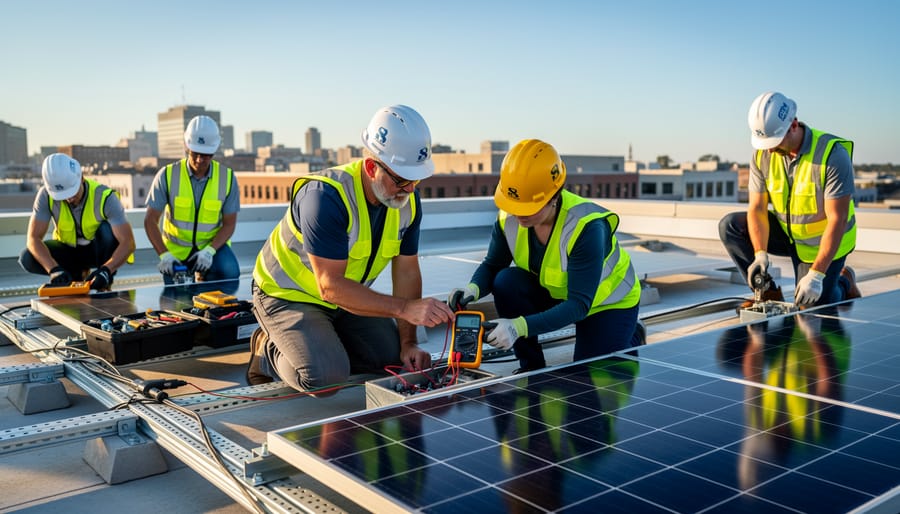
Building awareness of solar energy at the primary and secondary levels creates a foundation for future workforce development and informed civic participation in energy transitions. When students encounter solar concepts within their regular science and technology coursework, not as isolated environmental lessons but as integrated content, they develop practical understanding alongside theoretical knowledge.
Effective integration means weaving solar principles into existing physics units on energy and electricity, incorporating solar panel design challenges into mathematics classes, and using local solar installations as case studies in geography or social studies. Rather than treating renewables as a separate topic, schools in Denmark and Sweden embed them naturally where energy systems appear in established curricula.
Early exposure shapes career awareness. Students who design simple solar experiments in middle school or analyze photovoltaic efficiency in high school science labs gain tangible experience that demystifies the technology. This familiarity matters: workforce surveys consistently show that professionals’ interest in solar careers often traces back to hands-on school projects rather than abstract textbook chapters.
The coalition supports schools through resource sharing and teacher training workshops that demonstrate how solar concepts align with existing learning objectives, making adoption manageable without curriculum overhaul.
Technical Training: Vocational and Higher Education Pathways
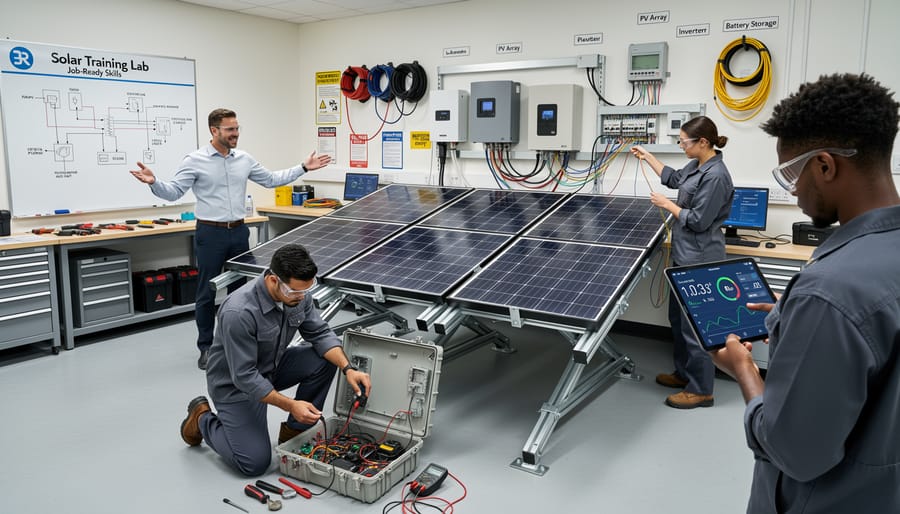
The transition to solar energy demands specialized technical training programs that produce job-ready professionals across the full spectrum of roles, from rooftop installers to utility-scale system designers. Effective vocational and higher education pathways distinguish between these distinct career tracks while ensuring standardized competencies that employers can trust.
Vocational programs targeting installers and maintenance technicians typically span 6-18 months, combining classroom instruction on electrical fundamentals, safety protocols, and solar technology with hands-on training on actual equipment. The most successful programs embed students directly with solar companies during final modules, creating seamless transitions from training to employment. Standardized credentials, such as those modeled after NABCEP certification in North America, ensure consistent quality and enable workforce mobility across regions.
Higher education pathways serve system designers, engineers, and project managers who require deeper theoretical knowledge. Bachelor’s and master’s programs integrate photovoltaic system design, grid integration principles, energy storage technologies, and project economics. These programs increasingly partner with research institutions to expose students to emerging technologies like bifacial panels and perovskite cells, ensuring graduates enter the workforce with cutting-edge knowledge.
The credential framework matters profoundly. Nations that establish clear, nationally recognized certifications for each role create transparent career ladders and help employers quickly identify qualified candidates. Programs that align technical training with these standards, and regularly update curricula as technology evolves, directly accelerate solar deployment by eliminating the skills bottleneck that otherwise constrains project timelines.
Continuous Professional Development for the Existing Workforce
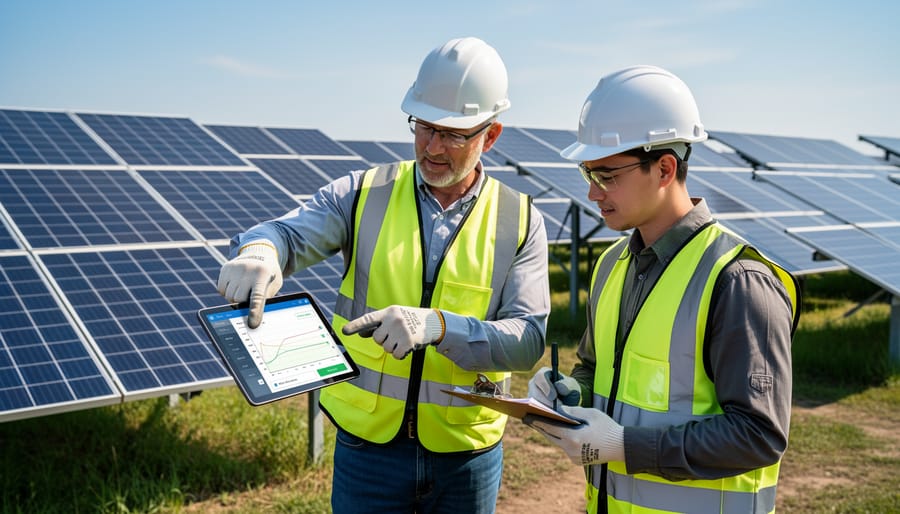
The solar industry’s rapid technological evolution demands ongoing learning pathways for professionals already in the field. Current workforce development strategies must address two distinct groups: existing solar professionals requiring updates on emerging technologies like bifacial panels, battery integration systems, and AI-driven monitoring tools, and workers transitioning from conventional energy sectors who bring valuable transferable skills but need solar-specific competencies.
Effective continuous professional development programs combine flexible delivery models, online modules, weekend intensives, and on-site workshops, with certification renewal requirements that incentivize participation. Germany’s Solar Technician Recertification Framework exemplifies this approach, requiring 40 hours of documented professional development every three years while offering modular courses aligned with specific technological advances. This model maintains quality standards without creating prohibitive barriers for working professionals.
For workers transitioning from coal, oil, or gas sectors, bridge programs acknowledge existing electrical, mechanical, and safety expertise while filling solar-specific knowledge gaps. These accelerated pathways, typically spanning six to twelve months rather than full multi-year programs, focus on photovoltaic fundamentals, installation standards, and regulatory frameworks. Successful programs also address the psychological dimensions of career transition, offering mentorship and peer networks that ease the shift from declining to growth sectors.
Regional Success Stories: Northern Europe’s Integrated Approach
Denmark’s Academia-Industry Training Consortium
Denmark’s collaborative approach demonstrates how strategic alignment between education providers and industry creates a pipeline of solar-qualified professionals. The Danish Energy Education Partnership (DEEP), launched in 2023, connects five universities, twelve vocational schools, and over forty solar companies through a structured framework that addresses every level of workforce development.
The consortium operates through shared governance, with industry representatives holding seats on curriculum committees at participating institutions. This ensures training programs reflect actual market demands rather than outdated theoretical models. Technical University of Denmark leads research integration while vocational schools in Aarhus and Copenhagen deliver hands-on installer training using equipment donated by partner companies.
Students benefit from guaranteed apprenticeship placements, with 87% of vocational graduates securing employment within three months of certification. The program’s success stems from binding commitments: companies pledge hiring targets and training hours, while schools meet industry-defined competency standards verified through third-party assessments.
Cross-sector funding sustains the initiative, combining government grants (40%), industry contributions (35%), and EU transition funds (25%). This education innovation has produced over 3,200 certified solar professionals since inception, directly correlating with Denmark’s 34% increase in residential solar installations during the same period. The model proves that formalized partnerships between academia and industry translate educational investment into measurable deployment outcomes.
Sweden’s Solar Technician Certification Pipeline
Sweden’s national solar technician certification program demonstrates how structured credentialing can transform workforce development from fragmented local efforts into a coordinated talent pipeline. Launched in 2019 through collaboration between the Swedish Energy Agency, national industry association Svensk Solenergi, and regional vocational colleges, the program established unified competency standards that employers could trust and educators could deliver consistently.
The certification framework operates across three distinct levels. Entry-level credentials focus on residential installation basics, roof assessment, mounting systems, and electrical integration, requiring 240 hours of combined classroom and hands-on training. Intermediate certification targets commercial-scale projects, adding advanced electrical work and system design competencies through an additional 320 hours. Master-level credentials prepare technicians for complex industrial installations and supervisory roles, incorporating project management and advanced diagnostics.
What makes Sweden’s approach particularly effective is the embedded industry involvement. Solar companies don’t just hire graduates; they participate directly in curriculum updates through quarterly industry panels, provide installation sites for practical training, and guarantee apprenticeship placements for certification candidates. This reciprocal relationship ensures training stays current with evolving technologies, when bifacial panels gained market share in 2024, the curriculum incorporated specific modules within six months.
The results speak clearly. Between 2020 and 2025, certified technician numbers grew from 450 to over 3,200, while Sweden’s installed solar capacity increased 340%. More telling: installation defect rates dropped from 18% to under 7% as certified professionals displaced unqualified installers. Regional vocational schools now report 94% employment rates within three months of certification completion, with starting salaries competitive enough to attract career changers from declining industrial sectors.
Building Cross-Sector Partnerships for Education Development
Government’s Role: Policy, Funding, and Standardization
Governments occupy a unique position in national energy education development, wielding three interconnected levers that shape the entire ecosystem: policy frameworks, financial mechanisms, and quality standards.
Policy frameworks establish the legal and institutional architecture. This includes mandating renewable energy modules in national curricula, creating accreditation pathways for solar-specific qualifications, and setting workforce development targets aligned with solar deployment goals. Denmark’s 2023 National Skills Strategy, for instance, required all vocational programs to integrate clean energy competencies, a directive that directly increased solar training capacity by 40% within two years.
Funding mechanisms translate policy ambitions into reality. Direct investments in training infrastructure, subsidized tuition for solar credentials, grants for curriculum development, and employer incentives for apprenticeships all lower barriers to participation. Sweden’s Solar Skills Fund allocates €15 million annually, covering 75% of training costs for career-switchers entering solar installation and maintenance roles.
Standardization systems ensure quality and portability. National certification frameworks, competency standards, and assessment protocols create consistency across providers while enabling professional mobility. These standards also build employer confidence and help students recognize credible programs, essential for scaling education efforts beyond pilot initiatives.
Industry Contributions: Real-World Training and Employment Pathways
Solar companies bring irreplaceable assets to education development: current equipment, actual job sites, and direct employment pipelines that transform theoretical knowledge into workforce-ready skills. Industry participation must extend beyond occasional guest lectures into structured commitments that shape what students learn and how they transition into careers.
Leading solar firms increasingly co-design technical curricula with educational institutions, ensuring training modules reflect installed technologies rather than outdated textbook examples. Companies loan equipment, inverters, mounting systems, monitoring tools, allowing students hands-on experience with commercial-grade hardware they’ll encounter professionally. This equipment provision creates authentic learning environments that classroom simulations cannot replicate.
Apprenticeship programs represent industry’s most impactful contribution. Structured on-the-job training combines workplace mentoring with classroom instruction, allowing learners to earn while developing expertise. Germany’s dual-system model demonstrates how formalized apprenticeships can supply entire industries with qualified technicians, reducing hiring timelines and ensuring standardized competencies.
Guaranteed employment pathways matter enormously for education program viability. When companies commit to hiring graduates who meet defined standards, enrollment surges and completion rates improve dramatically. Pre-employment agreements reduce student financial risk while giving employers influence over training quality and curriculum relevance, creating accountability loops that benefit both parties.
Academic Leadership: Research, Innovation, and Pedagogy
Universities and research institutions bring irreplaceable assets to national solar education development that neither government nor industry can replicate alone. Their role extends far beyond traditional classroom instruction.
Academic researchers lead in developing cutting-edge solar technologies and methodologies, then translate these innovations directly into curriculum updates, ensuring students learn current best practices rather than outdated techniques. This research-to-classroom pipeline keeps training programs aligned with technological evolution, from emerging photovoltaic materials to advanced grid integration strategies.
Universities also pioneer pedagogical approaches specifically designed for solar energy education. Scandinavia’s leading technical universities have developed hybrid learning models combining theoretical foundations with hands-on laboratory work and real-world system installations. These evidence-based teaching methods significantly improve knowledge retention and practical competency compared to lecture-only formats.
Perhaps most critically, academic institutions provide continuous program evaluation and improvement mechanisms. Through systematic assessment of graduate outcomes, employment success, and industry feedback, universities identify gaps and refine curricula, creating iterative enhancement cycles that strengthen national workforce pipelines over time.
Measuring Impact: Linking Education to Solar Deployment

Assessing whether national energy education development programs translate into accelerated solar deployment requires systematic evaluation frameworks that track both immediate outputs and long-term outcomes. Without clear metrics, even well-funded programs risk becoming disconnected from industry needs and failing to unlock meaningful solar energy potential.
The most telling indicator is workforce-to-deployment ratio: how many trained professionals per megawatt of installed solar capacity does a region produce annually? Northern European programs targeting 15-20 trained technicians per MW installation have consistently outpaced regions with lower ratios, demonstrating that education infrastructure directly correlates with deployment speed. This metric captures whether training volume matches market demand at crucial growth stages.
Equally important is employment conversion rate, measuring what percentage of program graduates secure solar industry positions within twelve months. Denmark’s programs achieve 78% conversion by design, using industry advisory boards to align curricula with hiring needs. Below 60% suggests curriculum misalignment or market saturation, prompting program adjustments before resources are wasted.
Time-to-competency metrics evaluate how quickly graduates reach productive independence. Sweden tracks this across installer, designer, and maintenance roles, finding their certification pipeline produces job-ready technicians in eight months compared to eighteen months through unstructured training, halving the lag between education investment and deployment capacity.
Coalition-facilitated global collaborations have established comparative benchmarking protocols allowing countries to measure their education effectiveness against peers. These frameworks track solar capacity growth per education dollar invested, skills retention rates over five years, and whether regions meet their nationally determined solar targets on schedule. Regular assessment reveals which program components deliver measurable deployment acceleration versus which represent expensive credentials without industry impact, enabling evidence-based resource allocation that genuinely advances solar energy transition.
Actionable Steps for Stakeholders
Advancing national energy education development for solar requires coordinated action across multiple stakeholder groups, each with distinct leverage points and responsibilities. The following recommendations translate the frameworks and examples from earlier sections into concrete next steps tailored to your role in the ecosystem.
For Policymakers and Government Officials
Conduct a comprehensive skills gap analysis within your jurisdiction to establish baseline data on current workforce capabilities versus projected solar industry needs through 2030. This evidence becomes the foundation for targeted funding allocation and policy design. Establish dedicated budget lines for solar education infrastructure, prioritizing regions with high solar potential but low current deployment rates. Create regulatory frameworks that recognize and standardize solar certifications across provinces or states, removing barriers to workforce mobility and ensuring quality consistency. Integrate solar energy competencies into national qualification frameworks alongside traditional trades, legitimizing these career pathways for students and career changers alike.
For Educational Institutions
University leaders should initiate formal partnerships with at least three solar companies or industry associations to co-develop curricula that reflect actual workplace requirements, not theoretical ideals. Vocational schools can establish equipment-sharing agreements with local installers, providing students hands-on experience with current technology without prohibitive capital investment. Embed solar modules into existing electrical, engineering, and sustainability programs rather than creating isolated solar-only tracks that struggle with enrollment thresholds. Faculty development matters: send instructors to industry sites for week-long immersions annually so teaching stays grounded in evolving practice.
Implementing a comprehensive national solar education program follows a structured pathway:
- Assess current capacity by mapping existing training providers, curriculum offerings, enrollment numbers, and graduate employment rates to identify gaps and duplication
- Convene stakeholder working groups bringing together government funders, academic program leaders, and industry hiring managers to define shared priorities and success metrics
- Design pilot programs for 50-100 students incorporating the core components outlined in Section 3, with explicit industry placement commitments
- Launch pilots in two contrasting regions to test scalability across different contexts, tracking completion rates, employment outcomes, and employer satisfaction
- Refine curriculum and delivery models based on pilot data, addressing identified bottlenecks before broader rollout
- Scale successful models through train-the-trainer programs and resource sharing platforms that accelerate replication without reinventing foundational elements
This phased approach, validated in Sweden’s certification pipeline and Denmark’s consortium model, reduces risk while building evidence for sustained investment.
For Industry Leaders
Solar companies must move beyond complaint about talent shortages to active participation in solutions. Commit specific hours of senior staff time to guest lectures, curriculum review panels, and student project mentorship. Offer apprenticeship positions with clear learning objectives and dedicated supervision, treating these as talent pipeline investments rather than cheap labor. Provide equipment donations or deeply discounted access to schools, recognizing that graduates trained on your technology become familiar future customers and advocates. Share workforce planning data with education providers so programs can anticipate demand shifts across installation, design, sales, and maintenance roles.
For Coalition Members and Cross-Sector Networks
Facilitate regular convenings where all three sectors share progress, challenges, and emerging needs, maintaining momentum beyond initial enthusiasm. Develop shared monitoring frameworks that all partners populate, creating transparency around who delivers which commitments. Publish case studies highlighting what works, making the invisible labor of partnership visible and replicable. Where partnerships stall, coalition facilitators should diagnose whether the issue is structural misalignment, resource constraints, or unclear governance, then broker solutions drawing on successful models from other regions.
The thread connecting these recommendations is specificity: vague commitments to collaboration produce modest results, while concrete actions with defined owners and timelines unlock the transformative education development that solar deployment requires.
The evidence is clear: nations that invest comprehensively in solar energy education accelerate their transition to clean power while building resilient economies. Throughout Northern Europe, the correlation between structured workforce development programs and successful solar deployment demonstrates that education isn’t merely complementary to solar expansion, it’s foundational. When we equip professionals with technical expertise, policymakers with strategic understanding, and communities with foundational knowledge, we remove critical barriers to renewable energy adoption.
This coalition exists precisely to strengthen these connections. We facilitate partnerships between universities developing cutting-edge curricula, governments establishing supportive policy frameworks, and industries creating meaningful employment pathways. Our regional initiatives in Denmark and Sweden prove that cross-sector collaboration transforms educational programs from theoretical exercises into practical pipelines feeding skilled workers directly into expanding solar markets.
The urgency cannot be overstated. Climate imperatives demand rapid solar scaling, yet workforce shortages threaten deployment timelines everywhere. Education gaps disproportionately affect vulnerable communities that stand to benefit most from local renewable energy jobs and affordable clean power access.
We invite stakeholders across sectors to join this collaborative effort. Whether you represent government, academia, industry, or civil society, your participation strengthens the ecosystem enabling sustainable energy transition. The framework exists, successful models provide roadmaps, and the need is immediate. Together, we can build the solar-ready workforce that 2026 and beyond demand, transforming educational infrastructure into the engine driving our renewable energy future.
Frequently Asked Questions
How long does it take to develop a workforce-ready solar education program from scratch?
A basic vocational training program can launch within 12-18 months if you have committed partners and clear objectives, though building a comprehensive national framework with multiple pathways typically requires 3-5 years. The timeline accelerates significantly when you adapt proven models from regions that have already succeeded rather than starting from zero.
What are typical costs for establishing a national solar training initiative?
Initial investments vary widely based on existing infrastructure, but expect $2-5 million for a regional pilot program covering curriculum development, instructor training, and basic equipment. Scaling nationally requires larger commitments, though most successful programs blend public funding, industry contributions, and tuition revenue to create sustainable models.
Are solar energy certifications recognized internationally?
Recognition depends on the credentialing body and bilateral agreements between countries. Several Northern European nations have established mutual recognition frameworks for solar technician certifications, and the coalition actively works to harmonize standards across borders to improve workforce mobility.
How can my organization join coalition education initiatives?
Organizations interested in participating can connect through the coalition’s regional chapters, which coordinate education working groups bringing together academic institutions, industry partners, and government agencies. Membership options range from formal partnership agreements to participation in specific project collaborations based on your capacity and focus areas.
These questions reflect the practical concerns stakeholders raise when considering education program development. Cost and timeline uncertainties often delay action, yet the answers demonstrate that starting points exist for organizations at different resource levels. The certification question addresses a real barrier to workforce mobility that the coalition’s standardization efforts help resolve.
Beyond the mechanics, potential participants want clarity on engagement pathways. The coalition’s flexible membership structure acknowledges that a small vocational school contributes differently than a national ministry or multinational solar manufacturer. What matters is creating entry points that match organizational capacity while advancing the shared goal of building solar-ready talent pipelines. Regional chapters serve as practical coordination mechanisms, turning broad commitments into tangible collaborative projects where education providers, employers, and policymakers solve specific challenges together rather than working in isolation.